Showing posts with label dolmenwood. Show all posts

LAW, ORDER, & DOLMENWOOD: Bringing Courts, Calendars, and Consequences To A Fantasy Setting


Update (2026 08 02): 🗓️ Commenter Centaurion has gone the extra mile and not only created a calendar, but has also included the dates and locations of each of the courts below! Absolutely check it out.

Initially, I thought Dolmenwood was going to be a hazy, dream-like, amorphous setting for D&D with talking animals, but it turns out its a pretty extensive history overlaying a frictious polical landscape...and talking animals. 

Jockeying for power are:

  • 5 Fairy Domains
  • 1 Usurping Outer God
  • 1 Deposed Fairy Lord
  • 1 Scheming Witch Cult
  • 1 Duke (Human)
  • 6 Human Houses
  • 3 Breggle Houses
  • 11 Old Gods
  • 1 Monotheistic Church
  • And more!

What this means to me is that PC actions generally will be within the (literal) realm of judgement by one or more of these groups. And those political lines are mostly known from the outset. In Dolmenwood, it is well understood the PC are in the Duchy of Brackenwold, under which there are 6 human and 3 breggle houses. Check out Among Cats And Books' breakdown of how you might run those factions.

In a previous post, I outlined a general picture of law and order in medieval England✤ from the very gameable Ian Mortimer’s The Time Traveler’s Guide to Medieval England: A Handbook for Visitors to the Fourteenth Century. So let's put this into use in the Dolmenwood campaign.

Quick Aside: The goal of this is not some strict simulationism, but instead to use what is very present in the setting to provide weight/consequence to PC choice and actions. When actions are committed, but have no weight, it makes (to me) a setting like Dolmenwood feel very flat and hollow. There's mention and reference to all these factions, but PCs never feel their consequence.

LAW & ORDER IN DOLMENWOOD

The Sheriff of Brackenwold oversees a bailiff for each human and breggle domain (which covers all the villages) and a bailiff for each large town, city, and stronghold in Dolmenwood. Additionally, a steward for each hex a keep is in will function as a bailiff but be beholden to the lord there, so an additional 9 stewards will be known to the Sheriff of Brackenwold.

Each bailiff (steward) will oversee a number of capital pledges for each hamlet, village, and small town. A hundreds court will be held 1/month by the bailiff and 12 wise freepeople to hear cases related to anything like debts, fights, and theft.

Each capital pledge will oversee the law & order of the village the PCs are in. Any mishaps in carousing will result in the subduing of the PC and/or transmitting the news to surrounding villages 1-2 days away fairly quickly. PC will then be brought to the bailiff and hundreds court.

Example of a Domain Hierarchy

Sheriff of Brackenwold

    A. Bailiff of the Domain

        Capital Pledge of each hamlet, village, and small town

    B. Bailiff of each Large Town, City, Stronghold

    C. Bailiff of each Lord's Castle and really answerable to the Lord and nominally to the Sheriff

The Sheriff of Brackenwold could be the only representative of the Crown that the PC see during the course of an adventure, at least (by old-school OD&D standards) the PCs reach 4th-5th level (hero) or, more likely 8th level (superhero)

At the level of the bailiff, you can really see how politics can come into play. The bailiff of the domain is most likely going to be chosen by the Sheriff of Brackenwold, while the bailiff of each Lord's Castle is chosen by the lord themselves. And the bailiff of each large town, city, and stronghold is going to be loyal to those populations.

LAW & ORDER EXCEPTIONS

Exceptions: Breggle domains

As part of the pacts long ago, breggles have retained some of their own autonomy. Therefore, Breggle bailiffs and Brackenwold bailiffs must submit disputes and those accused to the Breggle manorial courts. Breggle courts are run differently due to the known (and feared) ability of the breggle gaze to inspire awe and respect. This has allowed many to confess to crimes they otherwise would be silent about.

Brackenwold Bailiffs in Breggle Land: Also, given that Brackenwold bailiffs have to navigate this ancient pact, I could imagine they might be more of an older, seasoned, minor aristocratic sort. Slow to move, but able to drop a sly hammer. PCs asking something from these folks might get them further embroiled in their political machinations. You'll owe a favor and they will collect at an inconvenient time.

Exceptions: House Guillefer

It is said that no criminal rests easy in the domain of the Nodding Nobels because they are troubled by dreams of their wrongdoing and pursued by the Sleep Wardens. This is mainly true for those who commit murder or other crimes of that magnitude. Given the nobility's lax attitude toward governance, it is a domain where a fair amount of tax evasion and smuggling occurs. This makes the domain a constant thorn in the Backenwold Sheriff's side.

Sleepwalking Sentinels: However, its difficult for the Sheriff to do anything about it because most serious crimes have the criminal running to the nearest bailiff, shattered from lack of sleep and willing to do anything for relief. Those that don't come running are found dead in a state of fightenined rictus. The bailiff or capital finds them due to prophetic dreams or just themselves sleepwalking to the body. Sometimes the Court of Hundreds is called the "Court of the Thousand Yard Stare" in the Guillefer domains.

Exceptions: The Pluritine Church

The Enclaves of the Pluritine Church follow the one true Law. As such, it is the authority in the church lands near Lake Longmere. And given its military power, can project that authority to its holdings in other lands, towns, and villages- provided they get word. Therefore, any accused who can reach a church's doors and demand sanctuary comes under the church's jurisdiction.

Human Centrality: Given the Church's desire to gain influence, they take this right very seriously. However, it does not extend to fairyfolk and perhaps not even enchanters and magicians. Additionally, spending downtime to actually pray, give alms, or perform other works for the church will increase the likelihood of aid.

Spells for Truth: Additionally, like Breggle courts, the Church has easy access to spells that can compel the truth from the accused. Spells like detect evil and reveal alignment will provide strong proof of innocence or guilt. But these are also known qualities in the world, so "professional" criminal organizations will seek to subvert those. The Church is also known to use holy quest to place the guilty on a righteous path-- mainly to recover the lost shrines. These groups are known as the Penitent Expeditionary Forces.

COURT CALENDAR OF DOMENWOOD A hundred's court (100s) is held locally every month by the bailiff(s)but and, due to winter, Braghold, Grimvold, and Lymwald are avoided as months for Sheriff's courts

01     Grimvold The onset of winter, 100s
02     Lymewald Deep winter, 100s
03     Haggryme The fading of winter, 100s, Sheriff's Tourn Court (rotating domain)
04     Symswald The onset of spring, 100s
05     Harchment High spring, 100s
06     Iggwyld The fading of spring, 100s, Sheriff's County Court at Brackenwold (outlaws declared)
07     Chysting The onset of summer 100s,
08     Lillipythe High summer 100s,
09     Haelhold The fading of summer, 100s, Sheriff's Tourn Court (rotating domain)
10     Reedwryme The onset of autumn, 100s,
11     Obthryme Deep autumn, 100s, Sheriff's County Court at Brackenwold (outlaws declared)
12     Braghold The fading of autumn, 100s,

COURT EXAMPLE

How would this play out?

The inn in Prigwort "mysteriously" burns down after a week PCs spent carousing. As a market town, Prigwort has a bailiff and a church. The hue & cry is raised! All able members of the town now are hunting the PCs. So, the PCs have a decision: submit to arrest, reach the doors of the church, or skip town.

If they skip town, they will be pursued, mostly like by the Harrowmore bailiff, and the hue & cry will be raised in other settlements to not give quarter to those matching the party's description. If they remain at large, then the Prigwort and bailiff can submit a request to the Sheriff of Brackenwold to have the PCs declared as outlaws. The PCs can now be killed on sight. Just like Robinhood! Either the Harrowmore or Prigwort bailiff can also kill the accused in the process of pursuit, but not once they are caught.

If they submit to arrest, they will be placed in a gaol until the first Hundred's Court can be convened by the Prigwort bailiff. Since they are already in a town with a bailiff-- they don't have to be transported anywhere. And this is where their local connections come into play.

The Prigwort bailiff will then convene 12 judges from Prigwort in order to hear the accusations against the PCs. Good questions to answer are: Were they a general menace? Did they do good things for the town? Did they make/have friends? Did they have friends in high places? These will factor in who attends their trial and who speaks against them.

If they touch the doors of a Church, then the Church will now evaluate their sanctuary status (harder to do with magicians and demi-fay). Then they will undergo sentencing via tribunal. If no one dies, then jail time, a fine, or indentured service (or some combination of the three) might be applied to a guilty party. If someone did die, well then the accused will be jailed until the Sheriff's Tourn held twice a year and the presence of a coroner. With a coroner and royal judges present, the Sheriff can now have said person executed.

The Sheriff's Tourn might also occur in a different location, so its possible the PCs will have time to save their condemned friend or hatch a plan to effect their escape as they are being transported. Again, instead of dry procedure, this is some exciting adventure stuff!

❧ A Trial Procedure (modified from Errant)
First evaluate the PCs reputation in town on a 1-6 scale. With "1" being "cause of all ills" and "6" being "pillars of the community". If you need a reputation:
  • Just got to a hamlet, village, small town, reputation is "2" as folks are close, know each other, and PCs are strangers✤.
  • Just got to a large town, city, and stronghold, reputation is "3" as locals see a lot of folks passing through
Next, roll a d6 representing the mood of the court and add the above reputation to get the current sway of the court:
10+    Court levies judgement for the PCs
7-9     Case requires additional evidence to sway the court
2-6     Court levies judgement against the PCs

Remember the PCs can find evidence, bring witnesses, intimidate, bribe, stage a show, give speeches, and use magic.

In brief, a village is governed by a capital pledge who answers to the bailiff of the county. The bailiff collects tithings, holds the court of the hundred, and answers to the sheriff of the kingdom or the manor lord directly in control of the land. The sheriff is historically a locus of power, an extension of the king's will, including controlling a sizeable armed force. The sheriff holds a county court every 6 weeks and a Sheriff's tourn twice a year.

✤✤ In AD&D it was noted that most magic-users in association with town guards were actually indentured.

✤✤✤ I believe in an evaluation of medieval law, newly arrived strangers were in fact blamed for everything

CRYPTS OF DOLMENWOOD: Using The Timeline to Determine Motifs of Tombs, Dungeons, And Undead


I am currently trying to key Dyson's Winter Tombs as a Dolmenwood-by-the-numbers dungeon. As I was pondering the question of dungeon history, I realized Dolmenwood has a pretty laid out timeline of the past. And it hit me that I can use that timeline to better place dungeons in the history of Dolemenwood, which could also help determine prominent motifs.

TABLE OF BURIAL SITE/CRYPT/DUNGEON MOTIFS in DOLMENWOOD

Roll 1d12 and add the dungeon level or number of hexes from a human town/keep/castle. 

Alternatively, pick a date, and each dungeon-level deeper represents a 100-year change, but motifs only change when you hit a noteworthy period.

NB: Last thing, in order for a burial site to survive 100s or even 1000s of years, it must be well constructed. So, when I list burial sites below its implied "of surviving/identifiable sites."

  1. 100y Fall of Abbey, decline of Church
    • Church burial sites add this fall motif but smaller to demphsize
    • Human & Breggle burial sites increase heraldic symbols of House
  2. 350y Staint Clewyd dies slaying the Atacorn
    • Church burial sites add fall motif as predominant
    • Nag-Lord allies will have the Nag-Lord as a motif if allied with the cult
  3. 400y Nag-Lord arrival; as #4 with Triple Compact burial sites
    • Triple Compact motifs are more downplayed
    • Nag-Lord motifs are small and emerging if burial site is part of the cult
  4. 600-850y Triple Compact Banishes Cold Prince; human and breggle burial sites predominate
    • Drune, Church, and Crown motifs play up the Triple Compact
    • Breggle are a mix of house and Triple Compact
  5. 900y Cold Prince's Wrath, unnatural winter befalls Domenwood for 150 years; burial sites have 
    • All burial sites winter/snow/death motifs, also war/battle motifs between human and fay
  6. 1,000-1,100y Brackwold settles and builds out; breggles and humans co-rule ; deep in the forest, 
    • Burial sites are human & breggle; sometimes feature alliance motifs
    • Drune burial sites can be found remotely
  7. 1,200y Arrival of Brackenwolders as a second wave of human population 
    • Human burial sites motifs will feature different symbology than the previous woodcutter/Green Man motifs
    • New human motifs will also feature the Pluritine Church; 
    • Drune sites become obscure
  8. 1,500y Drune-Breggel war; Longhorn nobility begins as descendants of Hraigl
    • Drune depicts Hraigl's work as betrayal
    • Breggel motifs show Hraigl as a savior and mother figure to all breggels
  9. 1,700y Drune powerful and Breggles serve them, so burial places are drune with breggles in secondary positions
    • Drune burials feature motifs of power/domination with breggles in servitude
    • Breggle burials feature desires for salvation OR acts of Drune service
    • Human burials are "woodsman" motifs and might depicts the Drune/Breggles as hostile
  10. 1,800y Non-Drune human wood cutters who venerate the wood god arrive; burial sites are human but feature wood god/green man-type motifs
    • Human burial are "woodsman" motifs and feature forgest gods/Green Man motifs
  11. 1,900y Drune begin activity, and so have a burial presence 
    • As #12, but burial sites will now contain Drune
  12. 2000-2,500y Burial places mostly breggle, but rarely human- cold prince iconography might be featured prominently or at least snow/winter motifs
    • Burial places mostly breggle with few human
    • Cold Prince is a predominant, almost god-like figure at all burial sites
    • Snow & winter motifs also predominate
EXAMPLE CRYPT

In the dungeon I am keying right now, one sarcophagus is described as follows:
The Forgotten King (room empty): A finely carved granite stone work table of an age past forms the head of this hall; all four sarcophagus feature a relief of their occupant; the stone table in front features a crown, serpent, and sword with life-like fidelity

This is fine, but it doesn't really ground this burial site into anything connected to Dolmenwood. King of what? When? Is there any motifs linked to anything? What do the crown, serpent, and sword (I like the ring of that triplet) represent in history?

I dunno! So let's use the table above- [grabs 1d12, rolls]- a 5!

5. 900y Cold Prince's Wrath, unnatural winter befalls Domenwood for 150 years; burial sites have winter/snow/death motifs also war/battle motifs

Okay, so now this tomb, which is a part of the larger complex, was built in the years of the Cold Prince's Wrath. We can add some detail to the tomb now:

The Forgotten King of the Long Winter (room empty): A finely carved granite stone work table sits at the head of the room and inlaid with pale mother-of-pearl snowflakes; all four sarcophagi feature a relief of their occupant- all extremities, lips, and noses painted black as if frostbitten; the stone table in front features a crown covered in icecicles, a sword fashions like cold-iron, and a serpent with a snowflake pattern.

Great, so now there is a little bit more character to this empty room (1) its more than just "empty", but (2) it grounds it in some era. As a DM, I'd let the PC puzzle out if this king was for or against the Cold Prince. Maybe it could be an adventure hook carried forward.

Okay, let me wrap this up by presenting how this could inform undead (monsters) and traps, which are other stocking instances that could come up around crypts and burial sites. This is nothing astounding, but helpful in a pinch:

  • Undead: If this room did contain skeletons, zombies, or wights, we could use the table above to help decide the aesthetic and concerns of the dead. So for #5, I might say the king and his family were against the Cold Prince, but their undead hate all fay and attack them on sight while ignoring the humans. They might constantly question the intent of would-be intruders, perhaps even offering up cold-iron if the PCs can convince them they are against the Winter Wyrd.
  • Traps: Same trick as with monsters, we can theme the traps. Let's say the king was an alley with the Cold Prince; now the traps could be winter-themed. Howling winds that flow out fire. Ice that drops from the ceiling or grows as sudden crystals out of winter motifs. Maybe anyone human who touches snowflaked items suffers "Winter's Bite"- 1d4 damage and numbing pain.


In summary, I think this helps turn a couple of pages of history from mere "lore" into more influential and actionable traits.


EYE OF NEWT AND A DASH OF STARDUST: Ingredients for Fairy Tale Adventures


God forbid a girl have one night out away from her father without
waking up kidnapped and guarded by a three-headed troll


WHAT MAKES A FAIRYTALE?

Prismatic Wasteland created a large list of questions to blog about. The question "What makes a fairy tale?" caught my eye. And because I often think of running a sorta fairytale D&D and back the Dolemenwood KS, I started to write out what I consider to be key elements.

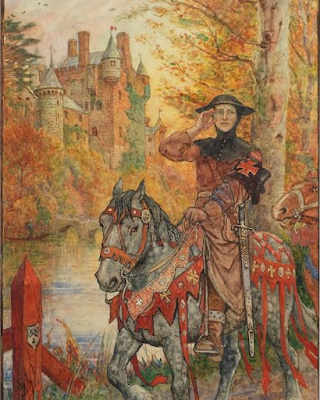
Its more than just excellent illustrations by Arthur Rackham, Henry Justice Ford, and Kay Rasmus Nielsen.

Initially, from a Western context, these stories were there to entertain, but also teach children how to behave and protect themselves in a potentially violent world. The stories often emphasize doing the right thing, amending the wrong thing, being clever, being brave, and overcoming something bigger and stronger than you. They also had a tendency to reinforce gender stereotypes (despite many stories featuring women at the center) and societal power structures.

So while we don't want to simply repeat 1:1 these sorts of stories, we might want to take various elements from them to roll our Dolmenwood campaigns. Fairytales are also a nice touchstone to seed your home games of D&D with become while few people have read a lot of Appendix N, most people have been exposed to fairytale stories and, at least as children, even imagined themselves in one. 

This is a good well to tap to get people into RPGs as it is a very familiar baseline allowing shortcutting in terms of campaign setup, reducing the amount of explanation and lore dump prior to getting to actual play. Ty over at Mind Storm recently covered the importance of a baseline in world-building. 

 I've tried to organize those elements into loose categories below:

PROBLEMS & CONFLICTS

  • Initially, it might a societal or class conflict that the main character has no natural way to solve and so seeks supernatural means: too poor to attend the prince's ball
  • Often centered on a problem that is supernaturally caused and needs a supernatural solution or has been exacerbated by a supernatural shortcut: couple can't have children so seeks a witch's council
  • Problems also arise because the main character did not listen to the initial conditions of a solution or a deal that was struck: do A & B, but never C despite that it will give you more (the character does C)
    • Often caused by curiosity and not staying in your lane: What happens if I do untie the green ribbon around my beloved's neck despite the fact she said no?
  • Solutions sometimes are not supernatural but are also displays of bravery, courage, kindness, and to a lesser extent humility
  • Mistaken identity is often a big problem


QUALITIES of ADVENTURERS

  • Being clever is a lauded trait and also helps the hero overcome asymmetry in an encounter
  • You are what you wear, how you look, and what your title says you are: ugly, dark clothing, poison, subterfuge, and being wolf-headed is considered "evil"
  • Titles come with responsibilities that must be fulfilled no matter how convoluted or contradictory to the person owning the title

    • If you are a boy and you wear the tiara of a princess then you are treated as a "princess" but maybe not a girl (or you could be depending on the game) 
    • You will be required to wear a pink gown because that is the expectation of a princess, but if you decreed by the office that you can wear pants well that is what a princess (during your reign) can wear 
    • Except during state dinners where it is imperative to follow the old ways including pink dresses for princesses for the sake of the old families. (And hold still because the cat, 12 mice, 24 doves, 2 raves, donkey, and 5 squirrels dressing are trying to make magic happen and the 6 white stallions waiting to take you are quite proud and hate being late)
  • Yes, good people can wear dark clothing or be wolf-headed but everyone still suspects them of being blackhearted no matter the public display of goodness
  • Because of this, disguises often work well (which is why mistaken identify is a source of problems)


QUALITIES of MAGIC (Thank you RiseUpComus for pointing these qualities out)

  • Magic often augments an object or ability but rarely does the actual work which still requires a person- a magic broom is good at cleaning and flying, but a person still has to sweep; gold still has to be spun from hay
  • However, often magic items are bestowed as a test to see what a person does with them, and the bestower might show up to take it back should it be used incorrectly
  • Magic items can be "OP" such as the Philosopher's Stone providing infinite gold and invincibility
    • Those sorts of items can still have a corrupting influence
    • Item from God often come with stringent requirements even if it means risking the life of the bearer- so if you steal bread while starving, you lose the right to hold the holy sword because you sinned even if it was for a good cause

SOCIAL EXPECTATIONS

  • Everyone makes a deal with everyone else and your word is your life; in breaking your word, you quite easily forfit your life
  • Manners are important while sometimes violence or murder is overlooked; this is especially true in the Legends of Arthur
  • Most knowledge is local and if someone doesn't know something, they often know someone who does (or they think they do)
  • And while good and evil do apply, more often other dualities divide like selfish vs generous or loner vs social or black-hearted vs kind-hearted
  • Ownership is like 9.5 tenths of the law in fairytales- beings place far more importance on it
  • Current beings are responsible for generation grievances


THE WIDER WORLD and OTHER LANDS

  • The Crown is distant, but 1 or 2 of its agents are always nearby and more likely than not abuse that power
  • The Christian god can be the "new kid" on the block but still quite work via the old ways: quests, potents, magic items, and chosen ones; only really "talks" when given a form consistent with the rest of the world such as Aslan the Lion
    • Josh also pointed out that invoking God is also an un-gameable silver bullet. I agree. I think the issue with evoking the Christian God too much is that it is sorta a giant reset button. All magic, good or bad, ends allow order and the mundane to reign. Buzz kill.
    • The devil though is often an antagonist
  • The Fay realm is pretty much like Las Vegas- what happens in the fay realm, stays in the fay realm at least until the fay wants to use it against you
  • The middle distance between two points is the best moment for the fay to intercede in a thing being done
  • Any structure forgotten can be claimed by the fay and/or the supernatural
  • Death, Dream, and Sleep are always close in a fairytale world, and deep ponds, lakes, caves, tree hollows, and holes in the ground are passages to the underworld
  • Seasons generally are the extremes of what they are: Spring pleasant, Summers hot, Autumns cool/colorful, Winters very snowy; food is likewise predictably cyclical unless an external force interrupts

A FEW LOST MITTENS
  • For more modern fairytales, I really love Angela Carter's The Bloody Chamber and for something a bit darker, Howls From the Dark Ages 
  • In terms of rulesets, I really like BLUEHOLME Printice Rules because most of the pictures are in fact Henry Justice Ford illustrations. It just gives this Holmes Basic D&D game a great feel!
  • Dolmenwood is a must for a fairytale campaign however I think it hides an almost Harn World-like political layer
  • The Jim Henson Storyteller series is amazing for some inspiration- I particularly like The Soldier & Death (above)- look at 'em, playing cards with imps!