Showing posts with label dungeon. Show all posts

APPENDIX N(EW DUNGEON CRAWL): Modern Media For Delving Deep Down

Tower Dungeon by Tsutomu Nihei

I was trying to get together some other new posts, but those are slow going so here is something that has been rattling around in my brain- how much recent media there is that is based in a dungeon. 

I listed a chunk of it in the Why Megadungeons post, but at the risk of repeating myself, I did want to separate it out into its own thing. I also tried to limit the media to roughly the last ~10 years. I think benchmarking the last decade also helps illustrate how much new popular media there is that will be most people's first contact with the genre.

Worth noting that none of these give a 1:1 experience of playing an RPG dungeon, of course, but most include scenes which match common elements in good pen & paper dungeons.

Anything missing?

Appendix N(ew Dungeon Crawl)

Video Games

  • Darkest Dungeon (2016)
  • Hollow Knight (2017)
  • Dead Cells (2018)
  • Minecraft Dungeons (2020)
  • Hades (2020)
  • Hollow Knight: Silk Song (2025)
  • Marathon (2026)
Movies, TV, & Animation
  • Dungeon Meshi (2024, manga 2014-2023)
  • Backrooms (2026)

Fiction & Manga

  • Piranesi (2020)
  • Scholomance (2020)
  • Dungeon Crawler Carl (2020)
  • Tower Dungeon (2023)
  • The West Passage (2024)

Art & Installations

  • MeowWolf (2016)

Meow Wolf, Santa Fe


TABALDAK'S GEAS: The ICL 2025 Appx. N Jam Entry


Last Thursday, I submitted an entry to the 2025 Appx. N Jam! 

The Appx. N Jam was an itch.io contest requiring submissions to be a four-page RPG adventure based on a made-up book title that was randomly assigned. Those titles were of the vein of those old swords & sorcery novels found in the AD&D DMG's Appendix N- the influences for AD&D listed by Gygax.

For a great collection of Appendix N stories, I would like to recommend Appendix N: The Eldritch Roots of Dungeons and Dragons edited by Peter Bebergal from MIT Press.

I was hoping to get a title such as [The Location of the Noun + Noun], like "Crypt of the Red Wizard". This sort of title gives a clear idea about the dungeon and the random encounter table.

Instead, I got "Tabaldak's Geas", which, while it gives a potential antagonist, a "geas" is not a location nor something that could be easily used as a treasure. Furthermore, a geas in the D&D sense often forces the players to do X. For example, in OD&D, running across a wizard stronghold might result in a geas being applied to the party, forcing a task of some sort.

So I decided to combine ideas that had been kicking around for the Appx. N Jam:

  • The idea of the Deck of Many Things has been used as a campaign starter since its often considered a campaign breaker
  • A cult based around mistaking a beholder-kin (which has create food & water) as a bounty-delivering god
  • Try to submit a fairly good-sized dungeon (I hit 23 rooms)

Here is the synopsis I created for the dungeon:

“Who has misfortune thrown into this trap’s jaws?"

Escaping danger, the PCs are trapped in the villa of an inscrutable, unscrupulous, and absent sorcerer, the Lord has gone mad, the Captain is hopeless, the Vizer is obsessed, & the Friar turned heretic...

The only way out rests under the baleful gaze of The Eye!

This 23-room dungeon villa tasks the PCs with finding a way to escape the powerful geas that holds them prisoner. They will have to navigate the dead that the geas won't let rest, hungry familiars angry at their abandonment, candle-wax doves that hate light, and a dream-mad lord stalking the halls. All the while, they will puzzle over the tria prima, bemoan a mask made of cheese, tame a desk with a nasty disposition, and ponder the black lacquor box below the alien monstrosity at the center of the villa.

An adventure for four characters levels 1-2 (or twice as many level 0)

I'll try to do a more specific post-mortem after the Jam is over, but overall, I am very pleased that I was able to create, key, and design an old book cover for the Jam. And look forward to maybe doing it next year or participating in other design contests. Below is the map and random encounter table.


If you are interested in other designs that I've done, please check out the free Designing Dungeons course I co-wrote with Josh, the 2025 SILVER ENNIE (Best Game & Best Rules) award-winning author of His Majesty the Worm


THE SPARK COLLAGE FOR DUNGON STOCKING: When You Got Vibes But Need Definitive


I am trying to quickly key the last dungeon level for my Tropics of Cancer campaign so I can start running it for friends and family. I'd like to do this quickly and often that means being a little more loose with the "rules" of good dungeon design and more needing tables of, I dunno, "organized vibes" to round things out. 

Now, this will result in weaker dungeons than those more clearly thought out with a purpose, room placement, and enemy design but with this campaign, I am aiming for the dungeon-building equivalent of slapchop. So I have the vibes for this dungeon stated in my last post, with an associated small collection of pictures that I've found that match the setting.

I decided a solution might be turning those pictures into a collage with a grid overlay so I could create rollable segmentation: part oracle, part die-drop table, part spark table, but all dungeon stocking goodness. Now I have something that complements my existing monster, trap, and treasure table and can help me fill in more details. A d66 table (1d6 x 1d6) seemed to give me pretty good division but you can make each box smaller if needed. But I would stick to a standard die size that could be read in a glance.


So I could ask for a room's contents, roll d66, and interpret what's in the square. I could also do the same for the color of a room or object- roll d66, interpret either by general color or pick among objects in that square. Since the pictures that make up the collage ARE things that remind me of the dungeon the overall composition should approach some cohesion that players won't notice unless they look super close-- much like slapchop.

And again, much like slapchop, the goal is to get it good enough to the table for play, not to win painting or dungeon design contests. Just trying to have fun!

HOW MUCH IS TOO LITTLE? Calculating Treasure in Dungeons


A common problem quickly encountered when designing your own dungeon or stocking a map drawn by another is the optimal amount of treasure to add. A cousin to that problem could be the "treasure" restocking, again, how much do you add? More distantly related might be if a particular module you picked up is going to contain enough treasure to level a party or at least make the risk worth it?

But it is difficult to understand at a glance because of the alphabet treasure tables (one of my loathes because of complexity), variation due to lairs, if the treasure is trapped or unguarded in which case you employ a different treasure formula (one of my favorites because of simplicity), and even variations in gem quality or type. It is also sometimes difficult to understand how rolling magic items changes treasure distribution.

If you have one or two years of DMing experience under your belt, you have a feel treasure amounts, but you might be like me and think, "Shouldn't someone have already calculated all of this out?"

Well the OSR blogosphere provides! An author by the name of Lungfungus who blogs at Melancholies and Mirth wrote a document brought to my attention on bluskey by blark about just this topic.

While the document contains a lot of good advice about dungeon design, I was particularly enamored with the section on dungeon stocking which synthesizes a lot of different methods of stocking into one table AND answers the question of "how much is enough" when it comes to treasure.

Summary of Actual Dungeon Mastering: How to Design Dungeons

First, on average, 1-in-5 dungeon rooms contain treasure

Lungfungus begins by examining a variety of random stocking methods spanning known editions of D&D from TSR and several popular retroclones. When it comes to treasure-containing rooms, from a TSR edition perspective, they occur roughly every ~4-in-20 rooms (BX methods 10-in-36 and AD&D roughly 4-in-20). A lot of retro-clones, being derived from these two editions, conform to the same distribution.

Second, the average value of a TSR treasure room on Level 1 is 586.5gp

Using the various treasure tables from Appendix A of the AD&D DMG, Lungfungus calculates the average amount of treasure a treasure room might contain and arrives at an average value of 586.5 gold pieces. Fantastic! Let's just round it off to ~600gp for ease.


But each treasure room could instead have a 1-in-6 change of being a magic item instead of coin/gem/goods-based treasure. We can also convert 1-in-6 to ~3-in-20 to keep all our rolls on a d20.

Third, 2000xp is the average need to advance a PC from level 1 to 2

Lungfungus uses a very familiar method of calculating the average total XP needed to level up by taking the average XP needed by a single PC to advance from level 1 to level 2 which is 2000xp. So, a party of 6 PCs needs on average 12,000xp in total to advance from level 1 to level 2.


Now there are a couple of additional calculations I am leaving out such a reducing treasure given that some XP is awarded for monsters and adding 50% more treasure than the required amount given that PCs will often overlook hidden treasure or not explore every single room in a given dungeon.


In that regard, it might be better to use "magic-user" instead of "fighter" when calculating the XP need to advance above given that a MU requires 2500xp vs a fighter's 2000xp.

Fourth, the total size of the dungeon can be determined from the number of treasure rooms required for a given party size to advance from level 1 to level 2

Therefore, since the average value of a treasure room is 586.5gp and the total amount of XP needed is 12,000, then a level 1 dungeon will need at least 20.4 treasure rooms. And so, since 1-in-5 rooms are treasure rooms in the average dungeon, we do a little algebra and solve for X to get the total size of the dungeon:


Total dungeon rooms: (1/5) = (20/X) 

Total dungeon rooms: 1X = 100

Total dungeon rooms: X = 100

Finally, the Lungfungus synthesized stocking method

Roll 1d20 per room and consult the table below:

1-12        Empty Rooms 13            Room with a Dynamic Element

14            Room that is Trapped

15            Room containing an Obstacle 16-20     Monster Treasure Containing Rooms: For any given room, there is 4-in-20 chance it contains treasure and a 3-in-20 chance that treasure is a magic item (6-in-20 if it is trapped); treasure value is ~600gp x dungeon level


The final thing that might be important to realize is that PC XP requirements increase linearly, so all you need to do is multiply the above amounts by the dungeon level to have everything scale properly. So the treasure room amount for Level 7 of the dungeon is ~600gp x 7 = 4,200gp. This seems like a lot however to get a fighter from level 7 to level 8 it takes 64,000 additional xp.

A SIMPLE DUNGEON SETUP: What You Need & What To Buy


This one picture captures how
many of the below materials are used

Its easy to get caught up in buying an expensive terrain set to run miniatures-based games of D&D or other tabletop RPGs. But through trial, error, and a few con games, I think I have some solid suggestions that make for a good-looking, minimal setup that packs easily.

DOORS: 4 minimum, but 6-8 optimal; it sounds excessive be in dungeons I do find the PC are often able to investigate enough space in a turn to use all eight doors: The one they entered, 3-4 in a room, then opening one of those doors and being about to see 1-2 more; so often 6-8 on the table at a time

COLUMNS: 6-8 wooden thread spools; a common dungeon feature yet I am sure rarely accurately used but, again, are helpful cover

WOOD BLOCKS: 20 seems to work well in combination with dungeon tiles below; I think I picked this up from Questing Beast, but 1in x 1in wood blocks are really versatile as to what they can become in a dungeon: throne, table, collapsed wall, lever, door etc;

BOOKSHELVES: 1-2 bookshelves never hurts because these are often key searchable features; I know it seems very specific, but for some reason its the one thing I often reach for in a room.

ALTER & SUMMONING CIRCLE: One (1) each because they often are focal points for action; not super important because its easy enough to be made or represented by wood blocks, but if you find a nice looking one- its worth the purchase; can be combined with bookshelves for a wizard room or used as a table for a bar

ROCKS: 4-6 rocks you find off the ground or can steal from a planter can make good terrain or denote crumbled walls/statues in a space; good too if you have a large room and want a little more terrain inside

GLASS BEADS: 10-12 in colors blue, green, and 2-3 in red; clumped together its a pool, in a line a river, if its green they could be slimes; red could be status effects or animated blood or just "treasure thing here"

The making of a 30' x 20' cardboard tile;
start to finish shown on one tile (right to left)

CARDBOARD TILES: Like most of the US, you've undoubtedly received an Amazon packed in the last month or if you order some of the above, one or two will be on their way, but instead of throwing it away you can recycle it into dungeon tiles. Sizes I like (assuming 1in = 5ft square):

  • 1-2 6in x 6in which makes a 30' x 30' room
  • 2-4 6in x 4in which makes a 30' x 20' room
  • 4-6 6in x 2in which makes a 30' x 10' room
  • 4-6 2in x 2in which makes a 10' x 10' square
  • 4-6 2in x 1in which makes a 10' x 5' rectangle
  • The last two can be colored black on the back to use as room features
And there you have it! Fully functional modular dungeon terrain that packs pretty light and represents a lot of what you need. Now that you've read the list, scroll back up and see how things are used in the first picture!

STRAIGHT UP VILLAIN: From Random Encounter To Intentional Antagonist

Yeah, no feelin'

AN ORIGIN STORY

In the latest session of Where Hell Comes To Prey my Nightwick Abbey campaign, the players made an interesting gamble. Two players decided to kick in a door despite the sounds of torture behind it. The door gave way, gave them a surprise round, and they pounced on their cannibalistic opposition dispatching one immediately and two more in short order.

The final hulking figure was knocked unconscious by a thrown crowbar (improvised weapon, thrown, 1d4 non-lethal dmg; rolled a 4!). The players interrogated this creature which yielded them information about a blood cult, a Baroness, an obsession with meat, and punishing the weak and undeserving.

Eventually, the cannibal broke free and after a failed lunge at the player, ran for an exit. The players did not pursue it. This cannibal is as follows:

Berserker: AC 12, HD 1+1*, 1 x weapon (1d8), MV 40, ML 12; 
Rage: +2 to-hit against humanoids

THE MAKINGS OF A VILLAIN

Okay. Its easy enough to say encounter done- next. But why not increase this interaction impact in the dungeon? The cultist would not doubt be pissed it had been captured and seek revenge. In doing so, the party's choices have a displayable impact beyond the typical markers such as the removal of treasure and interactions with "known" NPCs.

Now, this is not a totally novel idea- it's a riff on the "Nemesis System" found in Middle-earth: Shadow of Mordor. In MeSoM, if enemies kill the player or survive encounters with the player they are promoted within the game and become harder to kill. And I think that is neat!✤ The Abbey already has a related mechanism-- depending on who/what dies there.

Before jumping to the powers and rewards of defeating such a foe, how will we implement this into the play procedures? Because if a group creates 2-4 of these special antagonists it could get a little cumbersome to run. Here are my thoughts:

Add Them To An Empty Room: Very simple and makes use of empty realestate which ~30% of the area of the dungeon. But that might make the monster pretty static and the megadungeon might be complex enough players don't run across the same room again.

Straight Add To The Random Encounter Table: Easy- just write the creature in as the next number on the random encounter table. But this potentially expands the table with just singular encounters or create the need for DCC dice (roll a d7). Also singular threats tend to not last long.

A Leader Of A Like Group on The Random Encounter Table: A more stream-lined approach might be to just add them as +1 to a like group or something close to it. So the entry for "2d6 skeletons" might read: 2d6 skeletons + villain X. This preserves the structure of the table, shortens the delay of the appearance of the villain, and allows it to have friends- bigger threat.


"YOUR HATE HAS MADE YOU POWERFUL."

Alright so well add this villain to the random encounter table as a leader of the next group of like enemies. Now how do we transform my surviving humanoid creature above who is a member of a blood-cult? 

Well, here are my suggestions after ~20 min of thinking, and each time this villain escapes death or kills a PC, I will roll on this d6 table up with a max of 3 times:

1 | Thirst for Blood: Cannot be charmed or affected by mind-altering spells
2 | Hellish Hunting Spears (2x): Deal 2d6 dmg & pin on a to-hit of 4 over target AC
3 | Vicious Visage: Save vs. Paralysis or move half speed away from creature
4 | Teeth! Teeth! Teeth!: Gain claw/claw/bite 1d4/1d4/1d6 dmg, but will not use weapons
5 | The Relentless: Unless killed, next 3 encounters will be with this villain & company
6 | Murderous Messenger: Kills victims in the party's village/town/safespot; leaves taunts

I think it would also be good to increase the XP value of this villain and to keep things easy, let's just use the unguarded treasure table for that. Our villain has the following rolled each time they gain a new power: 

LEVEL 1 Unguarded Treasure according to Moldvey Basic: 1d6 x 100sp, 1d6 x 10gp (50%), 1d6 gems (5%), 1d6 jewelry (2%), and any 1 magic item (2%)

And we'll turn this treasure into cosmetic dressing for the NPC making them as unique and notable; enhancing their "silhouette" in video game terms.

FINAL FORM

And here is our new villain berserker! I will add them to the random encounter table along with the berserker entry and look forward to the next time the players need to roll a random encounter. The new random encounter entry reads: "12 1d3 Berserkers + The Moonlight Murderer"

ill: C. Huth
The Moonlight Murderer: AC 12, HD 1+1*, 1 x weapon (1d8), MV 40, ML 12; 
  • Rage: +2 to-hit against humanoids 
  • Murderous Messenger: Each time the party carouses, kill one villager; 1-in-20 its a known NPC; a disturbing message is left calling out the PCs & a riddle to a location for a show-down
  • Silver Nails (600sp): Heads bear the sign of the Baroness, driven through its left hand creating a permanent fist

✤ And if you're wondering why we don't see that in more games, I heard some rumor that the Nemesis system locked up as IP somehow- a shame if true.

EMPTY BUT NOT NOTHING: Thoughts on Actionable Empty Rooms

Its not much, but it's honest work

Here is an entry I just wrote in a dungeon:

06. SPENT KITCHEN: A simple kitchen is here. Empty stew pot. Skull inside.

Much like the previous "03. TOMB: 8 skeletons", it is serviceable, generic, and expected, especially for a room that was rolled "empty" and "no treasure" by BX stocking procedures. Even too wordy because I shouldn't repeat the obvious so: 06. SPENT KITCHEN: Simple; empty stew pot- skull inside.

However, like encounters, empty and special rooms, I believe, can also be layered to provide for a more dynamic environment. But the aim here for "dynamic" is to provide actionable information. Not just lore, but lore that can be used. Why?

Remember, players generally want to play D&D, not listen to a DM's made-up history about totally-not-Westeros. Knowing something about the world just to know is not as engaging as then being able to act on the same information. This really goes back to the same principle as with dynamic encounters: choice. And to that end, we want our lore to mostly be actionable in some capacity.

Also, I think these sorta rooms help appeal to a type of player that likes to play the "scholar role" as well. Or if you're moving a 5e player who loves investigation checks or insight checks into an old-school system.

How is this encoded in an empty room? Here are the ways I think about it:

The empty room contains:

1 | ...mundane items
2 | ...an encounter clue
3 | ...a warning
4 | ...a clue or password
5 | ...a mosaic, fresco, or basrelief
6 | ...an inert feature or nothing, but is an interesting shape

1. The empty room contains mundane items. Nothing is valuable in the same way as treasure. More functional, but not delving equipment-- like the stew pot. Can it be used for something? Yes. Conveniently. Not so much.

2. The empty room contains a clue to the encounter table. So in the stew pot is a skull. Most players will ask what kinda skull. This is an opportunity to help them be informed about the level they are on and what monsters or humanoids exsist.

Another variation on this might be a corpse. The players could investigate to determine the cause of death. But they have to get close to the body- potentially risky- which can create nice tension. Stab wounds, claw marks, or death by stirge all are going to be different. But remember don't say "death by stirge", instead "puncture marks on the neck, drained of blood"-- which might also make the players think "vampire'".

3. The empty room contains a warning. Maybe its an empty kitchen, but scrawled on the wall in chalk could be message: "The gnolls are only out for blood!". A little better than the skull because it gives two pices of information: creature and potential motivation. This could also be a territory warning, letting players know how far a territory could extend: "Oh $%&*, the Red Wolves are here too and they still completely hate us for offing their mage."
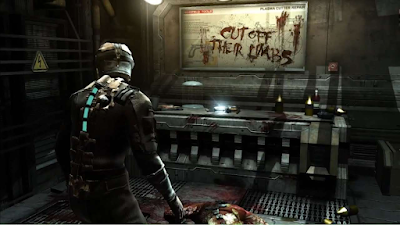
Suggest from a Discord I'm on;
A great example of both a warning & clue from Deadspace

4. The empty room contains a clue or password. I like the clue or left note because it implies it was left for someone or left to be returned too. I think placing notes in empty rooms really drives home the dungeon is being visited by other adventuring groups or factions. This can also allow players to become aware of factions they might previously not know exists or foreshadow them.

Riddles are fun because secrets can be placed in plain sight so your players will run into them, but not completely given away. Also its a sorta puzzle that doesn't limit play like say a puzzle door might. And given the use of Discord and such, players can puzzle the riddle outside of game-time.

Notes to avoid traps is good too. Like an empty room with three doors. Maybe the doors themselves are not trapped but the hallways on the other side are. A chalk scrawl on the opposite wall might say "As the middle child of 3 siblings, I survived, while my eldest brother died of poison, and my youngest sister died by the sword"-- the hallway behind the middle door is safe the other two have poisoned gas and a blade trap.

NOTE ABOUT PC LITERACY: I think its worthwhile, especially for old-school games, to determine if a PC is literate in "common" and if they know other languages. Employing 3 & 4 effectively requires the judge to know if PCs can read. And a lot of information can effectively be hidden in plain sight simply by being written down.

For instance, an order of wizards might simply write the "use this door" in common on the non-trapped door for their house staff. For more esoteric but still low-level information, it might be written in "wizard tongue". The first could be understood by any PC with an INT of 10+ while the second might be only known by MUs & Elves. But this could work for demi-human and monster scripts.

5. The empty room contains a mosaic, fresco, or basrelief. I like pieces of art because the biggest "lore drips" can occur with them. Its a way to show potential relationships between multiple elements while not having to explicitly lay it out or be answerable to further PC questioning-- which can be an issue with an NPCs handing out the same sort of information.

6. The room is empty, but interesting nonetheless due to space or an inert feature. Empty rooms don't have to be square, white rooms. Since there is a chance empty rooms will be employed by the PCs and/or they could eventually contain monsters, traps, & treasure, they might as well be interesting. Its a sorta future-proofing.

And if they are interesting enough that PCs "waste" time in them, eh, all the better. You as the DM/dungeon designer don't have to construct a space optimized for PCs to move through.