Might be great when combined with Through Ultan's Door and maybe a OD&D/Holmes ruleset instead of my beloved B/X...
OSR RULES FOR RUNNING AN OUT OF BODY CAMPAIGN
Might be great when combined with Through Ultan's Door and maybe a OD&D/Holmes ruleset instead of my beloved B/X...
Labels:
astral plane,
dreamlands,
ethereal plane,
house rules
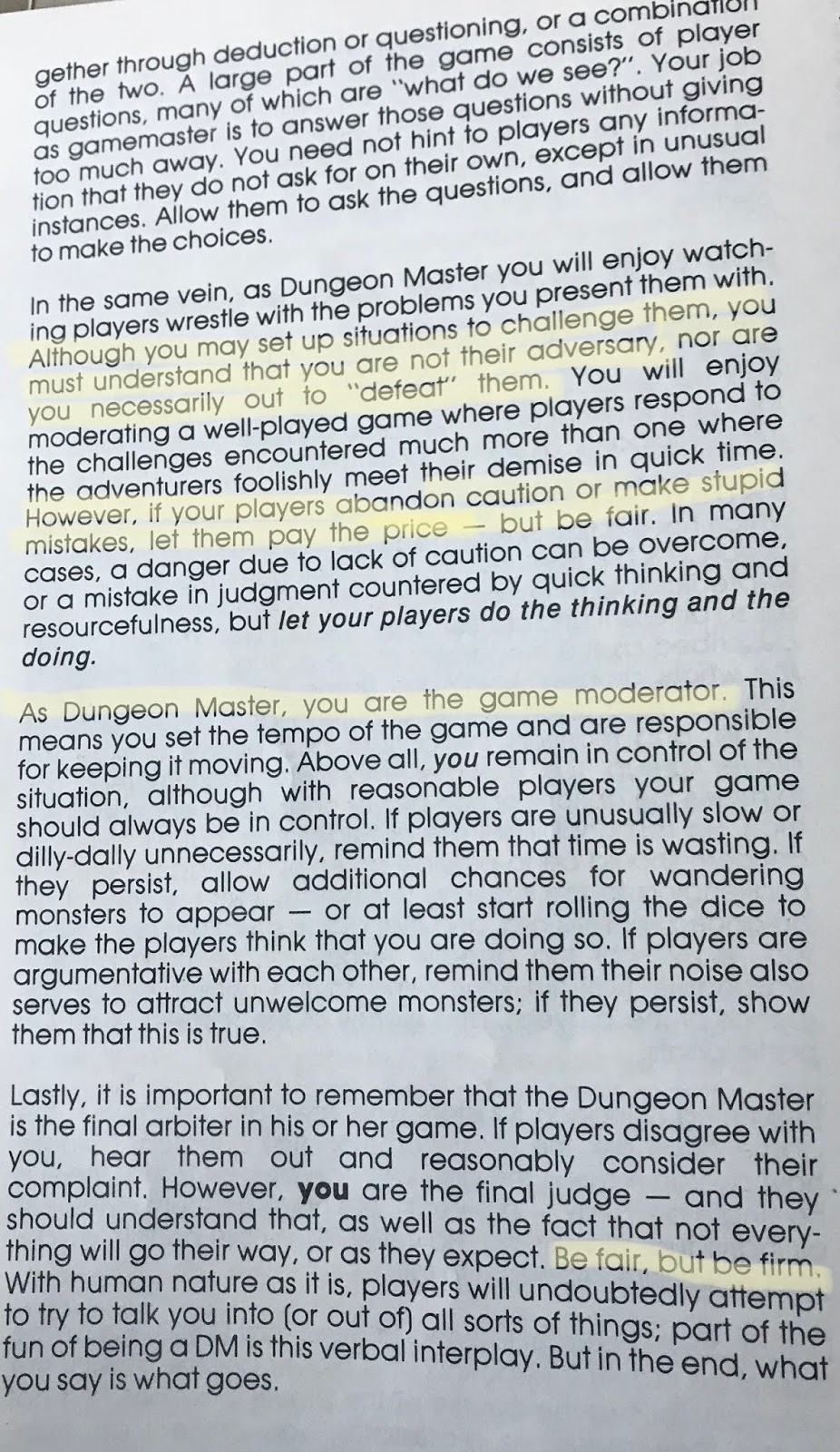
HOW TO DM FROM B1: IN SEARCH OF THE UNKNOWN (‘79)
What I think is interesting is that it describes the DM as being a moderator who keeps things interesting, allows players to fail if foolish, in a game with an unpredictable nature. It’s all good advice that we hear now, yet it was written in 1979.
A THIEF USES SKILL TO MANIPULATE THE PHYSICAL. A CLERIC USES SKILL TO MANIPULATE THE SPIRITUAL.
![]() |
| Sime |
The ever-clever Scrap Princess has posted about mixing up the core four classes with each other- so the fighter learns spell-like fighting moves, while the wizard buys the halbard spell.
I really like her ideas about the cleric using the thief's percentage skill system to perform a limited set of magical tasks, spell-like abilities, and such. I also like it because it finally puts the cleric as a character class that is "skill" oriented like the thief more than the fighters "weapon" orientation and wizard's "magic" orientation.
This, in my mind, makes a good symmetry: The fighting-man uses physical weapons to defeat the opponents while the magic-user employs arcane weapons. The thief uses their skills to manipulate the physical realm for their betterment, while the cleric uses their skills to manipulate the spiritual realm for the greater betterment (of their god).
She lists the follows as short list of classic cleric abilities:
-banishing supernatural agents
-trapping said agents if they can tricked or convinced to enter a vessel
-casting out possession
-healing sickness, infertility, curses
-fertility (land /domestic animals/ people)
-weather prediction-dispelling illusions/detecting of supernatural influence
-protective wards against disaster or ill intend-assessing auspiciousness of dates , partnerships or signs-omens
-lay dead to rest/ placating angered ghost or spirit
Of course, converting the thief abilities into spiritual ones could be fun:
Hide in shadows (of your god's glory): gain AC bonus (Lawful), attack bonus (Chaotic) or skill bonus (Neutral) as your god manifests through you
Move silently (and avoid the dead & fate): escape the notice of the dead or a failed saving throw (if you fail to, suffer twice the fate)
Find & Remove Traps (of the soul): remove curses, geas, alignment changes, & lycanthropy
Hear Noise (of the gods' whispers): with the appropriate sacrifice, you may attempt to prognosticate
Climb Sheer Surfaces (out of the grave): percentage chance you will arise provide your body is not eaten or desecrated
Open lock(ed hearts): Recruit folks to your cause provided they are of like alignment or neutral
Pick pockets (of those who should donate to your god): Gain funding from the common man for your pious quest from street preaching
"IMAGINATION IS A WEAPON": THREE EXAMPLES OF CLEVER 1ST LEVEL PLAY
![]() |
| Sidney Sime |
I am running a B/X/LotFP Caverns of Thracia campaign in a drop-in format at my local FLAGS. With 8 sessions under my belt so far, I've had players come up with some really clever ways of getting around combat encounters against with overwhelming odds or high-level adversaries. Below are 3 examples that stand out in my mind all performed by players with zero D&D experience and 1st level characters in an OSR system:
SITUATION 1- Clever use of the first level spell Message
In the very first game session, I had 10 players approach the ruins of Thracia and become alerted to the beastmen entrance A. While 7 of those players set up for an attack, the remaining 3 (elf, thief, wizard) swept around to entrance B. When confronted by the Death Cultist there, one thief player attempted to pawn herself off as a new prophetess of the cult with orders from their god to attack the beastmen at A.. Of course, the cultists are skeptical, but then the wizard uses their only 1st level spell slot of the day to cast Message at the cultist lead guard and pretend to be the voice of their diety backing up the thief's claim. I let that fly as the DM, and the cultists ran off to confront the beastmen at A. The combined efforts of a 1st level thief talking and 1st level wizard casting Message equals 10 dead.
SITUATION 2- Defeating a doppelganger with poison from a dead hireling
Hireling gets jumped by a spider, fails a saving throw, and dies by poison. After the defeat of said spider, this elf player pulls out one of the two bottles of wine he started with, downs it, and then uses it to collect some of the poison. Later, they unleash two doppelgangers who immediately mimic perfectly the party members they first meet. To solve this problem the 1st level elf player asks, "So does this monster copy everything Emma is doing?" Yes. The player then proceeds to cast Detect Magic to determine which Emma is the monster. Maybe not the exact wording of the spell, but as the DM, I'll let it pass. Then the elf player pulls out both identical bottles of wine, then hands the wine to the real Emma and poison to the doppelganger. They both drink- doppelganger fails the save vs. poison- dead. Not a sword is drawn.
SITUATION 3- Using a mirror to defeat
After the 2nd level dwarf is downed in combat with the guardian, the players have to choose a new champion. Other than the dwarf, no one is really in a good position to be locked in a one-on-one fight that locks out any other participant. Again the guardian calls out, "Choose your champion!". At that point, the same elf player as above grabs the cleric's mirror runs up to the champion and points toward its reflection, "This is our champion." I check my notes just to make sure there is no qualifying statements about champion choice. Nope. Boom, champion "defeats" itself, falls into a rusted heap leaving a Sword, +1 behind. Again, a mirror and clever thinking allow a 1st level character to defeat a 5 HD monster.
This is why I love DM'ing an OSR game. Its really delightful to watch players come up with clever solutions. And I believe the presence of death and asymmetry aid in the natural selection of smart solutions. Certainly, combat is fun, but its situations like the ones above that get the most cheers and claps around the table.
Labels:
B/X,
caverns of thracia,
combat,
LotFP,
player
INTO THE ODD COMBAT FOR YOUR D&D/CLONE OF CHOICE
One of the interesting things about Into The Odd is the combat rules. Basically, there is no to-hit roll, but if you are in the range of an attack you just roll damage. Here is a version of those rules for 5e D&D. Given how super-charged PCs are in 5e, this might be a great way to check them.
I'd have to think about applying it to B/X or LotFP, but it would make combat much more deadly.
Edit: Now that I've had time to think it's really infected my brain. I can't shake the idea that it would really make combat quick, but require more tactics on both the part of the DM and PCs.
ENCOUNTER REACTION CHECKS: I'm a big fan, and making combat more deadly will increase the likelihood players will want to at least try to talk first. Of course, this puts more pressure on the DM to come up with what monsters, NPCs, and adversaries want from the PCs (which might improve adventures as a whole).
INITIATIVE- Becomes extremely important to keep and maintain this in combat because of a single hit yielding so much damage. Maybe light weapons increase the initiative die size?
RANGE- Another factor that increases in importance. In most D&D combat ranged weapons are "meh" because most combat does not take place on a wide enough battlefield. However, if a bow gets you 1 or 2 attacks without any response that's huge in this system.
MELEE- I would still want to try to give other properties to weapons beyond to-hit/dmg. Big weapons are already going to hit hard with 10 or 12 damage. Maybe add reach, parry, slow, reload to emphasize other combat aspects. Weapon choice should be distinct and easy to understand with different weapons giving different situational advantages.
COVER- need more of it on the table to help increase AC especially for those characters with armor restrictions.
MORALE CHECKS- like REACTION CHECKS above, I think this optional rule is strengthened when combat is made deadlier. Now its easier to perform a first strike, kill a leader, or 50% of the force, so it makes sense to force the conflict into a route or non-combat exchange.
I'd have to think about applying it to B/X or LotFP, but it would make combat much more deadly.
Edit: Now that I've had time to think it's really infected my brain. I can't shake the idea that it would really make combat quick, but require more tactics on both the part of the DM and PCs.
![]() |
The Marigold Tarot by Amrit Brar |
ENCOUNTER REACTION CHECKS: I'm a big fan, and making combat more deadly will increase the likelihood players will want to at least try to talk first. Of course, this puts more pressure on the DM to come up with what monsters, NPCs, and adversaries want from the PCs (which might improve adventures as a whole).
INITIATIVE- Becomes extremely important to keep and maintain this in combat because of a single hit yielding so much damage. Maybe light weapons increase the initiative die size?
RANGE- Another factor that increases in importance. In most D&D combat ranged weapons are "meh" because most combat does not take place on a wide enough battlefield. However, if a bow gets you 1 or 2 attacks without any response that's huge in this system.
MELEE- I would still want to try to give other properties to weapons beyond to-hit/dmg. Big weapons are already going to hit hard with 10 or 12 damage. Maybe add reach, parry, slow, reload to emphasize other combat aspects. Weapon choice should be distinct and easy to understand with different weapons giving different situational advantages.
COVER- need more of it on the table to help increase AC especially for those characters with armor restrictions.
MORALE CHECKS- like REACTION CHECKS above, I think this optional rule is strengthened when combat is made deadlier. Now its easier to perform a first strike, kill a leader, or 50% of the force, so it makes sense to force the conflict into a route or non-combat exchange.
AS OPPOSED TO THOSE FOUND IN FANTASY, SPIDERS IN REALITY ARE QUITE WEIRD
Here is a nice post from Ars Magisterii on all the weird ways IRL spiders capture prey. Given that giant spiders are a (particularly low level) staple of D&D games with skeletons, goblins, orc, and traps, it's always helpful to have ways to freshen them up.
I especially like trapdoor spiders because its a nice way to combine pit traps and giant spiders.
I LIKE THIS IDEA OF PLAYERS EARNING POINTS IN GAME FOR THE NEXT CHARACTER THEY ROLL
At my local FLAGS I have been running a drop-in/drop-out game of The Caverns of Thracia. Since everyone starts out with level 1 characters, it is not surprising they die. This is not too crushing as using B/X-LotFP allows for fast creation. However, it would be nice to reward players somehow for their continued persistence in this game. This is where Kill Your Dungeon Master's fate points come in. Leveling up, trying a new character class, or whatever the DM wants earns player points they can spend on their next character. So instead of 3d6 down the line, a player can spend points to swap two scores, roll a 4d6-drop lowest for another, maybe even start a level 2!
Subscribe to:
Posts (Atom)