Showing posts with label DM. Show all posts

PRAISE THE DRAGON OF THE PIT: Building An Encounter On The Fly

The shrine as seen by the players


This past weekend I ran session 27th of Where Hell Comes to Prey, my home campaign set in Miranda Elkin's Nightwick Abbey. This "100-minute megadungeon" session centered on the party attempting to destroy a rumored profane shrine that had appeared in the Fog-bound Forest. I want to talk about building this encounter to cement this procedure in my head, but also because I think there is a paucity of posts demonstrating how to tie it all together when DMing. How does one use all the tips and tricks in concert like a conductor to create an adventure symphony? 

This post covers: (1) random events as a seed, (2A) variation on basic enemies, (2B) set piece and adding a "clock" to a challenge, and (3) shrine as NPC or how to extend utility beyond destroy this "bad thing".

1. RANDOM EVENTS AS A SEED: The Shrine

I've started using a regional events table as method of making the world breathe and walk independently of the players' actions. The big yearly event was "volcano" and for this month it resulted in changes in the Abbey as a new demon emerged (Session 26). For this month "shrine" was rolled.

Aside: At this point, the game is on in 20 minutes and I've gotten little done on the shrine portion after reviewing session 26, generating hirelings, writing down other rumors, and restocking.

Okay, so I've done shrines before, but I wanted not to make this one passive. Let's make it an active threat instead and connect it to the emerging new cult in Nightwick. So "shrine" has become "a shrine to the Dragon of the Pit" with the themes of never-ending hunger, fire, sacrifice, and domination. I wanted the shrine to represent the new cult's rapid reach to the outside world, especially with the still active volcano in the Nameless Mountains. What’s the connection between dragons and hell? From inplacesdeep:

The Infinite Layers of the Pit are made of the different chambers of the Dragon of Hell's infernal gut. Most chambers have their own individual lord of hell, with some chambers or even whole organs belonging to a great prince or president. The chambers tend to be themed, but beyond these broad strokes it is difficult to describe the Pit as it is the essence of chaos contained

2A. VARIATION ON BASIC ENEMIES 

To "active" in this case, means something that is a threat to the players versus a "passive" shrine which would just be offering a sacrifice and gaining a boon/bane. The easiest way to make a shrine "active" might simply be to have it surrounded by crazed cultists. Meh. The PCs certainly encountered that before. The players have seen that before. If there is not a cult to defend the shrine, why has it hung around? Why hasn't the local population of woodsmen not destroyed it yet. 

I decided that was because the shrine itself was alive and could defend itself with the bodies of its sacrificial victims.

Aside: By this time the game was already in motion. Players were starting to focus on the shrine instead of their previous attempt to infiltrate the Abbey and deal with an undead judge.

To make the shrine a "monster" I used a combination of three different previous posts covering reskinning, layering, and "punnett squares". Since the shrine's elements are charred skeletal sacrifices and fire, its easy enough to borrow from Nightwick's Blind Dead and Children of Stone.

The Blind Dead are an average of 5hp, damage as weapon (1d8), and have typical skeletal immunities from slashing and piercing. While the Children of Stone have an interesting breath weapon. Perfect, let's just smush these two together:

Shrine to the Dragon of the Pit: A profane totem carved in the shape of a phallic wurm sitting on top of a pyre and glowing with an internal fire that seemingly causes knots in the wood to blink and flare as if living eyes; around the base are chained 3 charred skeletal figures.

Shrine Sacrifices: Those sacrificed or who die in the presence of the shrine become its guardians; AC 12, HD 1+1, HP 5, Atk 1 breath of embers (15' cone), Dmg 1d6 save for half; Sacrifices must stay within 30ft of the shrine itself.


The shrine as seen by the players

When the party arrived at the shine itself. They spent a couple of turns investigating the shrine leading to the death of a hireling who was supposed to throw some holy water on it, but missed, awoke the shrine, and immediately got a face full of hot embers. But they learned something!

It was after this investigation turn, I decided that the guardians of the shrine were contained to a 30ft radius area around the shrine. Why? (1) Because I didn't want it to feel like a zombie spawn point. And I wanted to potentially be able to convert the shrine into a usable location should PC perhaps want to align with the shrine or use it for some purpose. (2) Related to this is that "Hell Always Wants to Make a Deal" and so has to be present to do so. If the shrine becomes too regionally aggressive it certainly is a target for attack and destruction. We have a set piece with a radius. 

Why don't the players just stand right outside the range and plink away at it? It's a good strategy and exactly what my players decided to do, however, they were slightly under-prepared and tried to throw rocks and use slings to destroy the skeletons. If given infinite time this would be successful. But that is boring.

The coursing fire inside the shrine flares tearing the top off in a gout of flame and smoke, in your ash-stung eyes, visions of thundering hooves of skeletal horses appear, but as you frantically clear your vision no sign of the corpse cavalier appears- yet...

So, I decided to add a "clock" to this encounter. Why? Entering into steady-state situations where success is possible if the party only waits long enough is boring. It is not what characterizes good adventure to me which is more composed of cunning plans, stunning victories, and harrowing escapes. 

The visions of the dire horseman presented a gamble to the players: can your "safe" plan work quick enough before this horseman arrives? The players' answer was "hell no" and they bounced after destroying a few skeletons of risen companions.

3 SHRINE AS NPC OR EXTENDING UTILITY BEYOND DESTROYING THIS "BAD THING"

At one point, the players decided to use an extra PC to try and talk with the shrine. Unfortunately, this PC was killed by the shrine because they had not come with an offering and the 2d6 reaction roll was quite poor. However, this action did make me thing about what is the shrine giving to the people that built it.

I needed a "give" to help the shrine become more like an NPC. Why? If the shrine can be fought, talked to, and plays a continuing role in the region when left alone turns an encounter thrown together in ~20 mins into a potentially long-lived piece of worldbuilding. That is a fantastic creative economy. And its creates a dimensionality to the “thing” and enhances its believability because it doesn’t or no longer exists simply as a PC obstacle. Multidimensional existence is important for creating a realistic, fantastical world instead of a colorful video game setting.

The Give: On first offering, gain 1 "sin" (takes up 1 equipment slot)
  • Daily Prayer: Hot Temper as Resist Cold
  • Silver Offering (200sp): Eye of Avarice as Locate Object
  • Flesh Offering (1 heart): Stomach of Fire as Magic Missle  

So there you have it. How I threw together a set piece encounter in ~20 minutes using existing stat blocks that has expanded to become a notable piece of world-building that ties back to the setting and factions.


WHERE HELL COMES TO PREY: Running Nightwick Abbey 03


I have just completed DMing my 10th session of Nightwick Abbey, an OSE megadungeon authored by Miranda Elkins and illustrated by Chris Huth. These posts will be a continuing effort to document this campaign I dubbed Where Hell Comes To Prey. If these horrid halls of Nightwick Abbey call to you, then please join Miranda Elkins' Patreon!

WHERE HELL COMES TO PREY

Our Sunday Congregation:
Miriam Cleric 2
Froggie Frogling 1
Shiva Rogue 1
Grog Fighter 1
Hirelings: Hyme (barber)

Session 10 APRIL 28 Highlights: 

A DUEL!: The cleric Miriam was challenged by a fellow seminary student who believed he was wronged in the past. Miriam chose Grog as his second who then proceeded to kill the challenger in one blow.

HARTS WITH HEARTS: Down in the dungeon, a trio of deermen offered, for inexplicable reasons, a bowl of still-beating hearts and encouraged the PCs to eat them like apples. Scattered hearts and scattered deer heads resulted.

A TERRIBLE END IN EITHER DIRECTION: The probing of a dead body causes the irruption of gas which seems to paralyze Grog. As Miriam watches over the fallen fighter, Shiva and Froggie travel south until they stumble into a dining hall. They quickly leave as an impossibly large bulk squeezes itself into the hall. The party travels north and stumbles upon a room whose floor is covered in paper. Froggie leaps in to grab a few pages and also earns wounds as if some terrible invisible claws ranked his leg. 

POST-MORTEM

At session 10, how do I still feel about Nightwick? Love it! A player asked me if I still enjoy DMing it after playing in ~90+ sessions as a PC- (again) love it. It is fun to be on the other side of the screen and to be the master of the maligned forces.

Here is what I think I am doing right:

"100 Minutes of Megadungeon Madness": When I started this series, I discussed how I was going to attempt a 120-minute setup by starting 10 minutes after the hour, run 50 minutes, break 10 minutes, and run a final 50 minutes. Around sessions 7 and 8, I started doubting about this format. I wondered if I was cramming a megadungeon into too short of a time period mainly because the players were not covering much distance in the dungeon. If they had an encounter at the beginning of the session, it was possible to have a chunk of time gone. I mulled over if I needed to change combat or allow all weapons to do average damage or if I should shortcut (undercut) some part of the BX D&D system. 

But in the end, after playing 90+ sessions of Nightwick, I know the BX chassis and the dungeon crawling aspect works. There is no need to change that, but I did wonder if I could change some other aspects of how I run the game. Plus the players were having fun.

Pre-gen PCs/Hirelings: Gotta keep doing this. When I have new players join, rolling up characters takes the most time, especially since there are some delightfully unique takes on the character classes in Nightwick. Plus, pre-gen PCs help players that die due to vampire bats or blood puddings get back into the game quickly.

Treasure Maps: These maps are actually a staple of classic play. As evidenced by the presence of treasure maps in OD&D and under Scrolls in BX D&D (B46). These maps will help enhance exploration but will come at (1) a resource cost and/or (2) require some deciphering either because they will have incomplete information or perhaps some riddles.

Light Variation: Recently, I started to use the light rule found in DURF. In short, basically, the PC roller a pool of light dice, "1"s are removed, and if all dice are removed then an encounter happens in the dark. I like it. It actually touched off a meaningful discussion about light. If the pool is equal to or larger than the number of party members, they win initiative ties in the dungeon.

Here is what I think I can improve on:

Use The 5 Senses: I really need to bring more of these into play in Nightwick. Just to add a little bit more to the world that I'm painting. And often in horror, you know something is wrong before you see "it". Like realizing the yellow rush matts on the floor are woven out of human hair or that the sound of water trickling is accompanied by the smell of blood.

Combat Variety and Objectives: I have written two particularly good posts on how to vary bands of enemies and also on objectives in combat. I need to be better about implementing them in the Abbey. In terms of bands of enemies, variety not only keeps it interesting for me the DM, but also provides a tactical opportunity for the PCs as well. I kinda think back to Darkest Dungeon- it would be fun to have something that vomits on players. Variety can also act as a way to further describe the Abbey instead of skeletons with swords, cultists with...swords, or beastmen with...swor...axes! For instance, deermen could be something like:

  • (1-2 hp) Range x Special Deerman Caller Its piercing shrieks disorient enemies; the initiative die is a d4   
  • (3-5 hp) Range x Dmg Deerman Hunter Uses a bow
  • (6-7 hp) Melee x Dmg Deerman Stalker  Uses a battleaxe
  • (8 hp) Melee x Special Crown-o-Horn Charges into battle with head heavy with a tangle of antlers & tusks    

While the Abbey is murderous, in my mind it's also interested in capture, corruption, and contamination. All these things might require a target to be alive. I'd like to force myself to slow down and give each group of enemies an objective. And actually, since starting this post, I've actually run Session 11 of Nightwick and it worked great- I had horrible rat things go after the nearest NPC and a group of Devilmen demanded the cleric hand over their holy symbol to leave the Abbey. Interesting the cleric wouldn't do that, so the devilmen ended up slaying one NPC and breaking several bones of a PC-- then they handed over the holy symbol.

"Quests": While megadungeons are eternal, my time and my player's time is not so I'd like to avoid the campaign just having to stop dead in its tracks like a tv show that gets canceled mid-season. 

After seeking some advice from other DMs and consulting the blogs, the best solution is just to declare a set period of play. Since my players so far have really dug the little "quests" that organically pop-up, I decided to make some more. 

Nightwick Abbey has a lot of blank space where elements are present but not completely defined. This provides an excellent opportunity for the DM to carve some personalization out of the module. A case in point is the tome the players "decapitated" from its lectern, then spent the next few sessions trying to find a body to reattach it to by the request of Halfdan the Necromancer. Players loved it! And now it earns them rumors.

Again since starting this post, during Session 11, I had a shadowy group approach the group to recover several more pages from a particularly violent area of the Abbey for a reward 100sp per person if at least 3 pages were recovered. A great opportunity for role-play, negotiation, and the PC to get a sense that they could have a first crack at understanding the knowledge.

In all, the players are still really engaged and are enthusiastically plunging head-first into each delve, so that is the best feedback a DM can have!

THE SERPENT SONG HYMNAL: My Collection of Tables & Such for Running BX Dungeons & Dragons

I like this illo because it looks
like the heads are singing


Since running the "More Wine!", the wine cellar-turned-dungeon, I have been collecting various tables & rules that I always reach for when running the game. 

I have collected these into a document I call, The Serpent Song Hymnal.

If you have been around the old-school scene for a while, its really nothing surprising but I found it nice to have it all collected in one spot for my own reference. Its kinda feels like assembling my own lightsaber.

My aim is for it to be a living document that evolves as I run games, scratch out well-used results, add new ones, and add/subtract whole tables. It is also not intended to be a new RPG ruleset or anything like that, but more my reflection of BX D&D. The way I butter my toast.

I do have a sort of player version as well. This document is more d6 tables concerning the backgrounds of various classes and the "spin" I like to give them as well as generating equipment rapidly. But I've not quite settled on what I'm reaching for when I'm helping players. Some tables might need to be more concerned with motivations like what I did with Lair of the Lamb.

Here is the fighter for example:

FIGHTER (All receive: Sword, Dagger, Shield, Gambeson)
D12, W13, P14, B15, S16


1. Barbarian     Battle Axe, Horned Helm, Oil Flask (2x)
2. Hunter         Bow, Arrows (10x), Snare (2x 2:6 trigger)
3. Guard        Spear, Manacles + Keys, Whistle
4. Errant Axe, Javalins x 2, Chain
5. Mercenary     Bastard Sword (1 or 2 H), Chain
6. Bastard        Loyal Squire (follower), Ancestral Claim, Chain

TRUST IN A DEAD FROG: A Lesson In DMing from Nightwick

A rough estimation of what Snorly
looked like prior to Session 26. RIP.

One aspect of RPGs as a class of game that intrigues me the most is the sorta "emergent behavior" that can occur as a result of holding firm to the results of dice or PC choice. One of the best examples is the combination of a random encounter roll and encounter reaction check. So maybe a combination is "dragon, green" and "friendly" or "elves" and "automatically attack".

Both provide some exciting options for a DM and PCs to contend with. And while it might be easier to play one as hostile as per alignment the other as friendly for the same reason, holding to the die rolls can take the campaign in surprising directions with very little effort by the DMAnd with today's time constraints and entertainment competition, lowering the effort/energy required to DM is a virtue. Especially as we try to get more people to DM.

In fact, whole sessions can be created just out of letting players live with the choices they have made instead of handwaving something away: 

  • We killed The Butcher in Session 23 gaining this creature's monstrous cleaver (magic axe +2)
  • Then in Session 26 the owner, Snorly the Frogling, was pummeled to death by fungus creatures and we abandoned the cleaver with Snorly's corpse ✣
  • Now in Session 51 we delved the same area again and regained the cleaver

But here's the lesson: Regaining that magic axe was an entire session (51) that the DM really had to do 0 prep for. The party decided, yeah, maybe we shouldn't just be leaving magic weapons around in a hell-haunted monument to hubris.

And was it a breeze because we've all been-there-done-that previously? No. The party made some fantastic rolls- Mechtilde leading with Steel (sword +1) and our other fighters landing heavy blows (Nat 20s!). A lot of magic was exhausted. And there was an ever-present threat of being stabbed in the back by manimals.

All because there was no handwaving to say we grabbed the body or axe in Session 23. It would have been easy and tempting for a DM to do so. We did work hard to get that axe. The takedown of the Butcher was a major accomplishment. Why not let the party keep that "win"?  We chose to run. We chose to leave everything behind. And that "failure", become a new goal and a new pin in the Nightwick map.

And the recovery was challenging. Although most of the party are levels 3 & 4, the second level of Nightwick continues to pose a challenge. In part, again, because the DM is letting the dice do the heavy lifting. Monsters can come in large numbers. We lose initiative a lot resulting in having to endure harrowing damage. But all very rewarding, in my opinion, even if the plan and objective are all known-- to recover an axe we already had gotten once before!

A strong reminder for me to trust in results. Trust in outcomes even if "bad". Trust in (game-appropriate) disappointment- bad rolls, dead PCs, drained levels, and lost magic weapons. It can pay forward in fun sessions requiring 0 prep. And who doesn't want some "free" in this (DM) economy?

We've also lost a sword +1/+3 vs. undead in a roughly similar manner given by Father Christmas. Although it was part of a plan to have 90% of the party make it out alive (Session 41).

RPG'S TONISBORG COELACANTH: Or The Lost Dungeons of Tonisborg & The Preservation of D&D before D&D, a Review


The Lost Dungeon of Tonisborg
coelacanth: a living fossil

 WHAT? A COELACANTH?

Let me frame my view of the field for Dungeons & Dragons history.

To me, understanding what actually happened in early D&D has often been a miasma of hearsay and anecdote. Early knowledge about D&D often seems to take on the same form as knowledge about The Bible and Origin of Species-- hotly debated, little understood in context, and almost never actually read. Even early internet sites and user groups are hard to plumb for understanding.

In the past few years attempts at understanding the history of RPGs, especially, Dungeons & Dragons have matured considerably. This is in no small part, I think, due to the emergence of both the indie story game scene providing a counter to "trad" RPG game formulation and the old-school renaissance refining/revitalizing aspects of "classical" RPG game formulation, again, apart from the present trad RPG presentation. But still lacking has been clarity on what the space looked like immediately before and after D&D was released. So as the scene's discourse tortion has heaved and shook the ground, it has become apparent that few really know how a game of D&D was exactly played at its genesis.

Recently three good works have popped up to tackle this unknown: Playing At The World and The Elusive Shift, books written by Jon Peterson, and the Arneson-focused The Secrets of Blackmoor by Griff Morgan & co. All three together create a much clearer picture of how D&D arose. And now recently in conjunction with The Secrets of Blackmoor documentary, Griff, in partnership with Greg Svenson, has released The Lost Dungeons of Tonisborg. A complete 1973 megadungeon written by Svenson, one of the original "Blackmoor Bunch" using the associated 1973 playtest rules of the soon-to-be-released Dungeons and Dragons (published in 1974).

THE LOST DUNGEONS of TONISBORG

The book contains 3 broad sections (these are my conceptual divisions, the book proper lists 8 parts):

  •  Section I CONTEXT: How to run a game of 1973 D&D
  •  Section II DUNGEON: A 100% reproduction of a megadungeon created in 1973 and not something half-remembered. There are actual scans of all 10 levels and keys and a remaster of the same for ease of play
  • Section III RULES: Re-printing of the playtest ruleset of 1973 D&D (which is still used by the same playgroup to this day) containing everything from character creation to how to stock a dungeon; A to Z.
So, unlike a lot of other instances of original play material or stories of play, here we have all the elements from 1973: an era-produced dungeon, era-specific rules used to run the dungeon, and an attempt at the era-correct context for use of those rules at the table. 

Like the coelacanth, Tonisborg provides a possible opportunity to understand how gameplay, dungeon, and rules were all related; a swimming fossil. Whereas before this publication, we only had glimpses of each part and always much later in time via other sources. For instance:
  • Context, but no rules or example: There are a few internet message boards where Gygax, Arneson, and early players drop hints and clarifications to how play was done. But we have to be careful because there is often little to directly back it up (i.e. memories of playing in Greyhawk but no Greyhawk dungeon maps to confirm [I think]). Gygax for instance has DMing advice, but rarely actually played D&D according to his own 1e AD&D DMG specifications. So context, but hard to know what ruleset this advice is being provided for AD&D, OD&D, or some amalgamation? There is also almost a different Gygax opinion for every edition of D&D too!
  • Rules, but no context or example: The 1e AD&D DMG (1979) provides us with tons of rules by Gygax, but never really much context on how to implement those rules. Nor do we have a true representation of a Gygaxian dungeon because his own Castle Greyhawk has yet to be published. 
  • Example, but no rules or context: I think The Caverns of Thracia (1979) offers a view into early multi-level dungeon design, but no strong basis for the ruleset used and no context for how it is run. 
  • Example, but not representative: And while we have a plethora of TSR modules, early TSR modules are reprinted tournament designs and later TSR modules initiated the trad linear-story approach to RPG design. In either case, the exploration, risk-vs.-reward Greyhawk & Blackmoor, along with Tonisborg, were/are megadungeons and not represented by ~90% of TSR modules despite clearly being an early formational play environment.
So what are you actually getting with this book?


REVIEW of TONISBORG

"Breathing Life Into An Old Dungeon"

The first two chapters of the book cover the history of the dungeon and how old-school play occurs. The book does a good job of trying to cover all aspects of DMing that one might need to make adjudication 1973 appropriate. Each section is also usually begun with a quote from Arneson or some of his players.

The advice covers some topics that the OSR has recapitulated in the Old-School Primer or Principa Apocrypha and some topics that I think are being resurrected.

Familiar topics in the old-school space are dungeon adventures as dangerous and need to be viewed as "war" (asymmetric & lethal) versus "sport" (balanced & fair). This section recommends players understanding that sometimes they need to run and employ retreat and counter attacks to overcome some foes. Or players should be sneaky and interact with the world, not their character sheet. On the flip side, this section councils DMs to be fair, employ environmental clues, how to encourage players to individualize their "basic" character and to remember the goal of the game is fun.

There were a few topics that a less broadcasted in the OSR think-space that I found interesting in the section as well. An emphasis on maps as both tools and treasure which are found as both in Tonisborg. Also the role of stairs as a way to move up and down levels. The meta-roles of a mapper and scribe are mentioned, but no "caller".  And even Arneson's tips on giving out "role-playing points" to encourage players who stay in character. A long section on "The Quiet Game and the Psychology of Fear" explains how Rob Kuntz uses quiet moments in the game to slow it down and increase the immersion. Mainly by asking specific questions which make players think something is about to happen. So various rolls and fakeouts are talked about: The Fake Roll, The Pre Roll, The Reversal Roll, & The Paranoia Roll. There are also discussions of how to use the environmental dressing to keep players on their toes: doors slamming in the distance, bloodstains leading off down a hall on the floor, screaming, and compounding those meaningless events. 

Now some of these could be listed under "Good Tricks for a Good Haunted House", but what is a dungeon if not a good haunted house? It's done the service of keep players on their toes, preventing lazy attitudes, and forcing deliberate choices. But I think this has the potential to be the least accurate portion of the work. The advice is good and certainly is even a bit different than the OSR space, but was it actually how it was done? The quotes span decades and come from a variety of sources. This might introduce misremembered ideas, but again at least its advice tailored to the play environment is delivered in the next section of the book.

"The Dungeons of Tonisborg"

The next section covers the actual ten-level dungeon of Tonisborg itself. Unlike the earlier section, all the maps are redone here, rooms numbered, and entrances and egresses clearly marked to each level and the level they go to. Each level is generally full-page map, keyed entries with sparse text, monster stats, and typical black & white illustrations ranging from PCs in peril to dungeons scenes, to whimsical comics of PCs in peril.

So what immediately jumps out at me when I am looking at this 1973 dungeon?

Layout more resembles actual tombs: First, the maps are more akin to tombs made fantastic than fantastic tombs. What I mean by that is the maps have a lot of long crisscrossing hallways with many, many secret doors that are anchored by large rooms. Kinda like the way an American mall might be laid out.
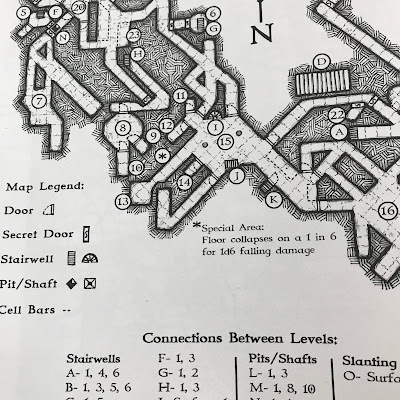
The Lost Dungeon of Tonisborg

I find this is a little different to more modern OSR dungeons where I think clustered rooms are connected by fewer hallways.

Tonisborg is "Jaquayed" Vertically: Each dungeon level feels like a bunch of "Y" shaped sections connect together at their southern arm and at that cluster there is usually a large room. So, when you proceed down one arm and explore it, you'd have to backtrack a fair bit to find a completely "fresh" arm. This is in contrast to the modern design philosophy which uses loops to discourage backtracking. However, what you do find in Tonisborg is the existence of many stairwells, climbable shafts, tunnels, and vents. So at the end of the northern arms of the "Y" are ways to go down or up. In fact, in further contrast to modern dungeon design, each level of Tonisborg contains on average of ~20 vertical connections between levels! Many spanning two floors, but about 1/3 spanning 4-5 floors.

Keying is Sparse: The book includes the original scans of not only the dungeon maps but also the keys that went with them. What jumps out is that each room description is just about one line: monster + treasure. This does not make for initially exciting setups, but the book outlines how to make these rooms more exciting. This makes Tonisborg more akin to Stonehell than other OSR medgadungeons. On the other hand, I think there is some wisdom to the one-line room key. It means the DM can get a megadungeon to the table fast which feels very similar to the advice given by Nick here on "The Two-Week Megadungeon". Too often I think we mistake good publishing advice for what is needed to get a game going, when in fact room + monster/trap/special + treasure (if any) is all that is needed to get going. The sparse key also reminds that reader that play at the table will bring a lot of energy to whatever is there.

Example of Level 10 keying

Room Size is Small But Unimportant?: Looking at the original map scans and monster placement, room dimensions are less important than distance. In several keys, at the end of long hallways are 10 x 10 rooms containing a dragon or 5+ headed hydra. This seems both pretty cramped for something that large and also pretty bland tactically. But something tells me, the rooms might actually be adjusted on the fly and the actual space is a bit more fluid. Distance is what matters because it affects movement and subsequent encounter checks which alters risk assessment by the players.

"Rules to Play With"

The final section of the book covers Zero Edition Dungeoneering (ZED) which for legal reasons is a copy of the play-test document of that game that would become the "OD&D" edition of Dungeons and Dragons. The rules here are extensive covering classes, mechanics, monsters, magic, treasure and dungeon stocking. We get a glimps into a D&D that could have been-- thief still absent. But a little warning that some of this might also be a house-rules influence too.  All my comments below will mainly come from a BX-heavy background with familiarity with OD&D and 2e AD&D. Let me try to hit some highlights:

Abilities: Characters are generated with 2d6+6, but like OD&D several of the bonuses for high values (15-16+) only range about +1 or 10%.

Classes: Halflings drown 90% of the time but have a +3 with bows/slings. Elves gain a forest direction sense and +1 to welding elvish-made weapons but only gain 1d3 HP per level. While dwarves take 1/2 damage from giant creatures.

Fighters have only a 85% chance of using a magic ring, cloak, or item correctly. Cleric can only keep 40% of money received and hording can cause level loss, but can use all weapons & armor. Magic-users can carry iron but it interferes with spell casting: 10% for a small objects, 75% for say chainmail.

Levels: It's interesting that it seems for all classes the XP needed to progress from levels 1-3 is reduced: Fighter 1>2 = 1000 XP, 2-3: 25000. Also, there is a point about level tiers: Veteran, Hero, Superhero, & Lord. These are more important designations because at Hero level you are able to resist fear & panic and the paralyzing aura of ghosts and ghouls. A PC is also considered "fantastic" and hirelings gain a +1 on all rolls when around said PC.

Combat: Two things here. First, the ZED rules allows a PC to make a number of attacks equal to their "fighting capability" against "mundane" opponents (those with < 4 HD). So a level 3 Fighter can make 3 attacks per round again mundane opponents in a 10' area. The similar leveled Cleric only gets 1 and Magic-Users get 2 interestingly.

Second, weapons are classified as long (2H sword or spear), medium (sword), short (dagger). When entering melee, whoever has the longer weapon gets to roll for the attack and damage first. Except in tight spaces like hallways of 10' or less or doorways, there the smaller weapon gets to roll attack and damage first. I think this is far easier than weapon speed and provides an easy demarcation like melee, ranged, and reach weapon designations provide.

Hirelings & Morale: Nothing earth-shattering here, but I like the strong emphasis on hirelings and morale and their role in play. This is a very important and often underused aspect of modern D&D.

1st Level MU Spells: I also find the composition of 1st Level MU spells lists interesting. For ZED edition they are: Charm Person, Dark Sight, Detect Magic, Hold Portal, Light/Darkness, Protection from Evil, Read Scripts, & Sleep. Very few offensive spells save for Charm Person, Light (blinding) and Sleep. But a lot of dungeon navigation.

REVIEW by QUESTIONS

How do you like the content? I like it a lot, again, because it is a complete package to understanding early play. Its interesting to me from a historical perspective as well as getting a hold on how D&D evolved. But given the effort and time that I feel would be required to make Tonisborg ready for play, I might run something else like Caverns of Thracia or Anomalous Subsurface Environment.

Is it something unique? Yes! Its context-dungeon-rules is only matched by the more recent Silent Titans which also includes the Into The ODD rules as well as a small how to play section. Another similar product is Super Blood Harvest, but even that product lacks discussion of the procedures of play. So Tonisborg really is a very unique product further enhanced by it fossilizes an important period of time-- the year right before D&D is officially published.

Do you like the old/new maps? Yup. Its important to be able to see exactly how dungeons were conceptualized back in 1973. Quite sparsely. But as I said above, there is wisdom here. I feel like the Blackmoor group understood getting something good enough onto the table for play is better than spending time and energy to make something perfect for publication. If we are worried about "plot", players will almost always provide a connection between two unrelated things.

Where does it fit in my gaming collection? Right now, right beside Playing at the World and The Elusive Shift, on top of The Secrets of Blackmoor. However, the book I think does give very good information on how to DM. I think it illustrates how to create a mysterious and engaging mood for the players while keeping to the forefront the game is supposed to be fair and fun. Two other situations: (1) A convention game to provide a unique experience that most people would not otherwise run at their FLAGs or at home; (2)  I would like to grab a group of 3-4 folks roll up characters by the rules in the back and run through the first couple of levels. Again to get a feel and appreciation for the genesis of the hobby.

PIOUS HANDS MAKE FOR GOOD KNUCKLE BONES: Super Cleric Bros. Session 5


A return to the cleric campaign! Previous sessions here.

Try to add DM Notes like this.

The current state of the Ossuary. Each result is the mechanical class (in-game fiction/flavor):

Ossuary Pilgram Table (roll 1d6)
1 | MU (magicians), St. Ulther
2 | Fighter (sailors), St. Ulther
3 | Fighter (fanatics), St. Serene
4 | Cleric (zealots), St. Serene
5 | none
6 | none

DM Notes: So when I rolled 3d6, I got a 5,5,6 (3 actual weeks have passed since we last played) which means that no pilgrims show up to the abbey this time. And I roll 1d6 for each current pilgrim to see if anyone has left on a 1 or 2. None do.

As it stands two MU followers of St. Ulther remain at the abbey ready to embark on any adventure the PCs might have for them. 

I just generate the followers using the Old School Essentials NPC generator here (also good for characters). And Oblate Samuel shaken from the death of his friend Leo, is back to being somewhat normal.

Brother Cadfael from the Cadfael series one
of the clerics takes their name from (I need to watch it)

The clerics'
first decision is what spells they will pray for today. The Reliquary allows a little extra bonus when they pray to various portions of it provide they have placed recovered monks' items there. The portion they have powered allows them 1 save throw re-roll (The BENEFICENCE of AZLEN).

The second decision is to return once more to Dyson's Tower to retrieve a third saint for the Ossuary rounding it out, which will allow a lot of pilgrims, and very much in the Abbot's wishes, who they like.

DM Notes: Since IRL weeks had passed, I allowed the clerics to at least have a standard pack of starting supplies, so they made one last stop to rally both Follower Lunell and Gersia. And after a passioned plea, collected Oblate Samuel.

DM Notes: Also they accused the Prior of being an agent of Orcus. Since time has passed, gossip as spread. The Prior is not too happy. They want to get the hell out of town. 

At the Goblin Camp

The approach to the camp is pretty standard now, they prefer the entrance to the south in order to sneak past the goblin camp. The clerics' aim was to return to the 1st Level and perhaps recover one more saint they sure were buried in the area with St. Serene and Ulther. 

DM Note: Because this area is almost always the start, I think its just better to sorta procedurize it. The PCs just have to have one method of surpassing the goblins on watch and we just make one check. In the furture I might try to alter the weather or add a patrol-- just to switch it up so the PCs never have *perfect* information about what's going to happen. 

The trip back to this location except for a bizarre ankle-deep fog covering the ground. They scrounge the scene of their last battle and fine a set of chainmail and the door leading to hopefully the last saint. But it was not, instead it was a crypt full of skeletons seemingly dumped without proper rites and full of spite for the living. This time, my players remembered their clerics could turn undead and short work was made of these skeletons. With the use of holy water, they scrub the floor clean of the mark of Orcus.

DM Notes: Maybe should have made the skeletons a bit harder to turn since they were in the radius of a mark of Orcus, but whatever. The PCs felt the threat.

Level 2

This level too is familiar ground to the PCs. They decide to bust up a goblin dice game in an attempt to find some information about the location of human saints. Brother Phellius offers up his newly won chain mail and dices against the goblins-- winning. The clerics learn another goblin, Snakesplitter, is being held on some charge and maybe the PCs could take them off the goblins' hands since no-one likes him. They were also warned to watch their back.

After leaving, the PCs asked Follower Lunell to Hold Portal the door.

DM Notes: I need a better quick dice game for D&D other than roll 2d6 who gets the highest. I bet Nate Treme has one.

A turn later they find the hastily assembled baracade Snakesplitter is barracaded in, but the four goblin guard want 100 coin as a "transfer fee". The clerics, being pious men rich in virture, are broke. So Redcap offers to make some new gambling dice out of their knucklebones. A fight begins and ends in the third round when Redcap is beaten by a Brother Cadfael's mace and moral breaks. The remain goblins just make new gambling dice out of his knucklebones.

Snakesplitter offers to come with them simply for beating Redcap to death. And gives them sass about first trying to convert him to being a monk.

Level 3

Snakesplitter leads them down a different set of stairs to Level 3 than before. But before realizing what is happening they are suprised by an ambush/gang/thieves guild of robber flies! Snakesplitter avoids the on slaught as does Follower Gersia, but Follower Lunell, Brother Cadfael, and Brother Pheallius are on the defensive taking hits each. But its poor Oblate Samuel that met his fate-- natural 20 and 5 on the damage roll. Robber fly basically ripped his arm off.

DM Notes: This encounter suprised me with how brutal it was. Also, I think I need to have some standard layouts ready for battle. I really like having tactile set up with objectives and "terrain". But maybe since I have 2 players, I should just got more free form.

DM Notes: Also this is the 2nd Oblate who died. They are supposed to be wards of the Abbey, so someone might come looking for them-- 1:6 they were connected to someone at Stronglaw Keep. 

After a few Cure Light Wounds, Snakeplitter showed the clerics a clue to what they came for-- a statue of the Saint of Sleep.

And because the DM, me, forgot the sheet with the riddle and we were at our 2 hour limit, that was game for the night!

DM Notes: If you get anything from this, then I hope its the idea that a good game of D&D can be done in 2 hours. Not need to pull out 6, 8, or 10 hour sessions. It just requires density of choice to be high. And that is what is nice about this "mini-megadungeon" format.