Showing posts with label dungeons. Show all posts

THE OLD DUNGEON WORKSHOP: One (Quick) Way I Build A Dungeon


I've recently completed the first level of my "wine dungeon", run it for 12 sessions, and finally have strong thoughts coalescing for a level 2. Given that next year will be the 50th anniversary of D&D, dungeons and dragons have been on my mind.

I think two three of the best articles I've read on dungeon building are:

Looking at Nick's The Two-Week Megadungeon post, he had a nice little table (below). I think it demonstrate that when creating a dungeon it is helpful to thing of monsters, traps, and treasures that define your dungeon.

I've taken that table below and linked to one of my various thoughts on the matter:

Roll 1d20 for each Room
1-10: Empty
11-13: Creatures (and what they want)
14-16: Creatures with Treasure
17: Trap
18: Trap with Treasure
19: Something Weird
20: Unguarded Treasure

Get to that map-making because after all: 
It also important to remember that something is better than nothing.  All D&D is hackwork and a half-assed idea that gets your game on the table is better than a perfect one that takes months. ~In Places Deep, Mastering the Megadungeon

Make your monster, trap, treasure lists, check 'em twice.
And draw out that dungeon- rooms both naughty and nice!
Grab friends one and all, 8-10 should suffice.
And kick in a door one, twice, thrice!
For their trouble, they die by tooth, claw, slime, or vice!
But the danger is worth it with treasure in their sights!

DIM ILLUMINATIONS: My Guest Review of Desiccated Temple of Locha

 I know I've been hitting the Nightwick recaps pretty hard on the blog, but that is in part because I think actually reports from the playing of dungeons in a classic style are still an under-represented aspect of the OSR scene. 

But that does not mean I'm not writing other things. For instance, if you'd like to know some of my other thoughts on dungeon design and play, then click on my guest spot at Bones of Contention where I dissect the Desiccated Temple of Locha.

A dungeon of suspended animation fish-people-- yes!


I tried to cover what was nice about this small adventure as well as where it might be improved. The author was also kind enough to read the review and deem it fair. But also supplied the extra bit of context that it originated as a one-page dungeon. This really helps clarify some of the choices.

Also, I once again employ Arnold K's Dungeon Checklist which was featured in KNOCK and I think is a great set of criteria by which to judge dungeons.

03 TOMB WITH EIGHT SKELETONS: Layering For Dynamic Encounters

A dynamic encounter for sure

It is entirely possible by playing D&D for any amount of time you have encountered or have written some variation of the following:

03. TOMB (80 x 80): Eight skeletons guard their former captain's tomb; will attack PCs who enter. Captain wears gold circlet (300 GP).

8 Skeletons AC 12 HD 1 (4hp) 1x weapon (1d6 or by weapon) MV 20, ML 12

This is pretty much the monster + treasure result from BX D&D and a serviceable one at that. You pretty much are picturing a room with a single tomb in the center and eight skeletons lined up along the walls. 

LAYER ZERO: You don't always need the latest monster book, you can easily layer additional simple elements to create novelty

Or monster tome, or 3-ring binder enchiridion, or monster cards. There is power in the familiar. It can be leaned on for shorthand in non-critical situations. And it provides players with the enjoyment of recognition in either a nostalgic or anticipatory sense: "Ha! I bet those skeletons will attack us just like in the GT1: Stone Grey Halls of Grog's Tomb" or "Ha! I've always wanted to fight skeletons in stone gray halls!". But too much of the familiar and D&D loses some of its spark, especially if you are pursuing an exploration-centered classical style of game.

Instead, for my own games, I have been trying to focus on layering simple ~1-2 sentence additions using other common, easily understood elements of the game to create novelty. The shortlist of layering:

  1. Unique Description
  2. Weapon Mix
  3. Stretching, but not changing, the stat block
  4. Terrain
  5. Objectives

LAYER ONE: Unique Description

Presenting the tried and true in a new light can make the mundane novel.  For instance, if you wanted to startle your players, you could have 7 of the skeletons kneeling in prayer to a central seated figure. This brings our 8 skeletons to something like this:

03. TOMB (80 x 80): Seven skeletons kneel in prayer around their former captain (skeleton on a throne, circlet, center); the seven skeletons will attack PCs who enter the room.
Monster: Skeletons AC 12 HD 1 (4hp) 1x weapon (1d6 or by weapon) MV 20, ML 12 
Treasure: circlet (300 GP, opal in center 200 GP)

This setup tells a small story and begs some questions. Who were these folks? What is the relationship? Is the kneeling an expression of subjection or reverence? Player table-talk might generate some new adventure seed for you.

However, this is not going to be a dynamic combat situation. The room described above is pretty much a "white room" with little in the way of terrain or enemy variety. A singular room is okay, but if too many rooms occur like this it encourages players to just adopt a singular strategy of heaviest armor, high damage weapons, and damage-only spells. And it gets boring and that is not okay. 

LAYER TWO: "Weapons" mix

One of the simplest ways to create variety is to just change up the methods of attack. This is pretty well covered here, but you don't even have to be that complex about it. Let us give a mix of bows and axes to our skeletons: range and melee, both still 1d6. And maybe one of those ax-welding skeletons has a two-handed sword and some rusted plate:

03. TOMB (80 x 80): 7 skeletons kneel in prayer around their former captain (skeleton on a throne, circlet, center); the seven skeletons will attack PCs who enter the room.
Monster: Skeletons AC 12 HD 1 (4hp) 1x weapon (3 x axe, 1 x 2H-sword, 3 x short bow) MV 20, ML 12; skeleton with 2H-sword has AC 13
Treasure: circlet (300 GP, opal in center 200 GP)

LAYER THREE: Stretching, but not changing, a stat block

Five out of our seven skeletons have swords. Still kind of same-same. So, what if we make the 2H-sword skeletons into something that will do the same amount of damage but be more interesting. We could change to a different monster, but, again, let's not alter the stat block too much.

How about "skeletal horses"? This is basically a superficial description change and we can use the BX charging rules as a method of attack (move 60' and a successful attack deals double the damage). We might also give these skeletons max HP, 8, as a way to denote their size instead of altering HD. And 8 hp is often an average 2 HD PC anyway.

To explain the horses, we are altering a simple tomb into something grander. Instead of a throne, how about the leader is in a chariot in front of a procession?

03. SKELETAL PROCESSION (80 x 80): 6 skeletons, heads bowed, stand eternally behind a  former captain (skeleton on a throne, circlet) seated in a rotting chariot pulled by a similar horsethe 6 skeletons & horse will attack PCs who enter the room.
Monster: Skeletons AC 12 HD 1 (4hp) 1x weapon (3 x axe, 3 x short bow) MV 20, ML 12; Skeletal Horse as skeleton, but 8 hp and will always charge on its attack (successful hit 2d6 dmg)
Treasure: circlet (300 GP, opal in center 200 GP)

However still two issues with this encounter. The first is that we still have a white room. So what can we add to give the room some terrain? And the second is that just because I have outfitted the encounter as more combat-oriented doesn't mean it has to go that way. So what can add to give these skeletons a reason to chat?

LAYER FOUR: Terrain

To solve the white room problem, let's place the captain and chariot on a dias that is 40 ft long, 20 ft. wide, and 5' tall in the center of the room. The 6 skeletons occupy about 20 ft. x 10 ft of space to the left of that. We can add four columns to the north and south around which amphorae can be placed if you want more coverage.

In my head this gives a king-of-the-hill object blocking the center line of sight blocked with columns to hide behind north and south. This should allow for tactical maneuvering around the room. Which can aid in escape, hiding, magical hijinks, or other such things. You can add this to the description, but most likely this information will be contained on a map of the room. 

The goal is to provide something else that can be acted on or used to solve whatever's in the room. You don't have to think of many pieces or anything original. Just something to keep the space from being wide open. If you look at a lot of skirmish games, you can see that rarely are things just a flat plane. The same should be applied to D&D.

Other alternatives could be things not even rated to what is in the room. But objects and "flora" added later: roots of a giant tree have found their way below; strange mushrooms cover the floor; waist-deep pool of rainwater has collected in one quarter or half of the room; a few 2-3 deep pits have opened up- one of which leads to the next dungeon level down.

LAYER FIVE: Objectives

This is coming last, but it is not the least. Is there a single sentence that could be added to this description that would allow some sort of discussion or bargaining to take place? Preferably, it would be something that provides a choice.

There are combat objectives, but I am thinking of something a little more tied to the world. And I also like tieing these sorts of things to character class, god, background, or place of origin if you have it. The Nightwick Abbey game I play does this very effectively.

Since this is an example and not tied to a specific dungeon, I'll just keep it general. Maybe some of the answers to the below questions can be found in earlier parts of the dungeon or in alternate side rooms. Some basic things the captain could ask are:

  • Are you a descendant of X?
  • Do you pledge loyalty to Y?
  • Have you come to give an offering?
  • Do you serve the god Z?
  • Who do you count among your foes?
If the party sufficiently answers then the skeletons leave them be and attack if they do not.

SUMMARY

I guess depending on your view of dungeon crawling or what your purpose is will tell you how you view the following as an improvement. But we have gone from this:

03. TOMB (80 x 80): Eight skeletons guard their former captain's tomb; will attack PCs who enter. Captain wears gold circlet (300 GP).

8 Skeletons AC 12 HD 1 (4hp) 1x weapon (1d6 or by weapon) MV 20, ML 12

To something meatier, yet still is a rather terse text block:

03. SKELETAL PROCESSION (80 x 80): 6 skeletons, heads bowed, stand eternally behind a  former captain (skeleton on a throne, circlet) seated in a rotting chariot pulled by a similar horse (on a large dias); the captain will ask "Who do you count among your foes?" If the PCs answer "The Serpents of Norr", they they will not attack. 
Monster: Skeletons AC 12 HD 1 (4hp) 1x weapon (3 x axe, 3 x short bow) MV 20, ML 12; Skeletal Horse as skeleton, but HP 8 & MV 30 and will always charge as its attack (successful hit 2d6 dmg)
Treasure: circlet (300 GP, opal in center 200 GP)

My final point is that for this example I used each layer, but you don't have to do that for each room. Each layer by itself could be a room of its own that thematically culminates into a room with all 5 layers. One advantage to this is you can introduce patterns to players bit-by-bit and then put them all together for a rather showy set piece or dungeon anchor.

DUNGEON REAL ESTATE: Or How Many US Homes Do Kobolds Occupy in B2?

Nice fixer-upper in a prime location
with lots of history & character!

I often have a hard time understanding just how realistic dungeon space is in various adventures. 

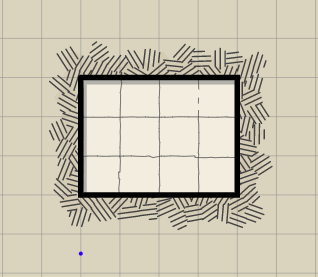
When a room is six 10-foot squares by three, how big would it feel IRL? What if we compared it to the average US home?

  • The area of a 10 x 10-foot dungeon square is 100 sq. ft.
  • The area of the average US home in 2019 is 2,300 sq. ft.
  • Therefore, the average US home is 23 dungeon squares (most likely split between two floors)
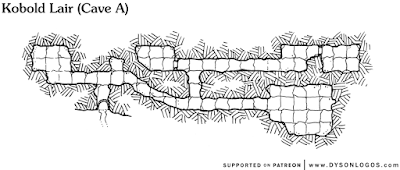
As found in B2 Keep on the Borderlands

For comparison, the kobolds in the Caves of Chaos (above) occupy an area of ~37 squares or 1.6 US homes in 2019. Here I excluded hallways.

But, Gygax didn't write B2 with a sense of 2019 US homes. He was writing in 1970 when the average US home size was 1,500 sq. ft. or 15 squares 

This would mean that our kobolds occupy ~2.5 US homes in the 1970's. Another question: What does a 1970's floor plan look like if converted into a dungeon?


Not really much because roughly the above house (excluding the porches) is roughly 40 ft x 30 ft or 1200 sq. ft. (so 12 squares). The bedrooms themselves would only be defined by a single square.

It ain't pretty, but it will do


So, it looks like our kobold lair above is something like 2-3 houses at the ends of a couple of streets. And each "house" is large enough to contain 3 bedrooms, a lounging area, and some sorta kitchen. This gives me a new appreciation of how dense dungeon areas really should be and how much room for various activities there is. 

And this gets back to the "white box" issue when combat starts in D&D or when exploration is occurring. The above 4 x 3 room should not be blank at all. Its going to be packed with stuff, especially if occupied by creatures, just like walking into anyone's home.

There could be traps anywhere. There could be gems, jewels, and bags of coin hidden various places. And when the swords come out, its gonna be harder to swing that 2H in these sorts of close quarters.


HOLE IN THE OAK PLAYTHROUGH: A Fairy Tale of Murderous Whimsy

Once Upon A Time...

There were four brave adventurers Desmano the Cleric, Grom the Fighter, Rodu the Illusionist, and Tadu the Thief, who descended into the shimmering depth of the Incandescent Grottoes. 

But this story will not be about them-- because they all electrocuted themselves mucking about with some levers and an electrified portcullis. Instead, this story will be about eight brave adventurers...

The Dwarf brothers Abo and Bo, Carl the Thief, Don and Rex the Clerics of the Seven Sisters of Sorrow, Changar the Fighter, Melf the Magic-User, and Plexa the Elf,

...descending into the mysterious Hole In The Oak.

(DM NOTE: Basically the party TPK'd so I grabbed the next closest book to me which was Hole in the Oak. The fantastic formatting allowed us to just jump right in.)

~SESSION 1~

01. BOTTOM of the SHAFT: The party's first problem was how to get all eight of their members down. Since they randomly rolled for equipment, the magic-user's rope was tied off on some rocks at the top and Carl the Thief secured the other end. After dropping a torch down to the bottom and confirming nothing was amiss, the party descended.

02. JUNCTION & 3. GRABBING ROOTS: Their first choice was turning east and running into a snarl of roots. A spear was the first item quickly lost to the grasping things. That won't do. The party attempt to cut through the roots losing a few more pieces of gear. After that, they decide to head west because it was the least amount of trouble.

10. TRIGGERED ILLUSION: The party is brought up short by the illusion of a wizard with a white-whiskered beard. The pause proves unfortunate as it allows a crab-spider to creep up from behind. Father Rex in the back holds the line as the dwarves and Changar the Fighter push back in rank to slay the beast!

11. TELEPORT CIRCLE: After a few spider-crab claws are taken for later roasting, the party pushes north into a room dominated by a wide round rug. The players, themselves being vets of old-school play, are immediately are suspicious. The probe again with their trusty 10' pole which- poof- vanishes! They also watched as a group of frogs hopped over the rug and turned north- many disappeared in the process. The group formed-up tight and moved to the west door. Theif picked it and they were inside. 

12. TINY PEOPLE: The party finds themselves perplexed by the jars of tiny dead people. A few a crushed in the investigation process and ultimately some tiny burials are performed by the clerics (DM NOTE: Gave them +1 on any next roll in response). They grabbed the spell scroll, left, and continued north.

15. TREASURE & PIT: Piles of gold and silver chalices spur Carl the Theif to leap the pit. Precious minutes are spent eyeing the treasure pile in an attempt to see if there are any traps. Players decide to go for it only see the illusion vanish leaving being a single foot-high wooden chess piece. They take it. Could be useful later. It's also at this juncture the players come across the phantasmal form of Bozurah who curses them all with mustaches!

(DM NOTE: Ended session 1 right here. For non-megadungeon adventures, I generally don't require exit from the dungeon. However, maybe that is an overall good rule for all dungeon adventures because it allows the players to take stock of what they've experienced and adjust.)

~SESSION 2~ 

18. DROWNED CORPSES: The party makes its way north and falls into the waiting ghouls' trap. At first, the party attempts to offer some of the tiny bottled humans they collected from Room #12. However, too dry and crunchy, but the ghouls offer them the option to fetch them fauns for dinner or become the dinner.

(DM NOTE: To better simulate this following, I just replaced "spoor" or "clue" on my Overloaded Encounter Die table with "Ghouls following PCs". Made it easy to remember and its a way to ratch up tension with the PCs).

16. TROGLODYTES: Reversing south our 8 heroes examine two locked doors to the east. Carl the Thief is able to pick the second door. Noting the foul stench and seeing the 3 reptilian figures hunched in the dark, both clerics call for an attack. Bursting through the door the party gains surprise! Carl's first swing is a miss, but Plexa the Elf follows up with a brutal sword through the heart of the smallest monster! A melee ensues, with the foul stench (of innocence perhaps because these monsters were just eating fish) choking the PCs, the monsters (maybe defending their home) were able to land some solid blows. But the melee prowess of cleric, dwarf, elf and thief proved too much!

The party made a thorough search of the room, discovering the three faces on the walls and the secret room therein. Avoiding the poison-trapped chest, the party made a nice discovery of a treasure worth 2000 GP + a 400 GP bracelet. Melf took the bracelet, but the party thought it too much to carry and vowed to return.

(DM NOTE: I've been trying this game the whole 2-in-6 for all thief skills and I like it. I think the X-in-6 matches a lot of BX adjudication and helps provide a bump in the starting skills. The X-in-6 thief class variant is also used in the Nightwick Abbey game I play with similar satisfaction. I also got a lot of good laughs out of the players' "guilt" over this fight. I really hammed up how these trogs had their dinner interrupted by some murderous band of burglars led by zealots.)

19. GHOUL BAY: Hauling the trog bodies back to the ghouls, the party hopes to make a deal that this fulfills their obligation. And with some luck, it does! (DM NOTE: Good RxN roll). The PCs quickly deal with the half-torso ghoul here and make a search of the driftwood and bones pile-- finding yet more treasure:  They discover a sack full of gems worth ~2000 GP total and a crystal dagger (+1).

20. FISHING BAY: Back south again as the ghouls were finishing their meal. After eyeing the party up, the ghouls repeated their want of faun flesh before slinking away. The party scurried back to Room #16 and locked the doors behind them. They then went through the east door in the room and up to Room #20- the fishing spot of the trogs. Finding nothing they turned south again to an unexplored hallway.

22. THE HALL OF KINGS: The party enters this hall of six statues of past kings. And are presented with quite a few options here: south archway, west archway, and to the east- four doors. Of the eastern doors, they find two locked but behind one is a loud rumbling snore-- they don't want to mess with that one. After some deliberation, they travel south to the archway.

(DM NOTE: I just had the players make up a few names and one notable deed.)

14. THE BLADE TRAP: The players knew something was up the minute I described an archway with skulls carved in it. That got a big chuckle. The dwarven brothers and thief kicked into find the trap mode and worked out the pressure plate. They spiked it to not depress and looted the skeletal body there. Then continued south then to the west to Room #4.

04. FACES OF THE DEEP: The party arrived at this early archway and were struck by the faces formed out of roots. In a gravelly unison, the root-face collective outlined how to receive information. The party laid out 10 GP for information and was told the location of a lost tomb and about the remains of an underground temple.

~SESSION 3~

33, 34, 35. BATS, PILLAR, & FACE DOOR: With new information in hand, the party turns east toward the cave complex. They take note of the two entrances to the north as they march east through the cave complex to arrive at three doors with faces on them: bull, jester, lion. 

And to their delight, they find the 10-foot pole (1-2 frogs as well) lost to the rug that was teleported here! They listen to each but decide the snorting bull is the way forward.

42. DRIPPING GROTTO: The players carefully navigate this room but continue north.

43. HOLES AND CREVICES: Surounded by holes in the natural rock that would just comfortably fit a human hand, the players decide to not risk going after anything they see sparkling. North they go!

44. LIZARD'S DEN: On their walk north, they players do take note of the hallway to the west which opens into a chamber containing a nest with several large eggs.

46. LIZARD SHIRNE: The players find out what laid those eggs. And unfortunately these giant lizards did not like the intrusion and took an immediate and aggressive stance ((DM NOTE: Bad RxN roll)! As the party took up their fighting formation and locked eyes with the lizards, strange visions of erotic lizardfolk rituals overtook most of the party's vision... which was really unfortunate as the fighter was quickly bitten in half! The three other "pets" of an era long past, launched into the remaining members. Each beast in turn obtained a mouthful of hero! 

With this new vision of blood shed replacing the lizard-induced one, the remaining party members turned and fled. But first they took eggs from the lizard's nest in Room #44 and made their way out of the oak (suprisingly forgetting to go back for their hidden treasure).

...the end!

In a sorta epilogue Carl the Thief, Father Don, and Melf the Magic-User (and his man-servent) returned to Cliff's End to sell the lizard eggs to two different nobel factions. 

(DM NOTE: For the selling of the eggs I just used the Retainer Negotiation table and we role-played out the deal. It was a lot of fun watching the players come up with reasons why selling potentially giant erotic-vision-inducing lizards was a good idea. There was often mention of a "giant-lizard gap" in the nobel's army they wouldn't want to fall back on.

I also had the players come up with defining features of the nobel houses. And if the game had continued I would have just used the Encounter Reaction table to determine the relationship of the nobel houses to each other. 

If I were to pick this adventure up again, I might just have the new players pick up from where the old player left off. A nobel house wants their own giant lizard eggs ["There is a strategic gap in our military."] and has hired the party to retrieve them. I would use some standard restock methods and maybe a new treasure to re-balance the total amount.)


Shaded areas are those the party explored in
Session 1 (yellow), Session 2 (pink), & Session 3 (blue)


JENNELL JAQUAYS On Jaquaysing the Dungeon


As part of a Kickstarter for producing a retrospective of her work, I got to ask Jennell Jaquays a question. There was only one question that immediately jumped to my mind and so very nice of her to entertain it!

WD: Hey JennellI have a question: How conscious were you of "Jaquaysing the Dungeon" when you wrote Thracia and Dark Tower? These modules are often (and rightly) held up as excellent examples of dungeon design with several loops, various accesses into rooms, and layered history. So, did you operate with a theory when designing them or was it more "oh this is cool"?

JJ: I would love to say that it was actually a design philosophy from the start, but I never thought of it that way. My college degree is in art. I took a lot of art classes in college, both studio classes and art history classes; enough to have both a major AND a minor in art if such a thing were possible.


Part of that study was an appreciation for historical architecture, including tombs, cathedrals, pyramids, Roman ruins and more. In fact, just before starting to play D&D, I had been in Europe as part of a month-long art class tour of cities in the UK and Europe (London, Paris, Chartres, Geneva, Florence, and Rome ... I missed much of the last part of the trip due to being hospitalized in an ancient care facility in Rome for measles, but that's another story).


Many of my early D&D designs were inspired by the structures of classic architecture, which are often intensely multi-level and interconnected. Think of the design of the great European and UK museums, monasteries, palaces, cathedrals (I visited a LOT of famous churches on that trip) and you'll get a grasp of inspirations.


One of the things about historical buildings is that they themselves have history. If one has owned an old house that has been worked on by owner after owner, one might have an idea how the use and appearance of constructed spaces changes over time. That has always fascinated me.


Next, I was intrigued by what would happen if a Pompeii-like event buried architecture and left it intact. Would the occupants of the structures dig their way out? Would others dig down to gain access to the buildings again? That was much of the premise of Dark Tower. That and Robert E. Howard's Red Nails Conan the Barbarian story.


These ideas played out over and over again in many of my designs in both table top RPGS and even to some degree, my canon Quake 3 maps on computers.


While I will admit to many of my "dungeons" having a monster hotel aspect to them, I made some effort to create an eco-system inside the spaces. Something that I have been attempting to improve on ever since.


Jennell

KNOCK! Vol 2: The Rot King's Sanctum Session 1


For KNOCK! Vol 2 I do have a much larger utilitarian review similar to my first one covering how to use all the bric-a-brac to spice up the Tonisborg dungeon. However, I've not had the energy lately to write that up, in part because I'd like to run at least the first two levels of Tonisborg with some "ZED" -made characters to get a feel for the dungeon itself.


I *did* have the energy to grab a buddy this week for a 1-on-1 BX dungeon crawl through Emiel Boven's very good The Rot King's Sanctum found on page 219 (and here on itch). So, meet our level 1 randomly generated characters (supplemented with a starting equipment table I made for an old campaign- hence the titles) :
  • Grim the Dwarf Barbarian STR 16, CON 08
  • Snorri the Halfing Tomb Robber DEX 11, STR 05
  • Ambrose the Cleric Preacher WIS 16, INT 03
  • Desdemona the MU Fortune Teller INT 13, DEX 06
While HP rolls were high, the equipment rolls were rather poor so few characters started with an AC of more than 12. But never the less, the "heroes" pressed on and found themselves in the sewers of Cliff's End because...

DM NOTE: Really nice to have a little table of hooks to the adventure going. Especially since hooks can provide objectives other than "kill everything". My player rolled a "2" on the hooks table.

...they were in possession of a map describing the lost tomb of one of the nine Tempest archmages buried under Cliff's End. Also on the map was a riddle: Only a key of copper lend you a hand in opening this tomb.

PCs at the start discussing the Cult of Nithis <(;)>
 

#1 ENTRANCE HALL: Grim steps up to listen at the door. Upon hearing nothing, he carefully pushes it in. The PCs investigated the first set of statues finding them somewhat hollow and having a small pipe protruding from their mouth. However, greed overcame caution, a pressure plate was triggered and it was only the demi-humans who were left standing. The next turns were eaten up by dragging the human MU and cleric to safety and avoiding a cult party.

DM NOTE: Snorri has an attribute bonus of -3. But those lower save throws are literal lifesavers.

The party returns to the ENTRANCE HALL, but this time it was Snorri the Halfing who crept in quietly and ran right into a cultist of Nithis (DM NOTE: both rolled surprise). A short fight ensued where the PCs got the upper hand quickly dispatched 3 of 4 cultists and fourth ran to raise the alarm. The PCs stayed to grab the emerald eyes from the statues. Grim the dwarf then was swarmed by rot flies. Requiring Ambrose to light some torches to burn them away (with a couple of precious HP lost).

DM NOTE: I really tried to use morale in this adventure to determine not only likely hood of the cultists running a way, but also their willingness to engage the PCs in ambushes. If they failed they were more likely to just track the PCs in pairs.

#CROSSROADS A: The PCs made their way through the north door to a crossroads in the hallway: north, a door but after listening nothing behind it; east, a door; west, a hallway that extends beyond their torchlight.

DM NOTE: I secretly rolled the cultist morale here for room #4. They passed, so I had them organize a ranged counter attack from the north and east.

Daggers fly from the north and east! Grim and the MU Desdemona take the brunt with thankfully little HP lost. Magic Missle takes out a cultist to the east as does Grim's two-handed sword to the north. Cultist break and withdraw but not without a warning from large black-furred shapes in room #4.

#PROCEED WEST TO CROSSROADS B: PCs have to choose again: north in the sound of rushing water; south-west where the air is damp and fetid; east toward another door; west down an open hallway where a door is inset. Still interested in the treasure map, Snorri pushes everyone north.

PCs push north to find an acrid green river- two guards argue orthodoxy


#8 CENTRAL HALL: Snorri performs recon moving in the shadows to try and creep by the first hanging bridge. He hangs close to the end, spotting a copper ring underneath the putrid river. The guards argue about Nithis orthodoxy and if followers of Kcyra should be converted then killed or killed outright. Meanwhile, Grim, Ambrose, and Desdemona have to contend with two shovel-wielding skeletons, covered in a velvety yellow mold, shambling into the edge of their torchlight. Ambrose has to hold it together as these desecrated bodies animated by the vile Nithis shamble by and into a door in the CENTRAL HALL.

DM NOTE: Rolled an encounter, but also a "friendly" result on the reaction table, so I decided to see what would happen if the skeletons were just walking by. A potential threat (or not) just to press the player. The skeletons are loaded with yellow mold so just hitting them can be bad news.

#7 CELLS: Not liking the skeletons creeping up behind the party withdraws from the CENTRAL HALL back south and then west. Grim kicks the door in surprising the cultist, Ambrose moved to attack! Desdemona launched another Magic Missle* but it was miscast, causing her to drop asleep. Not good as 2 cultists appeared from the south and east bent on capturing Desdemona for sacrifice. Snorri attacked the cultist trying to abscond with her, but his poor strength made little impact. Grim engaged two other cultists, slicing one in half (10 dmg against 4 hp) but fell to the wicked dagger of the other. In a stunning display of combat prowess, the remaining two PCs won initiative twice and killed two more cultists, causing the last one to run. Desdemona awakened at the shrill pleading the gnome merchant Melvin to hurry up and free him for a sizeable reward in addition to a secret way out! ~FIN, SESSION 1~

DM NOTE: I was using a house rule that MU can "risky" cast after they have used up their slots by making a Save vs. Spell modified by their INT bonus. If you fail, roll a 1d20 on a miscast table.

Grim's last stand. Desdemona is saved!

FINAL DM NOTES: I really like this adventure so far! A theme people immediately get: plague cult, rats, crows, mold, sewers. Great opening room with things to poke and prod, but a big risk and some reward. Small dungeon but a lot of good intersections that make it feel big because choice is always presented to the player.

But there are also a lot of great little extras. A hidden tomb that has nothing to do with the cult. The plague god here is a sibling of a healing god-- debate about who screwed over who. Reference to the city above Cliff's End. And three good hooks: missing person, secret treasure, or because god said so. A small scattered references to other things that a DM could build a campaign from.

All of the above required prep ~30 min before play. I didn't prep anything specific other than a hastely drawn small treasure map and make up a clue in case that hook was rolled. Otherwise I just made myself familar with the general layout. I would have liked to have prepared an Overloaded Encounter Die table for it and included some dungeon weather. And maybe trim the random encounter table a bit. Ten entries seems a lot for a 15 room dungeon. But maybe alterate to a progressive table is the alarm is raised.


RPG'S TONISBORG COELACANTH: Or The Lost Dungeons of Tonisborg & The Preservation of D&D before D&D, a Review


The Lost Dungeon of Tonisborg
coelacanth: a living fossil

 WHAT? A COELACANTH?

Let me frame my view of the field for Dungeons & Dragons history.

To me, understanding what actually happened in early D&D has often been a miasma of hearsay and anecdote. Early knowledge about D&D often seems to take on the same form as knowledge about The Bible and Origin of Species-- hotly debated, little understood in context, and almost never actually read. Even early internet sites and user groups are hard to plumb for understanding.

In the past few years attempts at understanding the history of RPGs, especially, Dungeons & Dragons have matured considerably. This is in no small part, I think, due to the emergence of both the indie story game scene providing a counter to "trad" RPG game formulation and the old-school renaissance refining/revitalizing aspects of "classical" RPG game formulation, again, apart from the present trad RPG presentation. But still lacking has been clarity on what the space looked like immediately before and after D&D was released. So as the scene's discourse tortion has heaved and shook the ground, it has become apparent that few really know how a game of D&D was exactly played at its genesis.

Recently three good works have popped up to tackle this unknown: Playing At The World and The Elusive Shift, books written by Jon Peterson, and the Arneson-focused The Secrets of Blackmoor by Griff Morgan & co. All three together create a much clearer picture of how D&D arose. And now recently in conjunction with The Secrets of Blackmoor documentary, Griff, in partnership with Greg Svenson, has released The Lost Dungeons of Tonisborg. A complete 1973 megadungeon written by Svenson, one of the original "Blackmoor Bunch" using the associated 1973 playtest rules of the soon-to-be-released Dungeons and Dragons (published in 1974).

THE LOST DUNGEONS of TONISBORG

The book contains 3 broad sections (these are my conceptual divisions, the book proper lists 8 parts):

  •  Section I CONTEXT: How to run a game of 1973 D&D
  •  Section II DUNGEON: A 100% reproduction of a megadungeon created in 1973 and not something half-remembered. There are actual scans of all 10 levels and keys and a remaster of the same for ease of play
  • Section III RULES: Re-printing of the playtest ruleset of 1973 D&D (which is still used by the same playgroup to this day) containing everything from character creation to how to stock a dungeon; A to Z.
So, unlike a lot of other instances of original play material or stories of play, here we have all the elements from 1973: an era-produced dungeon, era-specific rules used to run the dungeon, and an attempt at the era-correct context for use of those rules at the table. 

Like the coelacanth, Tonisborg provides a possible opportunity to understand how gameplay, dungeon, and rules were all related; a swimming fossil. Whereas before this publication, we only had glimpses of each part and always much later in time via other sources. For instance:
  • Context, but no rules or example: There are a few internet message boards where Gygax, Arneson, and early players drop hints and clarifications to how play was done. But we have to be careful because there is often little to directly back it up (i.e. memories of playing in Greyhawk but no Greyhawk dungeon maps to confirm [I think]). Gygax for instance has DMing advice, but rarely actually played D&D according to his own 1e AD&D DMG specifications. So context, but hard to know what ruleset this advice is being provided for AD&D, OD&D, or some amalgamation? There is also almost a different Gygax opinion for every edition of D&D too!
  • Rules, but no context or example: The 1e AD&D DMG (1979) provides us with tons of rules by Gygax, but never really much context on how to implement those rules. Nor do we have a true representation of a Gygaxian dungeon because his own Castle Greyhawk has yet to be published. 
  • Example, but no rules or context: I think The Caverns of Thracia (1979) offers a view into early multi-level dungeon design, but no strong basis for the ruleset used and no context for how it is run. 
  • Example, but not representative: And while we have a plethora of TSR modules, early TSR modules are reprinted tournament designs and later TSR modules initiated the trad linear-story approach to RPG design. In either case, the exploration, risk-vs.-reward Greyhawk & Blackmoor, along with Tonisborg, were/are megadungeons and not represented by ~90% of TSR modules despite clearly being an early formational play environment.
So what are you actually getting with this book?


REVIEW of TONISBORG

"Breathing Life Into An Old Dungeon"

The first two chapters of the book cover the history of the dungeon and how old-school play occurs. The book does a good job of trying to cover all aspects of DMing that one might need to make adjudication 1973 appropriate. Each section is also usually begun with a quote from Arneson or some of his players.

The advice covers some topics that the OSR has recapitulated in the Old-School Primer or Principa Apocrypha and some topics that I think are being resurrected.

Familiar topics in the old-school space are dungeon adventures as dangerous and need to be viewed as "war" (asymmetric & lethal) versus "sport" (balanced & fair). This section recommends players understanding that sometimes they need to run and employ retreat and counter attacks to overcome some foes. Or players should be sneaky and interact with the world, not their character sheet. On the flip side, this section councils DMs to be fair, employ environmental clues, how to encourage players to individualize their "basic" character and to remember the goal of the game is fun.

There were a few topics that a less broadcasted in the OSR think-space that I found interesting in the section as well. An emphasis on maps as both tools and treasure which are found as both in Tonisborg. Also the role of stairs as a way to move up and down levels. The meta-roles of a mapper and scribe are mentioned, but no "caller".  And even Arneson's tips on giving out "role-playing points" to encourage players who stay in character. A long section on "The Quiet Game and the Psychology of Fear" explains how Rob Kuntz uses quiet moments in the game to slow it down and increase the immersion. Mainly by asking specific questions which make players think something is about to happen. So various rolls and fakeouts are talked about: The Fake Roll, The Pre Roll, The Reversal Roll, & The Paranoia Roll. There are also discussions of how to use the environmental dressing to keep players on their toes: doors slamming in the distance, bloodstains leading off down a hall on the floor, screaming, and compounding those meaningless events. 

Now some of these could be listed under "Good Tricks for a Good Haunted House", but what is a dungeon if not a good haunted house? It's done the service of keep players on their toes, preventing lazy attitudes, and forcing deliberate choices. But I think this has the potential to be the least accurate portion of the work. The advice is good and certainly is even a bit different than the OSR space, but was it actually how it was done? The quotes span decades and come from a variety of sources. This might introduce misremembered ideas, but again at least its advice tailored to the play environment is delivered in the next section of the book.

"The Dungeons of Tonisborg"

The next section covers the actual ten-level dungeon of Tonisborg itself. Unlike the earlier section, all the maps are redone here, rooms numbered, and entrances and egresses clearly marked to each level and the level they go to. Each level is generally full-page map, keyed entries with sparse text, monster stats, and typical black & white illustrations ranging from PCs in peril to dungeons scenes, to whimsical comics of PCs in peril.

So what immediately jumps out at me when I am looking at this 1973 dungeon?

Layout more resembles actual tombs: First, the maps are more akin to tombs made fantastic than fantastic tombs. What I mean by that is the maps have a lot of long crisscrossing hallways with many, many secret doors that are anchored by large rooms. Kinda like the way an American mall might be laid out.

The Lost Dungeon of Tonisborg

I find this is a little different to more modern OSR dungeons where I think clustered rooms are connected by fewer hallways.

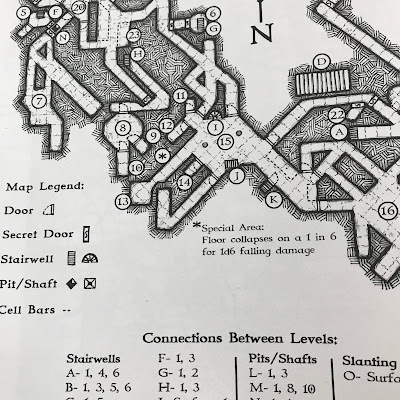
Tonisborg is "Jaquayed" Vertically: Each dungeon level feels like a bunch of "Y" shaped sections connect together at their southern arm and at that cluster there is usually a large room. So, when you proceed down one arm and explore it, you'd have to backtrack a fair bit to find a completely "fresh" arm. This is in contrast to the modern design philosophy which uses loops to discourage backtracking. However, what you do find in Tonisborg is the existence of many stairwells, climbable shafts, tunnels, and vents. So at the end of the northern arms of the "Y" are ways to go down or up. In fact, in further contrast to modern dungeon design, each level of Tonisborg contains on average of ~20 vertical connections between levels! Many spanning two floors, but about 1/3 spanning 4-5 floors.

Keying is Sparse: The book includes the original scans of not only the dungeon maps but also the keys that went with them. What jumps out is that each room description is just about one line: monster + treasure. This does not make for initially exciting setups, but the book outlines how to make these rooms more exciting. This makes Tonisborg more akin to Stonehell than other OSR medgadungeons. On the other hand, I think there is some wisdom to the one-line room key. It means the DM can get a megadungeon to the table fast which feels very similar to the advice given by Nick here on "The Two-Week Megadungeon". Too often I think we mistake good publishing advice for what is needed to get a game going, when in fact room + monster/trap/special + treasure (if any) is all that is needed to get going. The sparse key also reminds that reader that play at the table will bring a lot of energy to whatever is there.

Example of Level 10 keying

Room Size is Small But Unimportant?: Looking at the original map scans and monster placement, room dimensions are less important than distance. In several keys, at the end of long hallways are 10 x 10 rooms containing a dragon or 5+ headed hydra. This seems both pretty cramped for something that large and also pretty bland tactically. But something tells me, the rooms might actually be adjusted on the fly and the actual space is a bit more fluid. Distance is what matters because it affects movement and subsequent encounter checks which alters risk assessment by the players.

"Rules to Play With"

The final section of the book covers Zero Edition Dungeoneering (ZED) which for legal reasons is a copy of the play-test document of that game that would become the "OD&D" edition of Dungeons and Dragons. The rules here are extensive covering classes, mechanics, monsters, magic, treasure and dungeon stocking. We get a glimps into a D&D that could have been-- thief still absent. But a little warning that some of this might also be a house-rules influence too.  All my comments below will mainly come from a BX-heavy background with familiarity with OD&D and 2e AD&D. Let me try to hit some highlights:

Abilities: Characters are generated with 2d6+6, but like OD&D several of the bonuses for high values (15-16+) only range about +1 or 10%.

Classes: Halflings drown 90% of the time but have a +3 with bows/slings. Elves gain a forest direction sense and +1 to welding elvish-made weapons but only gain 1d3 HP per level. While dwarves take 1/2 damage from giant creatures.

Fighters have only a 85% chance of using a magic ring, cloak, or item correctly. Cleric can only keep 40% of money received and hording can cause level loss, but can use all weapons & armor. Magic-users can carry iron but it interferes with spell casting: 10% for a small objects, 75% for say chainmail.

Levels: It's interesting that it seems for all classes the XP needed to progress from levels 1-3 is reduced: Fighter 1>2 = 1000 XP, 2-3: 25000. Also, there is a point about level tiers: Veteran, Hero, Superhero, & Lord. These are more important designations because at Hero level you are able to resist fear & panic and the paralyzing aura of ghosts and ghouls. A PC is also considered "fantastic" and hirelings gain a +1 on all rolls when around said PC.

Combat: Two things here. First, the ZED rules allows a PC to make a number of attacks equal to their "fighting capability" against "mundane" opponents (those with < 4 HD). So a level 3 Fighter can make 3 attacks per round again mundane opponents in a 10' area. The similar leveled Cleric only gets 1 and Magic-Users get 2 interestingly.

Second, weapons are classified as long (2H sword or spear), medium (sword), short (dagger). When entering melee, whoever has the longer weapon gets to roll for the attack and damage first. Except in tight spaces like hallways of 10' or less or doorways, there the smaller weapon gets to roll attack and damage first. I think this is far easier than weapon speed and provides an easy demarcation like melee, ranged, and reach weapon designations provide.

Hirelings & Morale: Nothing earth-shattering here, but I like the strong emphasis on hirelings and morale and their role in play. This is a very important and often underused aspect of modern D&D.

1st Level MU Spells: I also find the composition of 1st Level MU spells lists interesting. For ZED edition they are: Charm Person, Dark Sight, Detect Magic, Hold Portal, Light/Darkness, Protection from Evil, Read Scripts, & Sleep. Very few offensive spells save for Charm Person, Light (blinding) and Sleep. But a lot of dungeon navigation.

REVIEW by QUESTIONS

How do you like the content? I like it a lot, again, because it is a complete package to understanding early play. Its interesting to me from a historical perspective as well as getting a hold on how D&D evolved. But given the effort and time that I feel would be required to make Tonisborg ready for play, I might run something else like Caverns of Thracia or Anomalous Subsurface Environment.

Is it something unique? Yes! Its context-dungeon-rules is only matched by the more recent Silent Titans which also includes the Into The ODD rules as well as a small how to play section. Another similar product is Super Blood Harvest, but even that product lacks discussion of the procedures of play. So Tonisborg really is a very unique product further enhanced by it fossilizes an important period of time-- the year right before D&D is officially published.

Do you like the old/new maps? Yup. Its important to be able to see exactly how dungeons were conceptualized back in 1973. Quite sparsely. But as I said above, there is wisdom here. I feel like the Blackmoor group understood getting something good enough onto the table for play is better than spending time and energy to make something perfect for publication. If we are worried about "plot", players will almost always provide a connection between two unrelated things.

Where does it fit in my gaming collection? Right now, right beside Playing at the World and The Elusive Shift, on top of The Secrets of Blackmoor. However, the book I think does give very good information on how to DM. I think it illustrates how to create a mysterious and engaging mood for the players while keeping to the forefront the game is supposed to be fair and fun. Two other situations: (1) A convention game to provide a unique experience that most people would not otherwise run at their FLAGs or at home; (2)  I would like to grab a group of 3-4 folks roll up characters by the rules in the back and run through the first couple of levels. Again to get a feel and appreciation for the genesis of the hobby.

CLASSICALLY CRAWLING DUNGEONS: More links for good dungeon crawling


Spring Cleaning: Look at Each Room From a New Angle—You'll Find ...
MC ESCHER

Matt Colville posted on Twitter recently that this generation of 5e players doesn't have a good sense of what a dungeon crawl is versus just adventuring in a dungeon. I certainly think large dungeons or mega-dungeons (tent pole dungeons) can provide a continual and exciting locus of play. This has certainly been replicated in very popular videogames like Darkest Dungeon, Dead Cells, & Hades.

But the information and practice of this form of D&D has been very scant in recent years in mainstream D&D thought. Here are some links to nice articles about megadungeons:

Gus L alludes to them in a conversation about how what "classic" D&D play is and the issues of fitting it to contemporary time/life allotments. Even bored teenagers these days don't have the time they did in the 80's.

Wendell works to break down a 179 room dungeon of Dyson Logos and stock it using the Holmes Basic Edition of D&D. It's a fascinating process and really helps demonstrate how good those tools are and how to infuse "life" into a large dungeon.

Wayne R tells you why you should do the whole thing in the first place

And if you liked all those, then Ava was nice enough to link a whole bunch here at her blog. Also, this blog has a mini-post about megadungeons.

THE CRYPT OF THE ST. NEMO the SLEEPER: Super Cleric Bros. Session 6 & A Maybe Dreamer Class


Return to the "super cleric bros. campaign", we left the PC standing in a hallway by the statue of the St. of Sleep (previous session here). And a riddle: 

I sleep behind the sun, setting west ❧ Three guardians east, stand eternal, at my behest ❧ Craving power, these usurpers have bellies distended ❧ They will have no sleep, no rest, & hunger unended

DM NOTE: I was a little worried about this puzzle taking too long being too obscure. I thought it would be good to include demarcations of location and threat. Also, I think puzzles are difficult because I always conceive them at first as something that has to be difficult instead of just something that should spice up play for ~30-1 min.

The PCs first walked west first to discover a bunch of crypts devoted to monks of the past. I had them roll d100 on a table of 100 useful items each representing something the monk was associated with, yielding: pot of glue, pot of alchemical lubricant, dwarven stone drill, diver's suit, and plague doctor's mask (Zyanese). Floating Disk once again comes in handy from their Follower Lunell to load up and carry all the stuff.

DM NOTE: Surprising/unsurprising non-damage combat spells really do amazing work, but only in situations that press movement, resources, and encumbrance. I need to remind myself to create those choices.

Two waves of ghouls are fended off with Turn Undead Rolls. I decided for some reason that all my ghouls should rythm which my players had fun responding like-wise. They ended up back at the staircase they can down the level in. The party moves back east then north once that happens they realize there are three crypts on the right (east) which contain some sorta ghoul-like creatures (pale blue glow to the eyes and blue-grey skin)

Turning left (west) they then realize there are two crypt to the right each with a sun motif. They try the one with the noon sun- no secret door, but a coffer box. Br. Cadfael opens it and receives a poisoning (1 hp; body feels heavy/sleepy roll initiative separately and at a -1) plus several 1000s of coins which they throw on the floating disk.

Moving forward to the second Eastern crypt, they find no coffer, but a setting sun, and when touched a faded blue outline of a moon forms and that's when the 3 guardians made their move. Br. Phelius attempts to turn undead but to no avail. These are not typical- their unlife is born more out of divine punishment.

Br. Cadfael orders the two wizards to the back ranks and barks for Fw. Gersia to fire Magic Missle which hits the first guardian for 6 dmg dropping them instantly!

DM NOTE: But yes, combat magic still in important.

In the resulting series of melee exchanges, Br. Phelius is brought to 1 hp. However, the clerics retain initiative allowing Phelius to retreat and Cadfael to step up in the melee. The cramped quarters serving to help create a bottle neck- along with the floating disk full of stuff. 

DM NOTE: A little annoyed with myself for not having done more prep to make this battle a little more set-piece. In the sense that just as I started with a small puzzle, PCs did some exploration, it would have been cool to end with some tactical combat

Cadfael has the favor of AZLN and avoids several melee exchanges with these guardians while Phelius heals for 6 hp and is able to re-enter the fray! But the cleric lose initiative, yet still, keep to their feet and both land killing blows against the guardians.

Once done, the clerics enter the tomb and recover the body of the St. of Sleep.

PROCEDURAL MODIFICATION as a RESULT of ACTIONS:

Here is the state of the Ossuary Pilgrimage Table or who will come to pray at the Abbey:

Ossuary Pilgram Table (roll 1d6)

1 | MU, St. Ulther
2 | Fighter, St. Ulther
3 | Cleric (zealot), St. Serene
4 | Fighter (adherent), St. Serene
5 | Elves, St. Sleep
6 | "Dreamers", St. Sleep

I might try to make Dreamers some sort of "thief" class. Improved move silently/hide in shadows. Maybe each adventure they can roll on a rumor-like table about their dreams which could be true or distorted (false). Or maybe they see an area like some sorta "treasure" map. Throw some sorta detect secret door as elf owing to a differential perception. Ooo maybe a dream journal, a spell book-like manual, that had random things the sleeper has recorded--- maybe occasionally Sleep, Darkness, and other illusion spells.

If the above table seems mixed up, that's the intent! Religions are weird and often have a mashed-up collection of saints and a lot of revision to make everything fit. I kinda want my players to be just as curious about their own religion-- "What to elves and lions have in common?". I also want to have a lot of gaps to make it wyrd and a little unnerving. Just like the descriptions of Christian angels being all fire, brass wheels within wheels, and eyes.


PIOUS HANDS MAKE FOR GOOD KNUCKLE BONES: Super Cleric Bros. Session 5


A return to the cleric campaign! Previous sessions here.

Try to add DM Notes like this.

The current state of the Ossuary. Each result is the mechanical class (in-game fiction/flavor):

Ossuary Pilgram Table (roll 1d6)
1 | MU (magicians), St. Ulther
2 | Fighter (sailors), St. Ulther
3 | Fighter (fanatics), St. Serene
4 | Cleric (zealots), St. Serene
5 | none
6 | none

DM Notes: So when I rolled 3d6, I got a 5,5,6 (3 actual weeks have passed since we last played) which means that no pilgrims show up to the abbey this time. And I roll 1d6 for each current pilgrim to see if anyone has left on a 1 or 2. None do.

As it stands two MU followers of St. Ulther remain at the abbey ready to embark on any adventure the PCs might have for them. 

I just generate the followers using the Old School Essentials NPC generator here (also good for characters). And Oblate Samuel shaken from the death of his friend Leo, is back to being somewhat normal.

Brother Cadfael from the Cadfael series one
of the clerics takes their name from (I need to watch it)

The clerics'
first decision is what spells they will pray for today. The Reliquary allows a little extra bonus when they pray to various portions of it provide they have placed recovered monks' items there. The portion they have powered allows them 1 save throw re-roll (The BENEFICENCE of AZLEN).

The second decision is to return once more to Dyson's Tower to retrieve a third saint for the Ossuary rounding it out, which will allow a lot of pilgrims, and very much in the Abbot's wishes, who they like.

DM Notes: Since IRL weeks had passed, I allowed the clerics to at least have a standard pack of starting supplies, so they made one last stop to rally both Follower Lunell and Gersia. And after a passioned plea, collected Oblate Samuel.

DM Notes: Also they accused the Prior of being an agent of Orcus. Since time has passed, gossip as spread. The Prior is not too happy. They want to get the hell out of town. 

At the Goblin Camp

The approach to the camp is pretty standard now, they prefer the entrance to the south in order to sneak past the goblin camp. The clerics' aim was to return to the 1st Level and perhaps recover one more saint they sure were buried in the area with St. Serene and Ulther. 

DM Note: Because this area is almost always the start, I think its just better to sorta procedurize it. The PCs just have to have one method of surpassing the goblins on watch and we just make one check. In the furture I might try to alter the weather or add a patrol-- just to switch it up so the PCs never have *perfect* information about what's going to happen. 

The trip back to this location except for a bizarre ankle-deep fog covering the ground. They scrounge the scene of their last battle and fine a set of chainmail and the door leading to hopefully the last saint. But it was not, instead it was a crypt full of skeletons seemingly dumped without proper rites and full of spite for the living. This time, my players remembered their clerics could turn undead and short work was made of these skeletons. With the use of holy water, they scrub the floor clean of the mark of Orcus.

DM Notes: Maybe should have made the skeletons a bit harder to turn since they were in the radius of a mark of Orcus, but whatever. The PCs felt the threat.

Level 2

This level too is familiar ground to the PCs. They decide to bust up a goblin dice game in an attempt to find some information about the location of human saints. Brother Phellius offers up his newly won chain mail and dices against the goblins-- winning. The clerics learn another goblin, Snakesplitter, is being held on some charge and maybe the PCs could take them off the goblins' hands since no-one likes him. They were also warned to watch their back.

After leaving, the PCs asked Follower Lunell to Hold Portal the door.

DM Notes: I need a better quick dice game for D&D other than roll 2d6 who gets the highest. I bet Nate Treme has one.

A turn later they find the hastily assembled baracade Snakesplitter is barracaded in, but the four goblin guard want 100 coin as a "transfer fee". The clerics, being pious men rich in virture, are broke. So Redcap offers to make some new gambling dice out of their knucklebones. A fight begins and ends in the third round when Redcap is beaten by a Brother Cadfael's mace and moral breaks. The remain goblins just make new gambling dice out of his knucklebones.

Snakesplitter offers to come with them simply for beating Redcap to death. And gives them sass about first trying to convert him to being a monk.

Level 3

Snakesplitter leads them down a different set of stairs to Level 3 than before. But before realizing what is happening they are suprised by an ambush/gang/thieves guild of robber flies! Snakesplitter avoids the on slaught as does Follower Gersia, but Follower Lunell, Brother Cadfael, and Brother Pheallius are on the defensive taking hits each. But its poor Oblate Samuel that met his fate-- natural 20 and 5 on the damage roll. Robber fly basically ripped his arm off.

DM Notes: This encounter suprised me with how brutal it was. Also, I think I need to have some standard layouts ready for battle. I really like having tactile set up with objectives and "terrain". But maybe since I have 2 players, I should just got more free form.

DM Notes: Also this is the 2nd Oblate who died. They are supposed to be wards of the Abbey, so someone might come looking for them-- 1:6 they were connected to someone at Stronglaw Keep. 

After a few Cure Light Wounds, Snakeplitter showed the clerics a clue to what they came for-- a statue of the Saint of Sleep.

And because the DM, me, forgot the sheet with the riddle and we were at our 2 hour limit, that was game for the night!

DM Notes: If you get anything from this, then I hope its the idea that a good game of D&D can be done in 2 hours. Not need to pull out 6, 8, or 10 hour sessions. It just requires density of choice to be high. And that is what is nice about this "mini-megadungeon" format.