Showing posts with label equipment. Show all posts

PRACTICAL MAGIC II: Or A Magic-User's Tools of the Trade

Ben L. of Ultan's Door fame took the starting spellbooks idea and really did a good job with them! 

The pairs of 1st level spells are well done and I'm a big fan of the inclusion of 2nd level spells to entice advancement. Wonderfully included is a description of the original book, what other knowledge might be learned from it (!), and a description of lesser copies. No specific mechanics are given for learning from the tome which is great! This gives the PC and DM something to negotiate over and encourages more free-form play.

The other reason I think starting spell books are a good idea is because by OSE/BX rules RAW,  the DM is supposed to provide the starting spells for a MU. And, BX MUs only can have in their spellbooks as many spells as they can cast (i.e. as many as they have spell slots).

I am sure no one follows this, but an upside is that spells can be better matched to remove "dud" combinations from random rolling and/or pair them more tightly the adventure, setting, or world. Some of this is reflected in the 1e AD&D DMG where Gygax suggests that starting MUs roll once on an offensive, defensive, and utility magic spell table to compose their first spellbook.

Another layer that might be fun is to provide a few pieces of equipment that a student of said book might use in their research, investigations, rituals, and practices. As such here is how I want to fold Ben's work in to my next campaign:

All MUs start with: Dagger (1d4), Hooded Cloak, Quill, Ink, & Paper (5 sheets)
Roll 1d6 for a lesser copy of:

1. Beyond the Convex Mirror: (1) Light, Ventriloquism; (2) Mirror Image
Equipment: Mirror, Lantern

2. Enchantments of the Twilight Court: (1) Charm Person, Detect Magic; (2) Phantasmal Force
Equipment: Wolfsbane, Wineskin (full)

3. Geometry of Unseen Potencies: (1) Hold Portal, Floating Disc; (2) Levitate
Equipment: Plumb bob + 20' cord, T-Level

4. Saffroy’s Principles of Arcane Dueling: (1) Magic Missle, Shield; (2) Web
Equipment: Torches (3)***, Silver Dagger (1d4)**

5. Lesser Emanations of the Archduke: (1) Sleep, Protection from Evil; (2) Invisibility
Equipment: Bag of Chalk, Hourglass**

6. Inner Illuminations of the First Organ: (1) Detect Magic; Darkness* (2) ESP
Equipment: Candles (10), Compass**

* One minor adjustment made here by using the reverse of Light, Darkness. I believe it still fits the theme as Detect Magic and ESP provided "sight" without light.
** As these would be expensive items, I might say these MUs start with (2d6*100) coin
*** Worth remembering that torches do 1d4 damage (fire); but maybe are extinguished on max dmg. or only after 2 hits like burning oil is after two rounds.

IT'S DANGEROUS TO GO ALONE! TAKE THIS: ... for 100 Coin.


I'd love to write a piece comparing the NES Zelda to 80's D&D

I am often thinking about low-level D&D games because those are the ones I play the most. And I am often trying to understand what can be done at levels 1-3 to increase the potential for survivability and nurture interest in the explored space. 

But I would like to do this while still challenging the players to ferry randomly-generated PCs through the early vulnerable levels without resorting to either the Gygaxian method of starting players at level 3 or the current 5e method of increasing stat bonuses, offering maximized HP/increased HD, and reducing early XP requirements to low levels (e.g. the accumulated XP for a 3rd level fighter in 5e vs BX is 1200 vs 6000).

One way to accomplish this providing tools, used broadly, at 1st level. Now, while I could just offer potions, scrolls, and hirelings in randomly rolled starting equipment packages, I do like to try and maximize choice for the players.  I think this is an important aspect at the beginning of dungeons because it builds group cohesion and encourages questions, so why not make it a part of the standard you-meet-at-an-inn scene?

Additionally, with 4 to 6 players, there is often excess coin which in some ways blunts the initial dungeon crawl session. Why should players get excited about 200 coins pulled out of a dungeon when they have 100+ coins sitting in their pockets?

So, after equipment is selected, for every 100 coins spent, the players may purchase one of the items below (by rolling 1d8 on the list) from various NPCs in the town or bar or the DM could prepare a curated list of one from each.

Example (using a silver standard): Red, Fish, Fetch, and Mayfly have a total of 460 silver. After equipping themselves with weapons, leather armor, special equipment, and dungeon tools they have 120 silver left.

The DM has chosen to pre-roll one time on each of the tables below generating this availability:

  • Potion-Gaseous Form, sold by the local alchemist
  • Scroll-Floating Disc, sold by a woman known for her card tricks
  • Treasure map- detailing the first 2-3 rooms of the dungeon, sold by a sage
  • Follower- an orphan with quick hands (lock picker) wants to join them (ward fees paid to the local sheriff)
The players now discuss and chose what they think might serve them best. The interaction itself could also be a way to introduce NPCs and provide some details/lore without an info dump.
  • Potion- PC: Can we get more of this from you? NPC: Maybe with the right material, but the lord would prefer I work on turning lead into gold.
  • Scroll- PC: Are you a wizard? NPC: More a diviner of fortune, for 50 coins I can tell you what the stars sing.
  • Treasure map- PC: Why don't you use it? NPC: I'm rather caught up in my own research and just needed extra funding. But I do have a topic you could help me with since you are going in that tomb.
  • Follower- PC: Kinda suspicious you just want to follow us. NPC Follower: Look I have few prospects at the orphanage and I seek revenge on Lord Blackblade. Also, I refuse to be a farmer.
-o0o- The Tables -o0o-

Potions: This list is from the Basic Rules book of BX D&D. I think the list is pretty solid and potions are very general-purpose given they can be consumed by anyone in the party.

  1. Diminution
  2. ESP
  3. Gaseous Form
  4. Growth
  5. Healing
  6. Invisibility
  7. Levitation
  8. Poison

Scrolls: Restricted to MUs, but really helps give them a bit of a jumpstart. Now I usually let my MUs start with 2 spells, plus Read Magic, so maybe this list might be better with a few level 2 spells on it. This list creates an interesting additional decision, especially with level 2 spells on it: hold the scroll to copy it or use it?

  1. Charm Person
  2. Detect Magic
  3. Floating Disc
  4. Hold Portal
  5. Protection from Evil
  6. Shield
  7. Sleep
  8. Ventriloquism

Treasure Maps: In modern play, treasure maps don't get enough love. But they are a great way to tell the players what exactly is in the dungeon, yet still, make it interesting by leaving out crucial information. Maybe you can also start the players with pieces of the map and this would be an additional part.s

  1. A general outline of the dungeon- omits enemy placement
  2. A general outline of the dungeon- omits noted treasure placement
  3. Map of how a part of the dungeon was, but not how it is now
  4. Map displays "enemy" force that no longer exists at all
  5. A well-mapped portion of the dungeon, but omits trap(s)
  6. Map of 1 or 2 secret doors, but not what's behind them
  7. Map of a secret room but not the hidden door that leads to it nor its general location
  8. A very detailed map of a collection of 2-3 rooms

Followers: These folks are like level 0 super-fans of the PCs for some reason. In keeping with the above theme of "utility", each follower fulfills a basic dungeon action or has some demi-human-like ability. But they almost certainly will not fight except to defend themselves and while loyalty is high (score 16) it can be lowered.

  1. Woodsman: Open doors on a 3:6
  2. Scout: Suprise now 1:6
  3. Lockpick: Pick Locks 2:6
  4. Sapper: Find (2:6) & disable room traps (3:6)
  5. Lamplighter: Lantern on pole, torches the ready, even in adverse conditions
  6. Sprite: Find secrets 2:6; bored always needs to see "action"
  7. Mountaineer: Climb as a 1st-level thief; good ropes/spikes
  8. Linguist: Knows 3 non-Common languages (one lawful, neutral, chaotic; or all 3 law/chaotic)
A more flavorful take can be found below. These followers have a bit more going on in terms of personality but still fill a utility role.

  1. Boar-rior: Pig-headed 1st level fighter, 2H weapons aren't slow, gluttonous (2x rations) 
  2. Candle keeper: Very good with light, constantly sets candles out, afraid of the dark
  3. Curious corvid: Smart bird that is quick to burgle small shiny objects 2:6, slow to relinquish
  4. Doc: Good at mending, but not much; else always longed to be a soldier
  5. Street rat: Could be actual wererat, 2:6 to pick-locks; might steal the 2nd best prize of the chest
  6. Charlatan: Can easily entertain with card tricks, knows 1 actual spell, arrogant
  7. Dungeon hipster: Can determine the safety of strange liquids (poison vs. other vs. IPA), but might accidentally drink all of a given potion (1:6) 
  8. Corridor cowboy: Ain't a monster that can't be rode or a rider that can't be throw'd, really good with a 50' rope, will attempt to lasso, and ride most monsters of pony-size or greater (2:6)
ADDITION: Great post here by Prismatic Wastes on group-decided leveling which might be good for working with followers. OR maybe allows players to upgrade these lists or part of them. But I'd be wary to going too high (say to Level 3 spells).

PSYCHOLOGICAL WEIGHT IN SLOT-BASED ENCUMBRANCE: The burden of magic & sin

WHAT IS BURDEN?
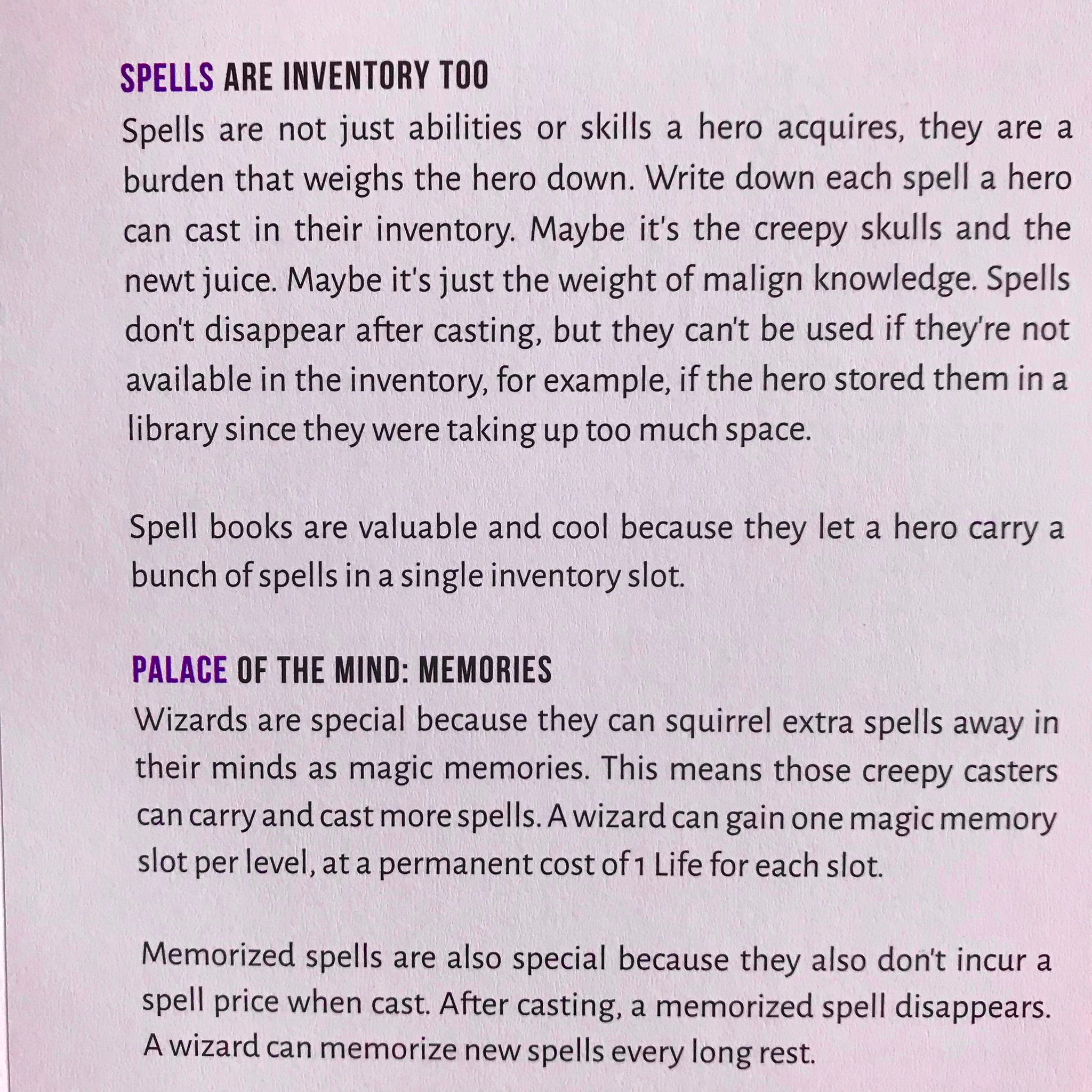
Ultra Violet Grasslands (now ENnie nominated!) by Luka Rejac is a wonderful book that distracts you so much with beautiful evokative art that you might miss some of the awesome rules tucked away in there. One of my favorites is below: SPELLS ARE INVENTORY TOO

Image

A character in UVG can carry about 10 significant items. So spells can take up slots just like any other item, tool, or weapon. Spells carry a psychic weight which encumbers the character. And this makes sense in my experience. One can be so occupied with a problem that it literally weighs you down. But riffing on that, why stop at magic? 

Magic items could also take up extra encumbrance due to the psychological weight of carrying them despite their size- like Frodo and the Ring at the end of LotR. Elric's Stormbringer might be another. A good candidate might be the Deck of Many Things- just a deck of cards, but the weight of its potential fate-changing power is great.

More mundane items could do the same thing. For instance, if your PC is carrying the decapitated head of a ruler. A head might take up 1 slot, but the psychological weight could make it greater. Extending this further, what about sins or breaking of oaths? 

Every time the PC sins or goes against some aspect of their background, oath, or pledge- they have slots taken up. It's an additional tangible way the player can understand and experience their choice without resorting to taking negatives on to-hit and skill rolls.

This I think is quite interesting.

EDIT: Also would be good for "obligations" the PCs might pick up. Non-trivial things they know they should do but aren't getting around to doing. This might be particularly useful in a hex crawl.

EDIT2: Could also be used for curses like lycanthropy or ghoulification. Each aspect of the curse would be listed as its own set of 1-3 slots. Again representing the burden of the knowlege the PC carries about thier inner desires.

SO HOW DO YOU GET RID OF BURDEN?
Well, if you can't get rid of it you can make it smaller via compartmentalization. Options include:
  • Complete your obligation (removal)
  • Seek holy intervention to pardon your guilt (removal)
  • Undertake a quest (removal)
  • Wear an object or talisman or keepsake (compress from X slots to 1 slot) but NPCs know your sin
  • Give in to the desire or curse (compresses from X slots to 1 slot) but DM controls your actions
SUMMARY- I think I really like this idea. It is a way to add player choice in how PCs manifest and deal with psychological guilt/curses/desires/transgressions/sin etc. It promotes its exploration without putting it at the center of the game. And it has a real meaningful (but not intrusive) game impact.

BACKGROUNDS IN CARCOSA

Great post from Hmmm Marquis on backgrounds, starting equipment, and goals for characters in a wasteland, Carcosa, Black Sun, or Synthexia campaign/hexcrawl. I might be tempted to change the d20 to a d30 table and add more overtly strange techno-stuff to make it more Carcosian.