NIGHTWICK ABBEY: The Purple Eater of People, Session 21


Previously in Nightwick...

Corfu (Dwarf 1)
Mayfly (Magic-user 2.5)

Ianthi (Changling 1)
Grant (Fighter 1)
Sotar (Cleric 2)
Brother Bréagadóir (Cleric 1)

In a swamp somewhere...

On the 30th of Leftember one day before the 1st of Quentember which is the Feast Day of St. Richard the Pryre, the party sets out ahead of the angel Malibek & the pilgrims. The angel knows the shrine is not a tomb, it's lost, and most likely on the heath. So, with a horn, to summon the angel, the party sets off.


THE WITCH: Traveling south the party stumbled upon a stooped figure picking flowers. The party dives behind a collection of rocks and shrubs, but not before the figure becomes aware of them. Now drawing itself to full height, the party can see there are also vulture-like aspects to this figure.

Brother Bréagadóir  steps out and says, "HelllloooooOOoo!" After a brief exchange of pleasantries, the witch agrees to give information in exchange for something and proceeds to drift over to the party in an open coffin containing her mother's corpse. The witch proposes a kiss first. Brother Bréagadóir declines on the account of the chivalric code. The witch then proposes he hand over his "lance". Brother Bréagadóir declines again citing that without his "lace", he could not then resist using it, which is a key element to his faith. The witch mulls that over and says, "Hmmm well that makes sense." And leaves with one parting bit:

"The shrine you seek is North, a man with fire for eyes will be there, and when you see him, tell him Goodie Gallows sent you!"

THE CASTLE: A a brief discussion, the party decides that it's best not to follow the mostly unpaid for advice of a witch. Because such advice is most likely a lie. The party turns further south. In the distance, as the sun drops low, the party sees a set of ruins. Mayfly feels this would be a great place to rest (maybe loot), while Sotar feels the exact opposite. The party reaches the ruins by nightfall. They light up torches and try to poke around the ruined keep.

Eventually, this was met with opposition. Heads seemingly covered in flesh masks popped up from the ruined keep's crenulation. Arrows fired from the top, spearing Ianthi! The party rushes to grab her and pull her out of range. A forced camp is made and bandages applied.

THE HUNTSMEN: In the morning the party moves southwest and encounters three bizarre things. The first is a large boar seemingly triumphant among a group of large crushed spiders. The second is a collection of 11 wolf skins seemingly devoid of anything inside as if the wolf in the skin just left it. The third is then meeting 11 men, dressed comically in peasant dress as if from a play, hunting a large boar.

The party, wary of their number, keeps their distance but directs the group of 11 to the location of the boar. 

THE SHRINE: With the light quickly fading the party chooses one last direction. Cresting the top of a low hill, the party sees a twisted tree wrapped around the statue of St. Richard! "Blow the horn!"

And at the cessation of the heavenly bellow, the angel appears in all its geometric glory. The shining three-sided representation of Law itself, bereft of its human skin, fires a searing light toward the twisted tree. Searing it to ashes, the angel then disappears!

There was much rejoicing. But with very little food because no one really packed for a party.

...and no gold.

To solve this problem, Brother Bréagadóir suggests that the party sell the location of the formerly lost shrine to the Bishop of Lychgate. Brilliant!


03 TOMB WITH EIGHT SKELETONS: Layering For Dynamic Encounters

A dynamic encounter for sure

It is entirely possible by playing D&D for any amount of time you have encountered or have written some variation of the following:

03. TOMB (80 x 80): Eight skeletons guard their former captain's tomb; will attack PCs who enter. Captain wears gold circlet (300 GP).

8 Skeletons AC 12 HD 1 (4hp) 1x weapon (1d6 or by weapon) MV 20, ML 12

This is pretty much the monster + treasure result from BX D&D and a serviceable one at that. You pretty much are picturing a room with a single tomb in the center and eight skeletons lined up along the walls. 

LAYER ZERO: You don't always need the latest monster book, you can easily layer additional simple elements to create novelty

Or monster tome, or 3-ring binder enchiridion, or monster cards. There is power in the familiar. It can be leaned on for shorthand in non-critical situations. And it provides players with the enjoyment of recognition in either a nostalgic or anticipatory sense: "Ha! I bet those skeletons will attack us just like in the GT1: Stone Grey Halls of Grog's Tomb" or "Ha! I've always wanted to fight skeletons in stone gray halls!". But too much of the familiar and D&D loses some of its spark, especially if you are pursuing an exploration-centered classical style of game.

Instead, for my own games, I have been trying to focus on layering simple ~1-2 sentence additions using other common, easily understood elements of the game to create novelty. The shortlist of layering:

  1. Unique Description
  2. Weapon Mix
  3. Stretching, but not changing, the stat block
  4. Terrain
  5. Objectives

LAYER ONE: Unique Description

Presenting the tried and true in a new light can make the mundane novel.  For instance, if you wanted to startle your players, you could have 7 of the skeletons kneeling in prayer to a central seated figure. This brings our 8 skeletons to something like this:

03. TOMB (80 x 80): Seven skeletons kneel in prayer around their former captain (skeleton on a throne, circlet, center); the seven skeletons will attack PCs who enter the room.
Monster: Skeletons AC 12 HD 1 (4hp) 1x weapon (1d6 or by weapon) MV 20, ML 12 
Treasure: circlet (300 GP, opal in center 200 GP)

This setup tells a small story and begs some questions. Who were these folks? What is the relationship? Is the kneeling an expression of subjection or reverence? Player table-talk might generate some new adventure seed for you.

However, this is not going to be a dynamic combat situation. The room described above is pretty much a "white room" with little in the way of terrain or enemy variety. A singular room is okay, but if too many rooms occur like this it encourages players to just adopt a singular strategy of heaviest armor, high damage weapons, and damage-only spells. And it gets boring and that is not okay. 

LAYER TWO: "Weapons" mix

One of the simplest ways to create variety is to just change up the methods of attack. This is pretty well covered here, but you don't even have to be that complex about it. Let us give a mix of bows and axes to our skeletons: range and melee, both still 1d6. And maybe one of those ax-welding skeletons has a two-handed sword and some rusted plate:

03. TOMB (80 x 80): 7 skeletons kneel in prayer around their former captain (skeleton on a throne, circlet, center); the seven skeletons will attack PCs who enter the room.
Monster: Skeletons AC 12 HD 1 (4hp) 1x weapon (3 x axe, 1 x 2H-sword, 3 x short bow) MV 20, ML 12; skeleton with 2H-sword has AC 13
Treasure: circlet (300 GP, opal in center 200 GP)

LAYER THREE: Stretching, but not changing, a stat block

Five out of our seven skeletons have swords. Still kind of same-same. So, what if we make the 2H-sword skeletons into something that will do the same amount of damage but be more interesting. We could change to a different monster, but, again, let's not alter the stat block too much.

How about "skeletal horses"? This is basically a superficial description change and we can use the BX charging rules as a method of attack (move 60' and a successful attack deals double the damage). We might also give these skeletons max HP, 8, as a way to denote their size instead of altering HD. And 8 hp is often an average 2 HD PC anyway.

To explain the horses, we are altering a simple tomb into something grander. Instead of a throne, how about the leader is in a chariot in front of a procession?

03. SKELETAL PROCESSION (80 x 80): 6 skeletons, heads bowed, stand eternally behind a  former captain (skeleton on a throne, circlet) seated in a rotting chariot pulled by a similar horsethe 6 skeletons & horse will attack PCs who enter the room.
Monster: Skeletons AC 12 HD 1 (4hp) 1x weapon (3 x axe, 3 x short bow) MV 20, ML 12; Skeletal Horse as skeleton, but 8 hp and will always charge on its attack (successful hit 2d6 dmg)
Treasure: circlet (300 GP, opal in center 200 GP)

However still two issues with this encounter. The first is that we still have a white room. So what can we add to give the room some terrain? And the second is that just because I have outfitted the encounter as more combat-oriented doesn't mean it has to go that way. So what can add to give these skeletons a reason to chat?

LAYER FOUR: Terrain

To solve the white room problem, let's place the captain and chariot on a dias that is 40 ft long, 20 ft. wide, and 5' tall in the center of the room. The 6 skeletons occupy about 20 ft. x 10 ft of space to the left of that. We can add four columns to the north and south around which amphorae can be placed if you want more coverage.

In my head this gives a king-of-the-hill object blocking the center line of sight blocked with columns to hide behind north and south. This should allow for tactical maneuvering around the room. Which can aid in escape, hiding, magical hijinks, or other such things. You can add this to the description, but most likely this information will be contained on a map of the room. 

The goal is to provide something else that can be acted on or used to solve whatever's in the room. You don't have to think of many pieces or anything original. Just something to keep the space from being wide open. If you look at a lot of skirmish games, you can see that rarely are things just a flat plane. The same should be applied to D&D.

Other alternatives could be things not even rated to what is in the room. But objects and "flora" added later: roots of a giant tree have found their way below; strange mushrooms cover the floor; waist-deep pool of rainwater has collected in one quarter or half of the room; a few 2-3 deep pits have opened up- one of which leads to the next dungeon level down.

LAYER FIVE: Objectives

This is coming last, but it is not the least. Is there a single sentence that could be added to this description that would allow some sort of discussion or bargaining to take place? Preferably, it would be something that provides a choice.

There are combat objectives, but I am thinking of something a little more tied to the world. And I also like tieing these sorts of things to character class, god, background, or place of origin if you have it. The Nightwick Abbey game I play does this very effectively.

Since this is an example and not tied to a specific dungeon, I'll just keep it general. Maybe some of the answers to the below questions can be found in earlier parts of the dungeon or in alternate side rooms. Some basic things the captain could ask are:

  • Are you a descendant of X?
  • Do you pledge loyalty to Y?
  • Have you come to give an offering?
  • Do you serve the god Z?
  • Who do you count among your foes?
If the party sufficiently answers then the skeletons leave them be and attack if they do not.

SUMMARY

I guess depending on your view of dungeon crawling or what your purpose is will tell you how you view the following as an improvement. But we have gone from this:

03. TOMB (80 x 80): Eight skeletons guard their former captain's tomb; will attack PCs who enter. Captain wears gold circlet (300 GP).

8 Skeletons AC 12 HD 1 (4hp) 1x weapon (1d6 or by weapon) MV 20, ML 12

To something meatier, yet still is a rather terse text block:

03. SKELETAL PROCESSION (80 x 80): 6 skeletons, heads bowed, stand eternally behind a  former captain (skeleton on a throne, circlet) seated in a rotting chariot pulled by a similar horse (on a large dias); the captain will ask "Who do you count among your foes?" If the PCs answer "The Serpents of Norr", they they will not attack. 
Monster: Skeletons AC 12 HD 1 (4hp) 1x weapon (3 x axe, 3 x short bow) MV 20, ML 12; Skeletal Horse as skeleton, but HP 8 & MV 30 and will always charge as its attack (successful hit 2d6 dmg)
Treasure: circlet (300 GP, opal in center 200 GP)

My final point is that for this example I used each layer, but you don't have to do that for each room. Each layer by itself could be a room of its own that thematically culminates into a room with all 5 layers. One advantage to this is you can introduce patterns to players bit-by-bit and then put them all together for a rather showy set piece or dungeon anchor.

NIGHTWICK ABBEY: The Purple Eater of People, Session 20


In Nightwick previously...

The Party

Corfu (Dwarf 1)
Mayfly (Magic-user 2.5)

Ianthi (Changling 1)
Grant (Fighter 1)
Sotar (Cleric 2)

At the Winsome Winch...

Recovering from a rainy midnight awaking and, for some, loss of arcane knowledge by giving birth (of sorts), the party scouts around the Hamlet of Vollage for rumors about the frogling bandit.

Ianthi strikes up a conversation with the bandit Benusch who has worked for the frog in question, knows his location, and drops that there are other bandit groups in the area who'd like to take the frogs down.

PIXIE MONGERS: Thanking the man for that information, the group decides to stick with the plan and investigate the ruined tower in this village. As they make their way there, the group runs across three local men selling "saint's bones". These turn out to be more fairie bones as Mayfly immediately identifies with a couple of dry heaves. A discussion ensues on the true power of said bones, how locally and humanely sourced they are, and why the men themselves weren't wearing them.

THE FALSE LEAPER:  After arriving at the White Tower the party notices a group of leapers one of which seems suspeciously less afficted than the others. Ianthi learns, after striking up a conversation, his name is Jesko and he is trying to raise money to undertake a pilgramiage to a supposed lost shrine of St. Richard the Pryre. A lost shrine seems intresting to the party for the chance to maybe look over its contents before the rest of the pilgrims arrive.

THE FALSE PERSON: Off through the northern swamp the party goes. The first thing that raises some eyebrows is that Mayfly spots four stone deer legs sticking up in the swamp. Closer inspection reveals they were no trick of light or weird roots, but in fact petrified deer legs. The most likly culprite are-- basilisks. 

Fortunately by mid-day, the party is drawn to a small camp by the sounding of a large bell and is greeted by a small group pilgrims. Collectively, the group pushes Sotar to the front being a cleric and all. After some back and forth, the source of the bell makes it self known. 

A peculier bald person steps to the front. Its as if they are something else pretending to be human--close, but not enough to bridge the uncanny valley. Once this person opens their mouth a voice like a bell (!) anounces they are "The Master" of these pilgrams (!!)-- the angel (!!!) Malibek- a tertapheme.

This is an interesting moment for Mayfly because the non-clerical thinking of the whole matter is that the angels might be more beings who have constructed the idea of the God of Law for their own purposes. But that's not something Mayfly will say out loud too much.

AN AGREEMENT: Malibek, too, is looking for the Shrine of St. Richard however doesn't really know where it is (this makes Mayfly suspecious). But the party fully committing to a course of action aggress to scout ahead for the shrine while Malibek protects his flock from the horrors of the swamp. And provides and Angelic horn to blow once the shrine is found.

...the sun sets.


GRENDEL MENDEL II: An Applied Example of Punnett Squares For Monster Design

Good enemy design, enviornmental complications,
& NPC goals make for good fights

Here is a practical application of my Punnett Squares For Monster Design idea.

In a few posts I have alluded to trying to design a dungeon called The Black Keep. The first level of that dungeon is a classic ruined moat-house-turned-bandit-camp. So there is a lot of opportunity for bandits to appear and and a lot of opportunities make them a bit better than the standard stat block below:

Bandit: AC 13, HD 1, 1 x weapon (1d6), MV 40, ML 8

Looking back at the Punnet Square post we have four categories again: melee x damage, melee x special, ranged x damage, ranged x special

Right off the bat I don't want to have to think about making groups bandits. I want to be able to roll 3-6 d8's for hit-points and go from there. How about hit points rolled determine the catagory on the Punnet Square?

Given that ranged enemies require extra effort for PCs to get to them and melee enemies need some extra HP to get to survive first contact, we can arrange things like so that "ranged" is the lower 50% of hit die and "melee" is the upper 50%. I like putting the "specials" on the end of the hit die, upper and lower 25%, allowing for a strong flavor in those catagories with them appearing too frequently.


Developing "mobs" and the "leader"

The Rot Hounds are people overtaxed, pushed off lands, and/or former rank-and-file military who have been screwed by nobility. They also have a supply of carnivorous frogs. So this can inform the square.

Rot Hounds Punnet Square 
Behavior: Can be bribed; capture magic-users for Henry

1-2 hp Ranged x Special: AC 10 Spear +Frogling 1x attack 
3-4 hp Ranged x Damage: AC 12 Short Bow & Dagger; will stay at range then run if able
5-6 hp Melee x Damage: AC 12 Sickles & Spears
7-8 hp Melee x Special: AC 14 Two-handed axe, +1 HD


The leader of this group is Henry Hounds-Head, a cursed former pikeman who blames the nobility for his ruin. Now robs the rich to build an army and seeks to undo the curse.

Like the Hounds, I tried to conceptualize around a known D&D monsters. For Henry Hounds-Head, I chose the beserker.

Beserker: AC 12, HD 1+1*, 1 x weapon (1d8), MV 40, ML 12;
Rage: +2 to-hit against humanoids

I was particularly drawn to the to-hit bonus as a way to express Henry's rage again the nobility. But we can make this leader a little more dynamic in both personality and behavior on the field. When creating a singular monster, I like to each cross as a reminder to include melee, range, and specials in a singular creatures. This is because they have to face off against generally a party of 4-6 PCs with some combination of melee, range, and magic and an HD total of 4-6!

Henry Hounds-Head
Behavior: Wants to recruit & will capture magic-users; hates nobility & connected to The Order

AC 14, HD 4, 1x as weapon, MV 40, ML 10

Melee x Damage: Two-handed Axe (1d8), not "slow"
Melee x Special:  On a "1" damage, weapon is stripped from PCs hands
Ranged x Damage: Spear (1d6)
Ranged x Special: On a miss of 11+, PC saves vs Paralysis or be knocked prone

RAGE: +2 to-hit against humanoids
KEEN SENSES: Animal-headed & suprised only on a 1-in-6
SOUND of BATTLE: 4 Bandits in the area after 1 round of battle

I chose 4 HD because by OD&D standards this confers "hero" status. I guess I could add some +X hp in order to keep him out of range of Sleep, but I am writing a 1st level adventure so maybe don't want to go too hard.

Related to the "hero" staus, I could either give Henry an additional attack per round or could even go so far has allowing a division of attacks equal to HD among non-hero targets. But I dunno, if I got that route he might be too tough.

WHAT DO YOU REPRESENT?: A Good Collection of OSR PC Miniatures

QUICK BASICS OF A GOOD MINIATURE

Just as there are differences in the OSR vs 5E aesthetic in terms of art and adventure design, the same is true for miniatures that represent PCs. This in part is due to the increase of cheap, but sturdy plastics which allow for very dynamic poses. These dynamic poses are great for singular display, but sometimes provide too much action when moving around exploring. PC miniatures for 5E are in a perpetual state of charging or a swirl of magical energy. This just cuts against my desire for a more classical feel. 

I have some other qualifications for miniatures. Monster miniatures are the best when they can represent a sorta range of monsters not just the one specified on lists on the box. Or PC miniatures that can represent a variety of classes. A hooded figure with a staff could be a magic-user, elf, or druid. A figure in helmet, full plate, and a sword could be a variety of class types from fighter to paladin, elf, and any mix of gender.

Basically, the most archetypical the miniature is, the more bang for your buck I think you can pull out of it. Because it just needs to be a good representation, not a perfect replication. This also prevents the miniature from interfering with your world-building and means you have to haul around fewer plastics. This last bit is especially important with terrain (hint: use aquarium plants from pet shops)

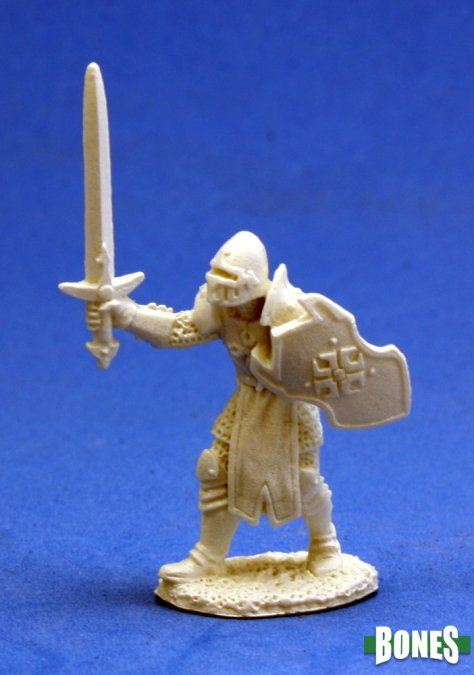
Human Fighter by Bobby Jackson

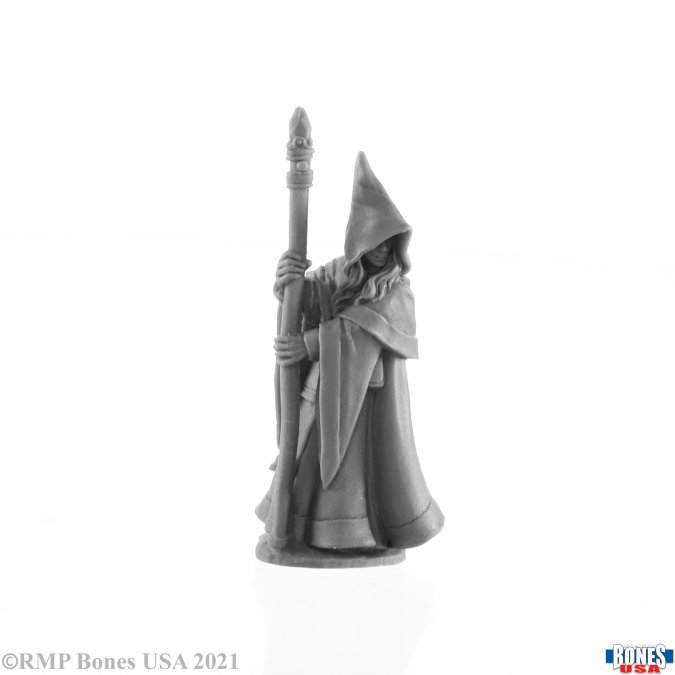
Elf Wizard by Bobby Jackson


BUT ARE THERE ANY REALLY GOOD OSR MINIATURES?

I think I've found some in the Henchmen & Hirelings pack, again, from Reaper Miniatures and by Bobby Jackson (see a trend). Which seem to sell for $40 for 13 miniatures or ~$3 each. But looks like shopping around you can get some cheaper. 

The first awesome thing about this set is that many of the characters are holding both a weapon and equipment! A couple of minis even have 10ft. poles.

The second thing is that despite this set being billed as mainly hirelings, these miniatures look like first or second-level characters. The equipment is not perfect and a lot of the characters seem to me to have vestiges of former (failed) professions. And there is enough variety that you can see that magic-users, thieves, and fighters are represented. True there is no strong cleric or demi-human character but its a good collection. This would also be perfect for DCC.

The third thing is that the expression on each character's face and their stance is more of a mix of wariness, fear, and uncertainty than heroic bravado. This, combined with their gear, gives the set a bit of a Black Adder feel which is kinda how I like to frame my games. Kinda like you're a former pig farmer in a fairy tale setting who is pretty sure this talking fish you just caught is trying to screw you over. But you really need the cash so you're gonna go along with the fish's stupid plan anyway. Maybe get a title out of it.


NIGHTWICK ABBEY: The Purple Eater of People, Session 19


Country Roads...corrected


Previously in Nightwick...

Corfu (Dwarf 1)

Mayfly (Magic-user 3)
Ianthi (Changling 1)
Grant (Fighter 1)
Sotar (Cleric 2)

At the Medusa's Head...

A bounty has gone out:

A daring frogling who calls himself Hoppin in the Hood has attacked several caravans with his band of happy frogs. The van Toad trading house has offered 150 knots (1500 SP) for his capture or proof of slaying.

The party is interested in this coin because being rich is second only to being alive as a preferred state in the Dark Country. Or maybe that is just Mayfly's feelings about the matter. Actually, Mayfly would prefer "power" over "riches".

Silver is tossed about by Ianthi and Sotar to gather information pertaining to this bachtrachian brigand. And they uncover the following rumors and tales:

"He's got a band of 30 happy frogs, but don't be fooled, he's a sadist and look my ear clean off!"

 "Given the where the attacks happen, I am sure he is based 'round the hamlett of Vollage"

And what does the party know about the hamlet of Vollage? Corfu knows a bit about the world and remembered that not long ago (by dwarf standards) a tower was being constructed by a knight of Lychgate but The White Lady, a powerful witch, attacked and burned it to the ground. Those who died inside became ghosts that haunt the ruins.  

(PC NOTE: Dwarves in Nightwick have a unique ability called There When the World Was Made which is a 2-in-6 chance to know lore about a place or events. Nice way to provide lore without a dump.)


HEXCRAWL TIME!

THE DECISION- FIGHT AN UNKNOWN NUMBER OF IMMORTALS or A KNOWN 30 MORTALS? The party figures that there is no way they are going to be able to take on 30 "happy frogs" with a penchant for ear removal. So, they decide to travel to the hamlet of Vollage to check out the ruins. Why not go "up" in a cursed tower instead of "down" in a cursed abbey for a change. So they hit the road.

THE SWINE HERDER...or SOMETHING ELSE?: About midday on the road, they run across a swine herder who offers up that rain is due soon and there will be no doubt strange things that await the party. That earned some side-eye, but Mayfly flips the herder a silver, just in case he was something in disguise.

THREE DISCARDED...SKINS?: The drizzle turns to rain as the party come upon three sets of clothing in the road. Grant makes a closer inspection and confirms they are in fact human skins, but removed as if clothing, and with such a deft execution the whole piece seems to be uncut or unruined by removal. Although a clear congealed mass and black hairs around the mouth confirm one thing...werewolves. 

Mayfly wanted to take the skins as leverage to use them again the frog bandit. Sotar commented that to apply that leverage, the party would have to come up with a way to make getting the skins more difficult f to get rather than straight-up murdering us. Point Sotar.

A ROADSIDE SHRINE with... SPRITE CRUCIFIXION? With the rain now a downpour and visibility nil, Mayfly casts ESP given the prior two ominous encounters. A 60' range, but better than being set upon by werewolves at 0' feet. Soon the party sees a small light bobbing up and down at an unknown distance. Drawing within the range of the spell, Mayfly is overcome with a strong sense of sadness. Will-o'-Wisp?

Imploring the party to stop, the group sees the light is in fact a sobbing sprite. The spite is floating in front of an obvious shrine to The Lady but adorned with two small sprite skeletons with tiny wooden halos (Sotar the cleric: That is f------d).

Mayfly asks what can be done to help. Bleed from the ESP maybe? The sprite perks up.

"Oh yes! You can eat them! I'll help you take the halos off!!"

Corfu speaks up, "I'll eat one"

"No! Not you" the sprite shouts, "nor you either" pointing at Ianthi. Clearly only those not of farie blood can consume the skeletons.

"Well first what is your name?", asks Mayfly

Amused the sprite replies: "I can't tell you that silly"

"Okay well, how about 'Raindrop'?"

The sprite repeats this over and over, until turning back to the questions of skeleton eating.

Hard "no" comes from Sotar and Grant, but Mayfly has heard stories about men gaining power through the consumption of magical beings and/or their organs. Any studying has been painfully slow. 

(PC NOTE: Also, Mayfly's WIS is 07 (-1) so impulsiveness and lack of patience is a trait)

"Sure, I'll do it." and Mayfly swallows the first skeleton goes down with surprising and disturbing ease.

(PC NOTE: Along with a failed save throw)

THE FIRST BARGAIN: Mayfly remembered tails of faerie bargains. Maybe not as powerful as those made with the infernal creatures of The Pit, but less likely to completely lose your soul.

"Now, since I did you a favor, I should get a favor in return. It is only fair," states Mayfly

"Ugh. Fine." Raindrop says with an eye-roll

A discussion follows that establishes (in the pouring rain) Raindrop knows who "Hoppin' Hood" is and where he lives. So Mayfly states the following: 

"Bring me the smallest thing he values the most."

"Done!" And Raindrop flies off.

(PC NOTE: Any people think old-school D&D is just grey corridors and hack & slash. Here we have a prime example of diplomacy and necrophagy. What's not to love! This was a great situation as a player. A creepy ask by an NPC combined with a drop of in-world knowledge about what could be an outcome: power. Already Mayfly has used soul-coins to gain a tutor, so why not eat a sprite skeleton? But this situation is another nice example of using IRL myths and stories about creatures to govern their in-game behavior. So, I chose to try and deal with this creature as a thing of myth not a "D&D monster on pg XX". Finally, the bargain we were able to make was also to help us with another problem- the frog bandits. So PCs, factions, verbal deals, and the mixing of IRL myth and in-game lore all smashes together. Perfect D&D cocktail.)

THE SECOND BARGAIN: The party makes it to the hamlet of Vollage, soaked through, but with dry silver. The local inn provides the party with plates of cooked cabbage and cooked eel- the majority go with the cooked eel. Not much is learned from the locals and the party decides to bunk down in the common room for the night along with to men-at-arms of the bishop (PC NOTE- sus).

One of these men-at-arms wakes the party up screaming... at Mayfly's glowing chest. Mayfly feels the glow moving up into his throat like an overactive glob of cabbage. Mayfly begins scrambling for wine, water, or anything to swallow this thing.

Adding to the panic and confusion, a small glow starts loudly rapping at the window so the party and a gagging Mayfly scramble out of the common room and into the storm. Two almost simultaneous things happen:

Mayfly hits the ground and coughs up... another faerie while feeling all the new magic he's learned recently drain from him!

Raindrop then informs the party of what "smallest and most valuable thing" has been taken... Hoppin Hood's remaining eye!

"You owe me!" Mayfly horsely barks at the new faerie. "I gave you life by my own essence and you owe me an equal favor in return! The eye was *just* for eating the skeleton."

"Ugh" the new sprite said with a stamp of a tiny foot.

It was discussed that the favor was to be determined later. The new sprite, named by Mayfly for the spell now lost to him- Espy, handed over a small flute made from her own rib. Then Raindrop tries once more.

"Okay who wants to eat the other skeleton?!"

...End Scene

(PC NOTE: What happened when the faerie was coughed up? Level drain
Yes, that feared and hated, in equal amounts, old school mechanic of the undead. Did I feel "cheated", naw. I could have chosen Mayfly to not have eaten the skeleton in the first place. Then, I could have said my character was gonna do everything to keep this high-in-calcium snack down. Instead, I chose to have Mayfly cough it up like a hairball because he was in the presence of the faerie who held its end of the bargain. Might be bad to double-cross a being who could be useful. Also, I thought level drain was really well employed in the moment by a creature not normally known for that sorta thing. It was a very interesting, entertaining session and what drove that-- educated risk-taking and "endangering" the PC. And despite being level-drained, I feel like my character still has gained a lot through this set of actions-- the character is building strong in-game history through action.
)

NIGHTWICK ABBEY: The Purple Eater of People, Session 18


After weeks of study, Mayfly returns to these hell-haunted halls...


Previously on Nightwick...

Cherwe (Cleric 1)
Sotar (Cleric 2)
Corfu (Dwarf 1)
Mayfly (Magic-User 2)
Ianthi (Changling 1)
Jek (Fighter 1)

Hirelings: Tieze, Cunrat, Bartel, Mach, Assmus, Pawel, Grolmus, Manhardus

AT THE MEDUSA'S HEAD...

Mayfly walked into the bar sporting two new silver daggers with deerman antler handles. 
(PC NOTE: Adornment X SP = 1/2 XP up to 200 SP/week; but just 50 XP shy of Mayfly leveling so have to delve at MU 2)
The group decides that they want to explore the West Tower again given the previous success in engaging deermen. Plus, most of the party wanted to take a second crack at the screaming heads.

...THEN DOWN TO THE ABBEY...

WEST TOWER: The party drops down into the Abbey and heads south without incident stopping in the very familiar DINING ROOM. So far, so good...

DINING ROOM: The room contains four doors. The north door is how the party arrived into the room. South door leads to parts unknown. East door, the party feels, will just lead toward the EAST TOWER which is not where they want to go. West door seems to lead closer to The Butcher given the THWACK! THWACK! that can be heard on the other side. The party chooses to head through the south door.

FOUR COLUMN ROOM: Through the south door leads to a smallish room with stairs to the south, a statue to the east, and more stairs to the west. The south stairs just lead to another scabbed-over wall such in the way of Nickwick Abbey. The party turns west up the short flight of stairs and finds themselves in a long hallway echoing with the THWACK! THWACK! THWACK! of the Butcher.

LARDER, RUINED SHELVES, & ROTTEN FIREWOOD: Traveling north up the long hallway, the party sticks to the exploration of three west-facing doors that open into mostly empty rooms of supplies for the Butcher. traveling north the THACK! lessens.

DOUBLE DRAGONS: The players reach the top of the hallway and are confronted by two stone dragon mouths sticking out of a wall- east and west. Ahead, north is a door. Glurp confidently steps forward...a "click" is heard...and jets of flame erupt from the dragons' mouths! Glurp's frog reflexes cause him to leap backward, but alas he falls unconscious with a hideously burned arm (PC NOTE: 11 weeks Gurp will be resting and sometimes a statue of a dragon's head is just that and sometimes it does breath fire.)

A little messier this time


F*%&^KING DEERMEN: The party did not want to leave empty-handed so they returned to the DINING ROOM to try one last recon effort up a small stairwell to the northwest of the ALTER ROOM. Up the stairs and turning west they encountered a filthy room with ochre plasma on the floor and the littering of deermen. Continuing west they are greeted by deerman arrows! Manhardus kills one but is slain in the following volley. The party's counterattack is effective with Cunrat, Lanthe, and Sotar each putting one in the grave. In a surprise, the deermen seemingly had collected 300 SP worth of silver baubles.

With Glurp groaning in pain and a good bit of silver gained, the party decides to head back. Mayfly casting floating disk to carry Glurp.

But the Abbey would not release the group just yet. Another herd of deermen met the party just right before the entrance. Mayfly cast light to blind the lead monster, but the magic seemed to slide off of it. Ianthi followed up with sleep, dropping 5 of the 8 deermen which sent the rest running! (PC NOTE: Seriously, morale checks are a key component to, especially, low-level play)

...BACK TO THE MEDUSA'S HEAD

PC NOTE: Not a lot of silver but enough to get Mayfly to level 3! And what new spell did Mayfly learn from his new mentor Halfdan? I was given a choice between detect invisible or ESP. Since the deermen have been a constant source of problems for the party, I chose Mayfly to ESP.  Might be useful to have a passive radar potentially.