KNOWING THE SHAPE OF THE UNKNOWN: The Structure of a Call of Cthulhu Game


What is a Call of Cthulhu game? Like what is the structure or nature of it? Maybe a better question is what do people expect of it? It must be a few things because there is Call of Cthulhu, Trail of Cthulhu, Cthulhu by Gaslight, ACHTUNG! Cthulhu, Delta Green, Cthulhu Dark etc.

Its on my mind because I've become a player in a steady game of classic CoC, so it has started to occupy my mind about what the game is.

By my count, a CoC game could be a(n)...
1 | Investigation
2 | Procedural
3 | X-files / Fringe case
4 | Urban "crawl"
5 | 1920's D&D
6 | Eldritch story arc

By the CoC Player's Handbook, a CoC game structure is supported I think by two sections. The first is on page 148 which outlines investigative procedures:

1 | Gather information
2 | Talk to and/or watch those involved
3 | Determine a motive or purpose
4 | Make a plan
5 | Carry out the plan

Chapter 6 of the book also lists several organizations that investigators could be apart of: Warth's Circus of Wonders, employees of Strange but True! News, The South 13th, SKT Research, Novem Angelus. Each of these organizations has a slightly different setup (circus, police, a society of rich people) which could influence game structure.

A nice CoC magazine (from the one issue I have read), Bayt al Azif, has an article on what is involved in a CoC game:

The themes that are important to take away from these stories for
Cthulhu RPG play include:
  • Discovering the secret “true” history of the world
  • The horrific supernatural that is hidden around us
  • Good preparation and research can help survive encounters with those supernatural things
  • The confrontation of the mind with some awful truths can be too much for their sanity to take
  • Sometimes people die or are driven insane by these truths

A third source, Stealing Cthulhu, which uses Cthulhu Dark as a rules-light system,  has a few things to say about what an eldritch game is:

  • So far, we have copied Lovecraft’s stories. But we’re not writing stories. We’re playing games: games in which Investigators uncover mysteries.
  • In converting Lovecraft’s stories into investigative scenarios it’s easy to think of crime investigations. Avoid this. 
  • Specifically, avoid stealing elements from detective stories: for example, bodies, murders and evidence.
  • In particular, avoid making humans responsible for the horror. These are tales of cosmic horror, not human plots. They concern hyperintelligent beings, not evil villains.
  • Finally, you need not begin scenarios with explicit mysteries, as detective stories do.2 There need not be a crime, death or mysterious disappearance. Although something must draw the Investigators’ attention, it need not be an definite puzzle. 
  • You can simply begin with strangeness.

A couple of notes in Stealing Cthulhu by Hite and others provide counter-examples to some of the above, by noting, for example, in the stories Call of Cthulhu and Dreams in the Witchhouse- the protagonists put together clues that lead them to the end. Also, as to not using "evil villains", the notes remind the reader of several classic Lovecraft stories that do use such villians: The Case of Charlie Dexter Ward, The Thing on the Door Step, Cool Air, The Horror at Red Hook, & The Dunwich Horror.

So, am I just playing the wrong game if I am pushing for investigations? 

Feel the answer is still "no" because CoC is a game, like D&D, that can range over a landscape of play styles or modes. No reason a very strict investigation might end up with a complex chase or race against time in the next session. But I think it still comes down, for me, to maximizing my choices when playing an RPG. I want my player-decisions, realized in-game via my character-avatar, to matter. And an investigation structure in CoC allows just that and provides an in-game justification of risking life and limb when "realistically" any person who stop while they were ahead (and not a head in a jar).
JUST ONE MORE THING: Adding "Unexplained" to Sean McCoy's Investigation Sheet


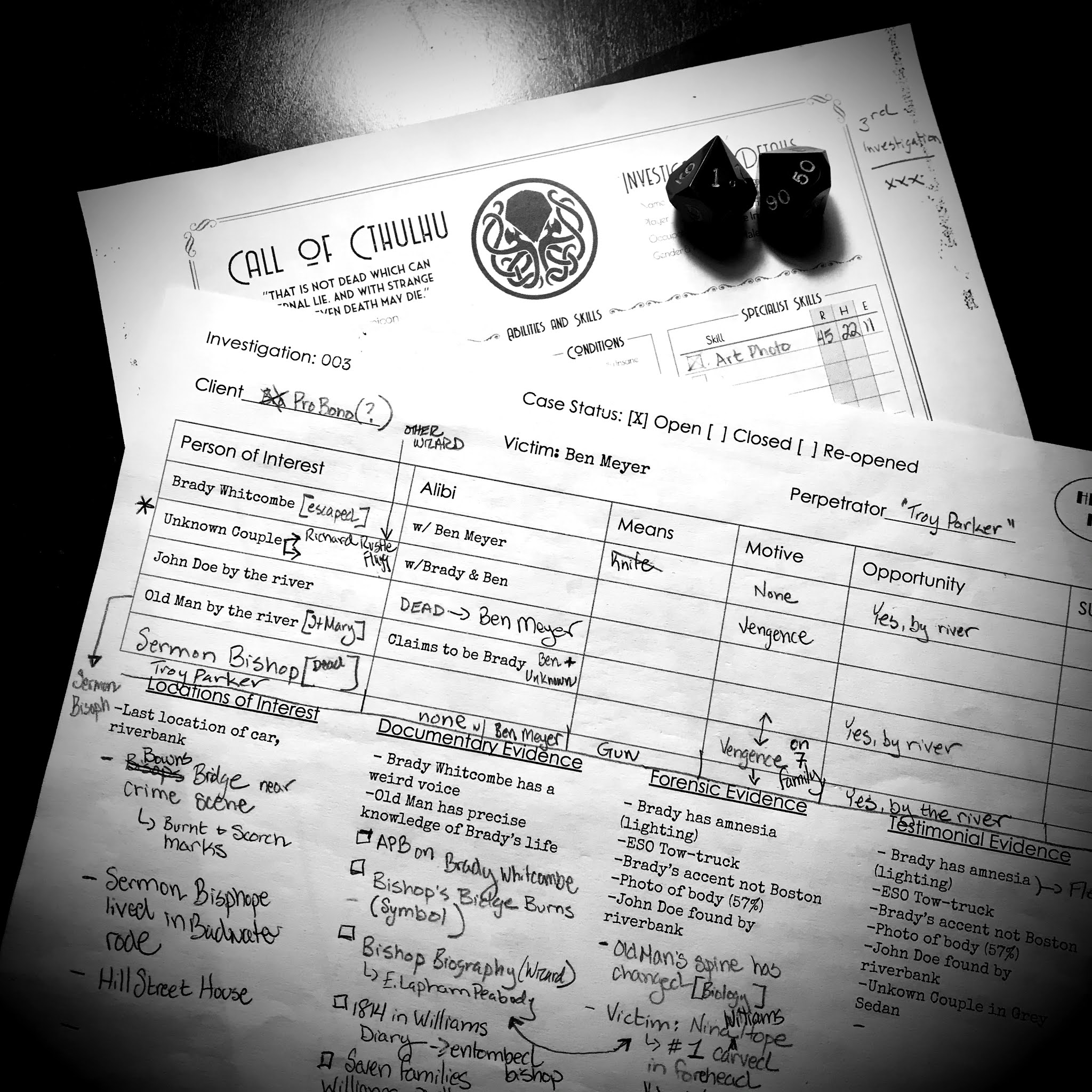
Henry Heart survives his 3rd investigation; the sheet barely did.

RECENTLY

In the previous investigation sheet post, I outlined how I thought Sean's sheet could be used to help design CoC investigations better by creating multiple plausible suspects while still allowing the Keeper to specify a single "true" perp. It would also have (hopefully) an additive effect of not causing the players to immediately jump to mythos solutions.

In my recent CoC game, my character was able to pin the responsibility not on an NPC friend who had become possessed by the soul of a vengeful wizard to carry out revenge killings, but instead on Troy Parker. Troy was an NPC who brought the body-jumping, murderous wizard back to the present. But because there was enough evidence pinning him to the scene of the initial murder that kicked off the investigation, he showed up at a planned murder, AND that he attacked my character and friends in public-- we could convince the Arkham police he was the guy.

Aaand conveniently we had already killed him. But got paid *dick* for all our efforts, which is why Henry Heart pocketed that $11 from Troy the Corpse's pockets.

Now the investigation sheet helped a lot. Despite a fair number of persons of interests and body swapping, Troy was the only one with a completely plausible connection to what was going on. But the body-swapping brought out a missing element of Sean sheet for CoC. A category for the "unexplained" associated with each person of interest.

"UNEXPLAINED"

I use the word "unexplained" instead of "supernatural" because I want the investigation sheet to look like something a detective might actually use. Again, to try and maintain some preference and push for the rational over the mythos. "Unexplained" sums up loose ends, unnerving bits, and pieces that don't quite fit. This category, I think, could be useful to players because it will: 

  1. Clearly outline which suspects could most easily be turned over to or sought by the cops because they are linked to the crime by mundane alibis, means, motives, and opportunities
  2. Help players track links between persons of interest which might be only supernatural
  3. Allow players to keep track of themes of unexplained phenomena which might mark yet additional mythos party involved (e.g. mi-go agents monitoring the investigators dealing with the Church of the Starry Wisdom)
  4. Provide a reason for PCs to not turn someone over to the cops because they want to cut a deal with them for their mythos knowledge  (which happened in our recent game)
For the Keeper, I think it just helps further demark who is a true suspect, a false one, and who is steeped in mythos but may really not have anything to do with the investigation at hand. It could also provide the hook for the next investigation or adventure.

KNOCK! Vol. 1: A compendium opening the door on the best of old-school thought


KNOCK! Vol.1 from The Merry Mushmen

Is KNOCK! the best RPG thing of 2021? Could very well be. Do you need it? Yes! Its worth 100% of the money. This is a collection of blog posts, writings, and "bric-a-brac" from the old-school scene helpfully bound into an analog print format. Here is Questing Beast's video on the book. And here is Chris McDowell's review.

I agree with both Ben and Chris that, like the hip-hop beats used to promote the Kickstarter, KNOCK! conveys the scrappy-to-slightly-feral, easy, free-flowing, imaginative nature of running an old school DIY game. This is important because frequently the scene gets dragged for its various drama rather than the exciting content and sound advice it produces; this book wonderfully showcases both strengths.

The additional beauty of this collection is that, like the 1e AD&D DMG, it meanders across so many topics: monsters, treasure, traps, player classes, theory behind play, and interrogative thought on older modules. Randomly roll a d200 and you are going to land on an interesting, informative article.

In fact, it is so complete in covering all the topics you need to run a fantasy adventure game, that if KNOCK! had included Knave in a two page spread, this collection would have been a complete RPG!

However, what I can say with most certainty is that you can build, stock, and run a really good dungeon designed with the most current old-school thought on the matter using KNOCK!

The basic advice in Moldvey Basic D&D is to draw a map, place special monsters and treasure first (so the items the dungeon is known for or weapon its rumored to have guarded by the monster rumored to have killed the last chump), then stock using the table below:

Its confusing, but the chance a room has treasure is:
50% if contining a monster, 33% if a trap, & 16% if empty

This gets you going, but how do you make all the above "good"? What is a "good dungeon" anyways? Well, answers to these questions are exactly the sorts of articles that comprise KNOCK! Let me demonstrate:

Dungeon Design

030: Dungeon Check List- 8 things that make dungeons more interesting; allows self-grading
054: OSR-style Challenges- The nature of what you are trying to achieve in old-school design
082: The Overly Thematic Dungeon- How to balance the fantastical with the realistic
112: Livin' Up Those Corridors- Hallways are an interesting places to explore too

Monster Design

016: Monster Design- Using the Lich as a template, how to switch up classic monsters
039: Wandering Monsters- Those 1d6 skeletons can be used to tell the dungeon's story or spark interest
086: Dungeon Geniuses- You always need "special" NPCs to fight, talk to, or bribe or all 3!
140: Complete the Dungeon- Great faction table with goals and secrets
144: Just Use Bears- Want a special monster but agonize over the stats? Just use bear stats.

Neat Traps & Special Not-Traps

080: 8 Statue Encounters- Part of the Dungeon Check List is stuff to interact with-- here's eight.
113: 34 Good Traps- "Save or die" can frustrate players, here's how to keep traps exciting but fair

Good Treasure

089: Better Treasure- "Sword +1 and 500 gp" is not doing it in 2021, here's how to spice it up.
104: D20 Magic Helmets- Switch out all "Sword +1" with these instead; armor- criminally underutilized
116: 300 Useless Magic Items- Dead wizard in a (now more exciting) hallway? Check her pockets.
133: 12 Magic Blades- Better than "Sword +2" & you gotta have your dungeon geniuses packin'

And that's not even half the damn book! I've left out articles on player classes, monsters, dueling, essays about the Keep on the Borderlands, how to create impact in your game, make the stakes matter, a series of beautiful maps, the demon generator, and the 3-4 small adventures!

I hope this series gets at least 6 issues so we can create an omnibus that is all d6 tables. The production is sharp; art beautiful; advice sound; and a great way to fossilize the scene output as digital media preservation becomes unreliable.

JUST THE FACTS MA'AM: Using Sean McCoy's Investigation Sheet in CoC

Does the investigator on the right just think this all
is a bad black mold infestation? Too calm...

Recently, a friend started a pandemic Call of Cthulhu campaign with me using a 1-on-1 set-up. The idea was that my Arkham city investigator, Henry Heart, PI (hat-tip to you Sam Spade & Joe Dimond), could easily be joined by any number of other characters should friends and family want to join us as they desired. The backbone of the campaign would be mostly short investigations and one-shot adventures.

CoC suggestion #1: CoC is very conducive to a one-player and one-GM set-up: combat light and friends can drop-in/-out.

CoC suggestion #2: DON'T BUY ANYTHING- grab some d10s and download the free quickstart rules which are FAR better than the player's handbook for CoC.

Now, I really wanted to stick to the basics of running an investigation. I wanted to actually try to work out suspects, locations, motives, and weapons to give to the cops instead of just jumping to, "Whelp no doubt this is the work of that old slimy bastard of the benthic zone-- Cthulhu!" Yes, I know most CoC stories end in just that revelation (of various colours), but maybe I could also just solve investigations by proving whoever the Arkham cops caught was innocent. Saves the trouble of convincing folks of magic.

This reminded me of Sean McCoy's post on Failure Tolerated about investigations. I particularly enjoy the investigator's sheet he put together in his post and re-created my own in Google Slides. I also agree with Sean that doing actual investigating is where the fun of CoC lay.

For my 3rd investigation, I began using Sean's sheet (see below). This sheet has been pretty great both as a meta-game tool and an in-game object. That duality is what I think is so nifty- it works well in both contexts. This is not how I feel about the "quest log" in D&D which can be a handy tool for the players but feels weird from a character's in-world POV. The sheet also has been helpful in culling the many "can do" courses of action into "should do" actions. Also helpfully points out that while we might understand what is going on (or have a strong guess), we can only prove about half of it to the cops.

Wish I had used one for the first 2 investigations

In the original article, Sean suggested the investigation sheet could be used in "reverse" to help a CoC Keeper establish a mystery. I think this is quite smart advice and so I tried it out using the intro scenario The Haunting from the quick start rules above. And here is what you get:

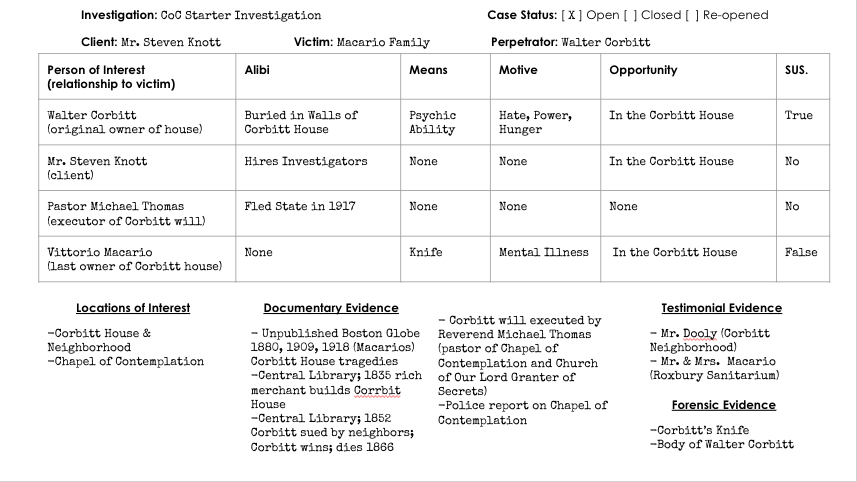
Investigation Sheet for The Haunting

Now, sure, The Haunting is a decent starting adventure for teaching the players what to do mechanically in CoC. And perhaps the Keeper as well. However, it does not really help me understand how to build a good mystery. The players are told that their client, Mr. Knott, wants them to figure out what happened to the Macario family while living in the Corbitt house so he can clear the property of its bad reputation. The game instructs the players (literally via Handout #1) to seek information at the newspaper, library, and police department and Mr. & Mrs. Macario are in an asylum.

If the players jump to the Marcarios they will learn there is a "spirit" in the house. If they go through documentary evidence they will learn that Corbitt built the house, was sued by neighbors, died, and the will was carried out by Pastor Thomas who fled the state in 1917. Thomas is connected to a shady church that burned. So, there is really nothing to puzzle out except what's in the house- but would new characters be motivated to believe in the supernatural? The meta-logic of CoC is going to cause the players to think so, but why would the characters?

CoC suggestion #3: Anytime players immediately jump to a supernatural explanation out loud, in character or out, as a reason for X events, drop their Sanity by 1d2 representing the character slowing choosing the irrational over the rational; 1d8 if they agree to increase their Cthuhlu score by 1

The PCs could convince Mr. Knott that nothing is going to happen to anyone renting the house. Because all actual evidence points that way- the Macarios went mad and are now locked up. And the investigator sheet points to that too- no other characters have the means, motive, and opportunity outside of a supernatural explanation (Corbitt himself). Open and shut case. If players go to the Corbitt house they can find Walter Corbitt entombed and his murderous will still active. And THAT IS what is causing the problem. But players crawling around in a spooky location trying to find a wraith's tomb behind a secret wall, to me, becomes a D&D dungeon crawl more than a CoC investigation.

I might have not played enough, but I think interesting investigations in CoC would somehow:

  • Create multiple likely perpetrators (What if you grab the wrong guy?)
  • Have a possibility to close the case with non-supernatural evidence/events
    (How do you convince people of magic without being accused of lunacy or worse yourself?)
  • Require rational reasons & evidence to convince the cops or authorities to take action
    (Can't just drop a copy of De Vermis Mysteriis on the Police Chief's desk)
  • Save supernatural elements to creating lingering doubt, slow burn, and/or big reveals
    (Was it really the husband or was he in fact possessed? And why have the killings not stopped?)
  • Have the ability to get the investigation wrong
    (Person X has no alibi on the night of the murder but does have a motive and opportunity, but the investigators add a supernatural explanation as to the "means" but lack proof that it occurred)
While some of these might be "fail states" they are not. Failure, doubt, and collateral damage drive good people to fringe ideas and unorthodox methods- like seeking occult knowledge and practices. Maybe we can just inject the victim's corpse with a little of ol' Dr. West's serum and get them to tell us who their killer was...

For The Haunting I would keep the undead Corbitt as the true antagonist, but maybe change things:

  • Vittorio Macario is innocent, but still had an earlier very heated dispute with his wife about her activities with the Chapel of Contemplation and her wanting to leave him w/ the children
  • Pastor Thomas might be trying to gain control of the Corbitt House that is owned by Knott and suggested the property to Macario knowing what is there
  • The Macario family would be new members of the Chapel of Contemplation creating further context and possible suspicion about their own activities
  • Corbitt House is a legal fight for ownership between Thomas and Knott
  • Have a 3rd party burn down the church, but for totally separate reasons unrelated to the case at hand
  • Vitttorio's wife knows he's locked up but refuses to testify because she knows he wouldn't purposely do what he did and she's afraid for her safety since leaving town and the Chapel
  • Provide some encounters of people looking to stop the investigators like rougher Chapel members not liking their snooping around
Now the investigation sheet looks something like this if filled out:

Vittorio has a stronger reason to be the actual perpetrator. The connection between the Chapel is made more ominous and deeper. Thomas and Knott have some personal hate, which calls into question why Knott is going with "independent investigators" (who might include former bootleggers or mob fixers). And Pastor Thomas also has more suspicious occult activities, but is still not the actual killer.

This whole idea need refining, but I think it had legs just as good dungeons maximize player choice, so should good investigations. Not just a straight line from the client, to the library, to police, to a creepy house to the boss monster and the true source of crime.


LAW & ORDER: There are two sides to the criminal justice system in D&D- the BS Players do and the DM who has to put up with it


So what is law & order for an anachronistic European-esque generic fantasy setting? 

I've thought about this since reading A Time Traveler's Guild to Medieval Europe. It's a great book that covers all the things you would need to know if you found yourself transported back in time. The systems for maintaining order are quite different.

In brief, one person is designated the guardian of order in a village. Anything that happens, that person is called out by the sheriff (appointed by the nobility) to answer for the crimes. If they can't produce the perpetrators or keep order, they die. 

Now, after being sentenced to death, you can name your accomplices. This can end up with a lot of score-settling in town. But since a lot of people know each other in small towns and villages and have relatives in the next towns over, "strangers" currently in town will be the first suspects. Or best people to die.

Village/town defense might be served by the local population with torches and pitchforks. If the place is large enough there might be guards in the service of a specific person (or church) but not really for the "greater good of the community".

In terms of D&D, if the laws are too constraining or long they become a burden. Players already have to contend with a set of "meta laws" which are the rules of the game. Adding fantasy laws on top of those rules could easily flop.

I guess there is also an often unspoke set of law at most tables about players not performing certain actions with their characters that would be particularly onerous like violence against innocent babies or performing particularly gruesome acts of torture. 

So the layers are: Unspoken Laws of the Table (universal to all rpgs played) --> Laws of the System (specific to the rpgs: "Clerics can't use edged weapons") --> Law of the World (specific to the campaign)

Why do we want to include this?

Without coded laws, I think it becomes actually hard to define what black market, corrupt, decadent, privileged, and "DM's is just screwing with us" actually is.

  • How can the nobility be considered decadent & exploitative if there are no rules to flaunt or exploit?
  • How can you have a thieves guild or black market if there is no legal system to skirt?
  • How can religion be observed if there is no observable participation or taboos to avoid?
  • How can PCs be outsiders if there is no benefit to being born in town?
  • How can PCs be sure the DM isn't just arbitrary if there is no pattern to the enforcement of activities?
Now of course there are ways to demonstrate all of the above outsides of a page of laws, but at a basic level, an institution/group/person is corrupt when they ignore the rules that others have to follow in favor of their own code.

Laws also provide an environment where social maneuvering, concealment in all forms, and stealth become valuable as well as connections to in-world institutions. Which draws play away from combat/violence as a catch-all solution to most problems. People complain about combat/violence in D&D, but there is also little in-game fiction that constrains its use.

Stated laws might also help with alignment, in that player judge actions based on societal actions instead of inherent good/evil; factions some into play who enforce, create, and/or adjudicate laws. 

How do you run this last piece in an interesting fashion? 

False Machine has written a heist adventure that takes into account laws regarding dress, weapons, and the requirement for papers presented if asked:

Sumptuary Laws Glaem has basic laws of dress and behaviour which are… unevenly enforced, (though you could be checked at any time). 

  • No Heavy Weapons. No projectile weapons. (Unless you are a licensed bodyguard or ceremonial guard. Are you? Where’s your license?) 
  • Only ceremonial armour allowed. (Again, you need a license for this) 
  • Light blades only. (Only if your clothes are “noble”, and you need a license). 
  • Employment/Guild/Faction/City papers to be produced on-command. 
  • Your chances of being checked for licences and I.D. go up the more suspicious, poor and out of place you look, and are common on entering controlled areas. 

I think these help add something to the task of finding and stealing the McGuffin of the adventure. Immediately the value of wizards (as magic doesn't seem to have embargos) and characters who can conceal or have social strategies come to the front.

I guess this post is getting long. So in a Part II, I'll try to lay out some simple rules that also scale from village to town to city.

DYSON'S DELVE: "Hey babe, you wanna do some role-play tonight?"


Dyson's Delve: The Original Mini Mega Dungeon (2019)

SETUP: Partner occasionally likes to role-play a little bit and asked if we could have something set up so whenever the mood strikes we can just start playing. I was looking for my copy of Winter's Daughter, but the closest thing at hand was this Delve.

To shortcut, the character was made by arranging the following scores: 16, 15, 12, 11, 8, 8 which yields a total bonus of attribute bonus of +1. This resulted in the creation of fighter, Princess Rosa, who started at level 2 (2000 XP). Some random equipment later via my digital DM screen and we are off.

BACKGROUND: Deposed from the throne that was rightfully hers, Rosa seeks treasure to build an army and take back what is rightfully hers. 

SESSION I: 

Rosa (F2) took the obvious stair entrance to the old watchtower. Finding nothing in the pulled down broken statue, she heads toward the entrance.

Stopped by two goblin guard who demands she freely handover her gold or she'll be freely handing out her blood. 2 goblins are quickly dispatched as she does not suffer fools, nor goblin reinforcements and she retreats to the South Chamber.

Desperately trying to escape she makes her way down the stairs to Level 1 Main Entrance- noisily. Again she is stopped by one goblin as the other one rushing to bring reinforcements. Rosa ignores the goblin in front of her to throw her mace at the fleeing goblin [gambit- roll 2d20 and scored two hits]. Goblin hit in the back of the head collapses, and the remaining guard flees upstairs.

Following an old cave tunnel, Rosa finds stairs that lead her to Level 2. Lighting a new torch, Rosa stumbles into a den of giant rats who attack her as a source of food.

Because of the goblin fights, Rosa finds the rats a little dangerous, at 2 HP she decides it's best to drop rations beat a hasty retreat back to Level 1. Exploring a ray of sunlight, Rosa returns to the surface and heads back to town.

❤️Princess Rosa- Alive;  ðŸ’€: 3 Goblins (15 XP); 💰: 11 EP

DM NOTES:

  • Goblins hate Rosa and will fortify the upper areas due to goblin deaths
  • Goblins should normally demand GP to pass into the tower; extra GP is you want to take your weapons; or can make a bargain to kill corpse eaters on Level 2 (3 ghouls)
  • Will try to encourage hirelings given its a solo campaign
  • Need to sketch out a small town; maybe just use Beyond the Borderlands


THE ELUSIVE SHIFT REVIEW: The cosmic horror of RPG arguments & time is a flat-circle


Picture by the author himself Jon Peterson

Peterson's editors must have held strong behind their shotguns and shield walls to force a much slimmer volume out of him. But it lacks no less of the punch of Playing At the World. In the same manner as his previous book, Peterson dissects conversations around what exactly this new game Dungeons & Dragons really was by two methods: (1) highlighting critical voices & discussions in the fanzines of the time, such an Alarums & Excursions (still in print) and (2) cross-comparing the numerous fantasy, western, and sci-fi that emerged shortly after D&D. Everyone then too thought they could produce a "better D&D".

At the end of the book, I had come to the realization, on an almost cosmic horror level, that the RPG community as a whole has not advanced any large arguments about what RPGs are and their purpose in about 30 years.

Here is what I am talking about:

"We might observe the initial players of Dungeons & Dragons divided into two camps- with due caveats about overlapping membership and interests- that reflect the two cultures of wargaming and science-fiction fandom: there were games people and story people."

[Post publication of the Greyhawk supplement in 1975]: "D&D is too important to leave to Gary Gygax." 

[Lee Gold writing in her first issues of Alarms & Excursions 1975]: "In their midst, Gold found, that, compared to her own group, 'the Dungeonmaster is player much more against the characters'. Her assessment corroborated Kevin Slimak's concerns about the problems of antagonism incumbent on the power imbalance between the referee and the players."

"Play a Gygax game if you like pits, secret doors, and Dungeon Roulette. Play a game such as in Alarums & Excursions if you prefer monsters, talking/arguing/fighting with the chance met characters and a more exciting game"

[From Bill Seligman 1977]: "The problem TSR has is that the term 'D&D' is starting to refer to fantasy role-playing games in general, and not just those bound by the D&D official rules"

"Kevin Slimak, feeling 'tired of trying to kludge a good game out of Gygax D&D...'"

Another interesting bit is how Gygax shifts from commenting on D&D as an open system to AD&D as a closed and complete system. Distinguishing between the two. This further leads to another discussion about if AD&D lays down too many rules which destroy the free-form play of the early little brown books/white box. 

Peterson walks us up to the early eighties where there are hardened attempts at a unified critical theory about RPGs. Which contains this graph showing the alignment of power gaming vs. storytelling; role playing vs. wargaming


We also get a brief section on how with the publication of the Holmes' Basic D&D  box set and D&D in the media in the 1980's,  there was a huge influx of younger players who were not steeped in the prior editions of D&D. Jorden writes:

"By 1981, 60 percent of all TSR products would be purchased by or for players between the ages of 10 and 14"

These "munchkins" touched off the same, by this time, ~5-year-old arguments, while at the same time feeling discriminated against by the "grognards" of the time simply for not being born early enough. This just sounds like a similar discussion occurring around players entering only ever having experienced 5e D&D and Critical Role.

In total: A fantastic book! As authoritative and insightful as Playing At The World, but more tightly executed. I would highly recommend it to anyone who is interested in RPG analysis and critique. I think it is an almost must-read because even if you hate D&D the book will provide a firm context for the game and illuminate resonating early critiques.

If you want to know how D&D was developed, I would hit up Play At The World first.