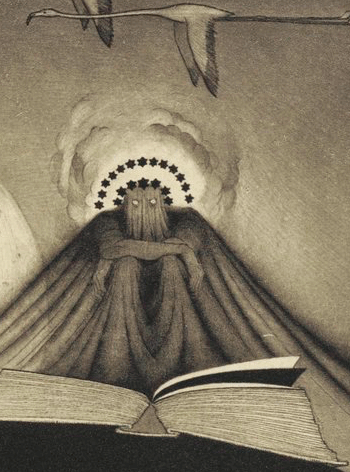
WHERE HELL COMES TO PREY: Running Nightwick Abbey 01


ill: Fernando FJL

Ill-met and hell-wrecked are these haunted halls of Nightwick Abbey. And now after years of wandering its menagerie of hubris, I too sit in one of its many seats of power and govern the machinations of the denizens and dead within.

In other words, with Miranda's blessing, I've started DM-ing Nightwick Abbey now that Levels 1-3 are out on Patreon and I have sufficiently delved into those levels enough that I won't spoil anything for myself.

To differentiate these posts from the Weeknights in Nightwick, I am going to try to concentrate a little on the prep of Nightwick. Try to provide insight on how I run a megadungeon campaign and more specifically how I am going to do that 100 minutes at a time at my local FLAGS.

Also, I have decided to dub this campaign Where Hell Comes To Prey in a similar vein to different runs of Spiderman or how anime series have different offshoots.

CAMPAIGN PREP

Campaign Binder: The first thing I did was prepare a 3-ring bind split into three sections: character generation, The Dark Country, Nightwick Abbey, and a separate denizens section. I threw in a copy of my DMing pamphlet to help with the running of the game- which I will hopefully markup in response to the particular needs of this campaign.

Campaign Format:  It is typical to think of a D&D campaign as being an 8-hour per-game affair that demands/requires everyone to show up for every game. This doesn't have to be the case. I think megadungeons in particular lend themselves to open-table games and I want to show that off.  In particular Nightwick Abbey, unlike Arden Vul and even well-known dungeons like Barrowmaze and Forbidden Caverns of Archia, is written and laid out with high DM-utility in mind. 

So I settled on running a "100-minute game"- really 120 minutes because of two 10-minute breaks. My aspirational goal is to make a regular habit of showing up at my game store on Sundays at 2:00 PM and run if 3 players will participate. Furthermore using BX D&D will help reduce some of the overhead.

Pre-generated Characters: Since I will be running a more brisk game, I wanted to get to the playing of D&D ASAP and to do that I turned to pre-generated characters. What is interesting about this is that its actually a bit of advice from OD&D: 
"Prior to the character selection by players it is necessary for the referee to roll three six-sided dice in order to rate each as to various abilities, and thus aid them
in selecting a role." 

Miranda has some pretty great classes in the Nightwick Abbey package. Notable to me are froglings and changlings which are this setting's "elves" but are humans stolen at birth by the fay. Miranda also has given the fighter some enhancements like cleave and ODDs two attacks with ranged weapons if the fighter has not moved. A couple of classes also have "half-class" extras if you roll properly.

So here were my starting 8 PCs: Graverobber, Magician, Fighter x2, Frogling, Cleric, Changling (Fair), and a Rogue.

What I Should Have Prepped: Jumping ahead. Okay given that I have been playing for two years now in the Miranda's Nightwick game and I thought I had a lot of the lore down, but I felt like when I ran the game I didn't quite give the start the "oomph" it required. But we were down in the Abbey soon enough.

WHERE HELL COMES TO PREY

Our Sunday Congregation: 
Steve, Graverobber
Colin, Cleric +follower
JP, Rogue

Down in the Abbey: Through the Fogbound Forest, the party treks deeper and deeper until the trees close in and the light wains further. Each Bogdani they pass instantly knows the direction they are heading and makes a small sign of protection.

BEHOLD! Nightwick Abbey!: When the treeline breaks, the party is confronted by an expanse of erry purple vine blanketing the ground around two ruined towers- the only visible portion of the dread abbey's ruined upper works.

West Tower then East Tower: After investigating the two towers, the party flips a coin and attempts entry through the West Tower trap door. Stuck. After a couple of futile attempts, they break their shovel off wedging the West trap door shut. East door it is!

The Toll of the Great Goblin Kingdom: The party turns southeast and after creeping through the dark hallway are hailed by two sets of luminous eyes in the dark: "50 silver to pass this way!" The party, having about 30 silver between them, is reluctant to empty their pockets. Negotiations end with the party promising to return with the proper and amount and creatures requiring an additional 10%.

(DM NOTE: The barracde is actually somewhere else and I transposed it here, but no worries with little slip ups like this because by its fictional nature, the Abbey can shift)

Sweet Leaf Room: The party doubles back and enters a northwestern door into a ransacked, sour-smelling room: Sweet Leaf was smoked here. The party turns north.

Hunting Wolves: In the flicking torchlight, this columned hall appears to show riders on horseback hunting women who run screaming in the woods. The party moves east and as they draw close hear piercing cries of what sound like deer. The party's graverobber and thief slip up on either side of the archway. The cleric and follower take cover behind two columns and call out a challenge to the accursed creatures. With the snort 3 deermen charge into the room! 

ill: Huth

With nice planning the PCs are able to backstab two deermen and the cleric + follower take down the third! Their effort is answered with arrows fired from the dark, one striking the cleric deep in his side. The players decide to beat a hasty retreat south with a deerman head.

Sweet Leaf Room: Back in the musty room, the party turns east and enters a room burned beyond recognition with two charred corpses lying in the middle of the floor. As the party steps close, the corpses jerk up as if pulled by marionette strings, and burned lips emit a wet cackle!

ill: Huth

The party is almost caught off guard, but the cleric is quick to brandish the holy symbol of the God of Law... to no avail! The floating corpses laugh in mockery. Swords and knives gain no purchase either given the unnatural movements of the foul foes. In response, one corpse lashes out at the cleric with preternatural speed and removes the poor soul's throat! (DM NOTE: Nat 20 & 6 for damage vs 4 HP). Horror turns to resolve as the devout follower follows up with a smiting blow of her own and the combined efforts of the rogue and graverobber bring down the other mockery of life. 

For their efforts, the party finds a mysterious vial of power and a jade rosary with lurid iconography.

Hasty Retreat & Return: Having survived two encounters, the party decides to retreat from this cursed place. The body of the cleric is left behind...

They figure Halfdan the Black would be interested in the two items and is rewarded with 300sp for their efforts. 

POST-MORTEM

Nightwick Abbey is a pleasure to run. As Nova pointed out in this nice review, what one might lose in description is made up for in high utility. Especially in a dungeon that is made to shift. And with 3 levels at my disposal I know (through experience) it will be enough to keep going.

Love the Cause of Death Stamp

Total exploration was 6-7 rooms and 3 encounters which included 2 combats. One character died out of 3 which matches the death rate of the Abbey overall. Two of the players were folks I have gamed with before, but 1 individual was someone who just looked over at what we were doing and decided to join-- no prior experience with BX D&D but they easily slide right into the game.

The pre-gens really helped and I'm gonna stick with that. It allows me to ensure folks are starting with viable characters and into play quickly. I like to think this was also aided by a half-page character sheet I designed to reduce the feeling this is going to be a complicated experience. Honestly, if I could reduce a character to a monster-style stateline I think that would be ideal for an online generator.

The 100-minute format worked too. Now on the whole 2 hours might be short. It does require people to be focused as you can go stretches without finding treasure. But the exchange is that its a time that works for me and I (hope) will encourage more spontaneous sit-downs and returns. Well see.

If these horrid halls of Nightwick Abbey call to you, then please join Miranda Elkins' Patreon!

LESSONS FROM HELL: John Romero's Level Design Rules for DOOM

Siblings

In December, I finished Doom Guy: Life in First Person by John Romero. I highly recommend the book in large part because it captures and conveys what its like to be caught up in one's own passions. I feel this way about Game Wizards & The Elusive Shift. 

The connection between DOOM and D&D is pretty strong. In fact Romero's id crew was regularly playing Carmack's D&D campaign on Saturdays after their breakneck coding sessions. And in one session (I think the last they ever played) it was Romero himself who cut a deal with a demon to gain a powerful magic sword in exchange for a tome that would give the demons knowledge on how to invade the material plane-- and they did- ending the world. End of D&D and the beginning of DOOM.

In Doom Guy, Romero outlines his level design rules. And I wanted to discuss how they might inform dungeon design. These rules work in companion to Goblin Punch's Dungeon Checklist. Where Punch's list is about what is in the dungeon, Romero's list gives one an idea about how the dungeon is constructed at a high level.

1 | The start of the level should present interesting choices or look impressive

  • Yup! When I run small dungeons off the top of my head, in the first room I usually have a weird statue, a locked door east, and an open arch west with something that can be seen.
  • Hard to make something "look" impressive in our pen & paper context here so instead I would say describe something fantastical about the adventure location that thematically sets the tone for the adventure.
  • I would also say that "interesting choice" or "interesting look" is a 1:1 exchange, so instead of going for impressive vistas try interactable vistas.

2 | The start of the level should fit its purpose. Do I want to teach the player or make them feel scared? If the former, there are no enemies. If the latter, watch out.

3 | Reuse areas in the level as much as possible as it reinforces the understanding of the space every time the player goes through the area again. For example, if players come back to a central halo before going out to a spoke, they will remember the hub the most.

  • I tried to do this with my "wine dungeon" and I think it works quite well because players develop a strong sense of the space. What to avoid and where shortcuts are. 
  • I think players often dislike dungeons because they are rarely allowed to get to know a dungeon and then employ that knowledge to their advantage. 
  • This in turn has resulted in dungeons becoming truncated and further withering of this opportunity. Nightwick has been something I've mapped for the past two years and it really has some important knock-on effects in terms of player planning

4 | Provide contrast in every element of the design: light, sound, and action. This keeps a level fun and interesting and prevents it from falling into a monotonous loop of gameplay. We want the player to feel like they are on an exciting roller-coaster ride.

  • I read this as its better to maintain an aesthetic consistency (variety) than a realistic fidelity (monotony). Meaning it is less important that a tomb is true to its IRL counterpart and more that it has a variety of things that are tomb-like. Or fit with what has been signaled by following #1 & #2.
  • Although not stated, enemies are also party of level design and variety is important there too, but again it has to be within the constraints of what has been signaled already to allow the players to maximize agency through preparation and reasoned decision-making

5 | Changes in wall or floor texture should be accompanied by a height change or border texture

  • I admit this one might be hard to conceptualize in an RPG format, but perhaps its best interpreted as provide transitions between two different aesthetic areas.
  • If you have a burning hell pit next to a golden throne room, perhaps its best to have a room, hallway, or corridor statues with melted gold crowns and scepters and scorched tapestries.

6 | Include at least four secrets in your level

  • This feels like one of the most D&D pieces of advice and still just a really solid one. Why not include 4 secrets in your level? Honestly, I bet this is also a single trick that would make most D&D dungeons 100% better.
  • Also, this doesn't just have to be singular doors, both early D&D and DOOM would hide secret doors behind secret doors.
  • Often DOOM would also provide an audio cue that something has happened, but its not always immediately obvious what.
  • DOOM also is good about showing a goal (through windows in a wall or door on a floor of lava), but not how to get there.

7 | When a player solves a piece of a puzzle, they should already know where to go next. An example would be that you already tried to open the red door before you found the red keycard. A bad design would be to flip a switch, then see and hear nothing that shows you what you just did.

  • I think the ur-concept here, on a very high level, is that when players affect change in the environment, they should see the effect of that change and understand how they can go further with it (or if they can't, they know this as well).
  • The second, more specific, point is good too: show the problem before the solution. Or you risk players not being able to recognize the solution. This seems to be an issue more with mystery games, but puzzles and locks still show up enough in D&D its still important.

8 | If an area in your level looks like it could be made in an earlier tech, you have failed. Make the area more interesting and use more of the engine's features to ensure that.

  • Ha! Might be damning advice for old-school play considering the scene is concerned with using "old" D&D tech. Also kinda funny in light of Romero himself putting out new levels for DOOM (1993) in a package called SIGIL and SIGIL II✤ using said DOOM.
  • Here is what I would transmute this advice into:
    If an area in your level looks like it could be made [using only random die rolls] you have failed. Make the area more interesting and use more of the [RPG system's] features to ensure that.
  • I think this kinda harkens back to my "03 Tomb With Eight Skeletons"- don't stop just at random stocking with by-the-book tables- alter something- change the "tech". Generate new encounter tables, new monsters, create a more interesting room feature ect.
  • Use Tomb of Adventure Design or The Monster Overhaul or reskin to a more exciting effect 

SUMMARY: I don't think that all of the above 8 points are unknown to those who swim in the classic-play dungeon exploration sphere, but they are concise and pithy. I think they are worth considering and might be useful to reflect on when trying to decide if your recent dungeon work or effort is all that it can be.

✤ I've also been playing through SIGIL and SIGIL II. What a delight! DOOM (1993) is to FPSs as Moldevey/Cook BX (1981) is to D&D. Highly recommend.


I SEARCH THE BODY TOO: Thoughts On Revamping An Old Table

A still-life painting might be a great source for these tables

I currently use a d66 "I Search The Body" table in my Serpent Song DM pamphlet. It's a classic of the OSR. Players seem to love it and it's a good way to have a little extra show up at the end of combat. Typically these tables have d100 results: 50% coin, 25% mundane and unique trinkets, and 25% simi-magical items or maps. Or close enough.

The immediate "con" for these tables is that they are so a certain extent unnecessary. Wandering monsters can carry treasure, often carry weapons, and could easily be assumed to carry some basic equipment just like adventures. And really they only make the most sense for "intelligent" monsters. More likely for non-intelligent monsters it might make sense to understand what salts, biles, and nectars you can gather from them.

The "pro" for these sorts of tables is that they often delight players, help dole our micro-rewards, provide emergent play through unique trinkets, and provide a space for DM-world building or seed-planting: You find prayer beads to Orcus; a green jar of dried lizard tails; a letter in goblin

What you really don't want to happen is for the I Search The Body tables to become a reliable source of treasure instead of looking for it in the dungeon. Then the game reorients toward a combat focus similar to what happens when XP for defeating monsters is greater/easier than XP gained elsewhere.

Why change? What's the reason for switching off from a d100 table (or my d66 table)? Well I think its because I am trying to reconcile the enjoyment of players for these tables with my current feeling that I don't want to create ~50-60 novel things for my current campaign.

With the goal of 2024, the 50th anniversary of D&D, being to focus on play, I think it's okay that "maximal" creativity in every aspect of the game takes a back seat. Get "it" to the table. Play it. And modify when informed by experience. So, could a 2d6 or 3d6 roll be used instead of a whole table? It might be that I only really care about the players collecting some coin, a few weapons, and mundane equipment. Maybe a potion or map very rarely. And most of the time, I'd be fine with nothing instead of having to make up a unique trinket.

"I Search The Body": Maybe 2d8 because we get more results without using 3 dice and let's scope it for a dungeon environment. One final rule: If the PCs ask if the found items have a specific property roll a 1d6 modified by their CHA bonus (charisma meaning "gift from grace"). On a 1-4, the property of the object is something they don't want or is counter to their ideal. On a 5-6, the property of the object is something they do want or helps their cause.

02 (1.5%)-  map
03 (3.1 %)- cracked gem
04 (4.7%)- specilized equipment
05 (6.3%)- spell component
06 (7.8%)- 1d6 x silver
07 (9.3%)- rations
08 (10.9%)- nothing
09 (12.5%)- nothing
10 (10.9%)- nothing
11 (9.3%)- wine
12 (7.8%)- 1d6 x silver
13 (6.3%)- mundane equipment
14 (4.7%)- message
15 (3.1)- religious icon 
16 (1.5%)- potion

In some ways, this matches the options I thought about giving at the beginning of the campaigns.

NIGHTWICK ABBEY: The Purple Eater of People Session 78


Previously in Nightwick...

This week's adventurers:

Blossom (Rogue 5)
Mayfly (Magician 5)
Mechtilde (Fighter 4)
Yevegniy the Coward (Cleric 4)
Verinka (Changeling 3)
Cherwe (Cleric 3)
Liminal Space (Changeling 3)
Krupe (Cleric 1)
Voorhis (FX)
Poppy (Fighter 1)
Hirelings: Helusch

AT THE MEDUSA'S HEAD...

The month of Unodecember has brought cold air, light snow, and some change. The Pope Teodorus has declared new days of the week: Sunday, Moonday, Swordsday, Wandsday, Cupsday, Coinsday, Devilsday

Hard to miss the
6'6'' quest giver
While the party is discussing this week goal, retrieving thousands of silver coins from a deep pool, they are approached by Johanna d' Ligne, cleric of Father Winter, offers the party healing potions in exchange for collecting the miasma of a slain Knight of Armadeus (PC NOTE: This is another player's character from a completely different group who is also in Nightwick now. Or more accurately has returned to Nightwick after hearing someone (who???) broken open a way to the 4th Level)

Since the winter's cold had stiffed a few joints, the party decides to first tackle the stash of coins on the 4th level of the dread abbey, but for tangling with "management". In preparation, the party discusses how to create nets for coins and how to efficiently fish them out of the pool. In the end, several sacks, hoes, wooden pitchforks and 10-ft poles are purchased to do this task. And off the party goes.


...THEN DOWN TO THE ABBEY...

TWO TOWERS: Emerging from the fog-bound forest, the party immediately notices that the ubiquitous purple vines have seemingly withered in the cold winter months. Additionally, it appears that someone has been doing repair work on the two normally crumbled towers. Very strange.

MOSELEUM ENTRANCE (LEVEL 3): The party takes an increasingly familiar path through Level 3 to reach the broken seals and the spiral staircase down the Level 4. Fortuitously, the journey is unhindered by the denizens of these horrid halls.

SPIRAL STAIRCASE (LEVEL 4): All is quite so far. The party reaches the bottom, ESP is cast, and our Rogue and Changling listen at the door in the northwest. Again nothing.

MODEL CITY & CRYPT ROOM: The travels west into the room with a small model city from a land far off from the Dark Country; party continues west unimpeded- Mayfly picks up strange thoughts on the edges of the ESP range. The party entered a room containing a crypt in the northwest corner, previously investigated, and turns north- ESP checks (nothing), listening (nothing)- pops open the door

THE SILVER POOL: Before the party is a pool glittering with what Blossom suspects is ~3,000sp of silver coins. However, it was previously discovered the water is super-heated. Equipment is assembled into a rickety ~12ft fishing net using 10ft poles, wooden pitchforks, and large sacks. Hoes and a shovel are then used to escape the coin into the sacks. The rest of the party watches the doors.... suspicious the abbey seems quiet.

HOLY COW: Feeling lucky, which in Nightwick is worse than feeling scared, the party decides to explore the hallway to the east (after traveling back out the door they came in). Blossum checks for traps and discovers a tile 10ft in front that might be something. She tests the trap to reveal when depressed a rain of darts shoots out from the sides of the room.

Mayfly then reaches into his pocket, removes something, and whispers into his cupped hands. All of a sudden four bands that spend the wide of the room illuminate in an ill-purple hue. Pointed questions ensue. Awkward deflection occurs. The party then works to stake each metal strip in the "up" position allowing investigation of the now-revealed statue.

The icon lounges in a luid position is cow-headed, and craft by an artist with the eyes of a pervert and the erotic subtlety of a grope. But its made of gold (Blossom estimates
3000sp)! So still worth something! And the party sets to work repurposing their poles, hoes, sacks, and rods to carry this golden tribute to fecundity.

And still no trouble is present. Hmm. Not wanting their luck to run out as their torches sputter, the party decides to depart this horrible place and makes it back out.

...THEN BACK TO THE VILLAGE.

(PC NOTE: Miranda give us a choice to leave our bounty outside the Abbey and attempt another delve, given we had played only ~2 hours, or we can call it an early night. Given we have delved for longer before and ended up with nothing to show for it except dead hirelings (or a PC), we decided to take our 6000sp and call it a night.

I think this choice is an important facet of long-term megadungeon campaigns, particularly those that enforce a town-dungeon-town loop. Some nights you hit it just right: delve for 3 hours, have some fights, and get some nice loot. Other times, you delve, get your ass kicked, delve again, and still get your ass kicked- and leave with nothing. But just the opposite can happen, your party can find or know of a nice pile of treasure, you delve with that goal in mind, obtain it, and get out. These short sessions feel great as a player and provide the DM with a little bit of a break as well.

This ebb and flow of session length, treasure gained, and losses endured is a pattern that more unfolds with prolonged play. And contrary to what others might claim, is not unique to a particular advanced system, but more in the commitment to returning to the same campaign world.)

100 MINUTES OF MEGADUNGEON MAYHEM: My Open-Table Megadungeon Format 2024 Goal


I never feel that I have a good handle on retrospectives and I don't have awards to give out yet, so instead let me talk about an RPG goal that I have in 2024 given it is the 50th anniversary of Dungeons and Dragons.

Play is a key activity in the RPG space and a key goal of mine in 2024.

Few other activities trump play in terms of keeping the hobby alive. A crucial loss of the G+ era was the ability to have actual play be in such close proximity to the discourse and creativity around old-school D&D. The whole scene vibrated with this energy. Talk about a cool idea on Monday and by Thursday/Friday night, you had games running with those same concepts. I want to continue to evangelize that aspect. Play is the best expression of D&D. And experiences from actual play still seem to be a minority in the hobby space. 

I started out running Caverns of Thracia & Forbidden Caverns of Archaia at my local game store. It proved popular as I would regularly have tables of 6-10 strangers. Wonderfully, 3 other people from that experience decided to start DMing as well. I love my present-day 2+ years experience with Miranda Elkins' Nightwick Abbey and its done a lot to make me want to get back into the DM's seat more.

But time per week will be a factor in 2024 and I want this to not be a burden on me and morph into feeling like an obligation instead of something fun. To combat this issue here is what I think is a nice setup:

100 MINUTES OF MEGADUNGEON MAYHEM

1 | Two-Hour Format

WHY: I'll be busy this year so a short session would work best for me, the DM. Also, if a player happens to join and it is not their thing, then they will not have wasted an afternoon. Here's the breakdown that is technically 120 minutes, but "100 Minutes" is a punchier sell.

  • 10 min: Gather...
  • 50 min: Play!
  • 10 min: Break.
  • 50 min: Play!

2 | Megadungeon-Focused Open-Table

WHY: With the goal of adventure crammed into 100 minutes, I think this "microcosm" would be ideal: town-to-dungeon and back again. This keeps the world simple and it can be quickly conveyed in a few moments. I think the past couple of years of ZeldaDark Souls, Blasphomous and Darkest Dungeon games have also prepped the wider potential audience for a megadungeon environment.

Plus, I think there is great potential for a megadungeon to grow specifically through the actions of the store players. So a nice opportunity to build something that is community-specific if that makes sense? The great podcast Into The Megadungeon expounds on this.

I also want to encourage a more low-overhead version of D&D. I want to break down this idea that it requires so much prep and backstory and PC optimization. Bleh. Sit-down, roll up a PC and play!

3 | BX-based System 

WHY: It's the one I know the most and would be easiest for me to run. This gets back to the whole idea of keeping this a fun activity and not an obligation. I can also add in a lot of the OSE Advanced classes for players who want that. And since I am running it at a store, Old-School Essentials might be the way to go because it is also something the store itself could stock✤. 

Some possible alternatives:

  • OD&D: The 50th anniversary of D&D this year would be a great time to roll this out thematically
  • Shadowdark: Best option to draw 5e folks and it was inspired by BX
  • Knave 2e: Just released, so a simple classless system, but might throw too many people off who want to play an elf barbarian
  • Cairn: Like Knave quick and to the point especially the auto-hit combat and ablative armor (or Mork Borg)

I'll most likely use the house rules document Serpent Song Hymnal to adjudicate. I also think I'll be throwing in some recent rules I've picked up:

  • If a PC fills only four equipment slots, +1 to all rolls
  • Fighters have a bonus equal to their level which can be added to the to-hit roll, damage roll, or to make an extra attack with no bonus
I might also use Shadowdark's sand timer method of tracking torches to keep everyone making decisions fast. This won't always result in optimal decisions but I think it will keep game playing feeling fast and risky (I hope).

5 | Downtime Procedures

WHY: I think downtime procedures from carousing to crafting to romancing provide (1) a sink for resources, (2) a sense of a living world, and (3) an outlet for role-play that might not quite be provided by strict dungeon crawling. Keep it simple at first, but use Downtime in Zyan to flesh out any additional needs of the table. Ben L., the author, puts it best here:

[Downtime] serves as an antidote to the relentlessly cooperative and world-focused character of OSR play by allowing PCs to develop some uniqueness and depth. It facilitates the pursuit of individual ends in addition to the collective ones. By not gating downtime behind name level play it allow players to pursue their dreams and leave their mark on the campaign world from early levels. It is also designed to be part of a virtuous circle with adventuring, so that downtime itself creates hooks and problems to be solved through adventuring, and adventuring creates the possibility of further downtime.

6 | Just Play

Hope this is an inspiration for you, dear reader, to run a game this 2024. Remember, no one knew how to do it "correctly" or the "best way" in 1974 and 50 years later I think it is still that way- just play. As Miranda so wonderfully put it:


---

✤ I know that RPGs make next to nothing when compared to MtG or Warhammer. But when recently speaking with the ower of my local FLAGS, I was dismayed to learn that even 5e makes nothing for the store because most folks just come in, see the books, and buy them on Amazon.

The owner did think about pivoting more toward indies inorder to support the RPG space, but still be able to make a profit on the books.


THE OLD DUNGEON WORKSHOP: One (Quick) Way I Build A Dungeon


I've recently completed the first level of my "wine dungeon", run it for 12 sessions, and finally have strong thoughts coalescing for a level 2. Given that next year will be the 50th anniversary of D&D, dungeons and dragons have been on my mind.

I think two three of the best articles I've read on dungeon building are:

Looking at Nick's The Two-Week Megadungeon post, he had a nice little table (below). I think it demonstrate that when creating a dungeon it is helpful to thing of monsters, traps, and treasures that define your dungeon.

I've taken that table below and linked to one of my various thoughts on the matter:

Roll 1d20 for each Room
1-10: Empty
11-13: Creatures (and what they want)
14-16: Creatures with Treasure
17: Trap
18: Trap with Treasure
19: Something Weird
20: Unguarded Treasure

Get to that map-making because after all: 
It also important to remember that something is better than nothing.  All D&D is hackwork and a half-assed idea that gets your game on the table is better than a perfect one that takes months. ~In Places Deep, Mastering the Megadungeon

Make your monster, trap, treasure lists, check 'em twice.
And draw out that dungeon- rooms both naughty and nice!
Grab friends one and all, 8-10 should suffice.
And kick in a door one, twice, thrice!
For their trouble, they die by tooth, claw, slime, or vice!
But the danger is worth it with treasure in their sights!

I SHOULD HAVE CAST LIGHT: And Other Lessons From the 4th Level of Hell

Couldn't help making a book cover for the campaign using
the King story that in part inspired Nightwick, Rose Red

Finished our 76th Session of Nightwick Abbey and that session was a bad one. Well "bad" only in the sense that the party did not get much done, gained no treasure, and almost died. Almost. Its good because the Abbey re-established itself as a threat. Its good because narrowly avoiding a TPK made things tense.

What makes it a good "bad" game, well at least from my perspective I felt like with this session I ignored everything I have learned from my previous 75 sessions of delving Nightwick. And as a result, risked a TPK. Here is what I did wrong with Mayfly:

  • Lack of basic equipment accounting makes for poor trap management: We've transfered from a VTT to Figma-a virtual white-board. This has been great because it decreased prep time for our DM, Miranda, and made it more likely that game would happen.

    But this has caused me to not transfer over some of that stuff to my new sheet. Stupid. Because in our 76th-session we encountered a trap that would have be disabled with 10ft poles, 50' of rope, and sacks. This trap came back to haunt us.

  • Not talking first leads to fights you don't need to have: This one really gets me. I am a big fan of talking to things in dungeons. It is often interesting as a player and interesting as a DM. Sure maybe cutting deals with dark forces is a bad idea, but it makes for exciting gameplay. Not what Mayfly did this time.

    The minute two demons introduced themselves- Fireball. Now true one introduced themselves "The Bane of Mothers" and "The Eater of Children" so such a crazy reaction, but...eh... maybe should have given them a few more minutes. They were also immune to fire and Web burst into flames.

    However, Mayfly is high INT (can cast Fireball), but low WIS (doesn't always judge the best time)- so this really was on point.

    Now the setup orientation looks like this: Demons-Best Fighter-Paralyzing Trap-Rest of the Party. Bad. We escaped due to a well-cast Fog but due to the trap our best fighter was uncontrollably sobbing due to understanding the sins of all mankind.

  • When threats are unknown, assume maximal threats: I have two general spell memorization strategies ✤ for Mayfly (well three as I have one for overland travel) which are:
    • Attack Target: Fireball (3), Fireball (3), Web (2), Protection from Evil (1), Light (1)
    • Level Recon: Fireball (3), Web (2), ESP, (2), Protection from Evil (1), Charm Person (1), Sleep (1)

      What happened here is that I chose the "recon program" without really understanding the threats of Level 4 very well. Which caused Mayfly to not have additional damage heavy hitters. But even so, I might try running more with Lighting Bolt because that will help with fire-immune creatures.

  • Light is still GOAT and a still underappreciated offensive spell: With a now magic-sword controlled fighter (yup, gotta be wary about magic weapons with egos when you are feeling down), the party decides to keep going. We run into 5 "Bleeding Knights". Our sword-possessed charges ahead and the party rushes to form a skirmish line. 

    Ulf fires off a Light spell and blinds one knight (in BX you can't attack if blinded✤✤). Mayfly follows up with the single Light scroll he has from 20 sessions ago-- blinding another. Ulf is able to blind another. Then our magic sword friend gains purchase and begins slicing through them

    Next time, prep Light at least once. Best twice.

---

✤ In Miranda's Nightwick Campaign, Magic-Users use spell points instead of slots. So the spell level is how many points it costs to cast. I like this system because it still constrains spell choice but allows some high-level spells to be cast a lower levels-- which fits into my view of how to conform old-school play to modern environments (see also here and at All Dead Generations).

✤✤ Even if the Metzer interpretation of Light is used (-6 to-hit and -4 to saves instead of blind) it is still a good bargain and strong against 4+ HD enemies.