RPG'S TONISBORG COELACANTH: Or The Lost Dungeons of Tonisborg & The Preservation of D&D before D&D, a Review


The Lost Dungeon of Tonisborg
coelacanth: a living fossil

 WHAT? A COELACANTH?

Let me frame my view of the field for Dungeons & Dragons history.

To me, understanding what actually happened in early D&D has often been a miasma of hearsay and anecdote. Early knowledge about D&D often seems to take on the same form as knowledge about The Bible and Origin of Species-- hotly debated, little understood in context, and almost never actually read. Even early internet sites and user groups are hard to plumb for understanding.

In the past few years attempts at understanding the history of RPGs, especially, Dungeons & Dragons have matured considerably. This is in no small part, I think, due to the emergence of both the indie story game scene providing a counter to "trad" RPG game formulation and the old-school renaissance refining/revitalizing aspects of "classical" RPG game formulation, again, apart from the present trad RPG presentation. But still lacking has been clarity on what the space looked like immediately before and after D&D was released. So as the scene's discourse tortion has heaved and shook the ground, it has become apparent that few really know how a game of D&D was exactly played at its genesis.

Recently three good works have popped up to tackle this unknown: Playing At The World and The Elusive Shift, books written by Jon Peterson, and the Arneson-focused The Secrets of Blackmoor by Griff Morgan & co. All three together create a much clearer picture of how D&D arose. And now recently in conjunction with The Secrets of Blackmoor documentary, Griff, in partnership with Greg Svenson, has released The Lost Dungeons of Tonisborg. A complete 1973 megadungeon written by Svenson, one of the original "Blackmoor Bunch" using the associated 1973 playtest rules of the soon-to-be-released Dungeons and Dragons (published in 1974).

THE LOST DUNGEONS of TONISBORG

The book contains 3 broad sections (these are my conceptual divisions, the book proper lists 8 parts):

  •  Section I CONTEXT: How to run a game of 1973 D&D
  •  Section II DUNGEON: A 100% reproduction of a megadungeon created in 1973 and not something half-remembered. There are actual scans of all 10 levels and keys and a remaster of the same for ease of play
  • Section III RULES: Re-printing of the playtest ruleset of 1973 D&D (which is still used by the same playgroup to this day) containing everything from character creation to how to stock a dungeon; A to Z.
So, unlike a lot of other instances of original play material or stories of play, here we have all the elements from 1973: an era-produced dungeon, era-specific rules used to run the dungeon, and an attempt at the era-correct context for use of those rules at the table. 

Like the coelacanth, Tonisborg provides a possible opportunity to understand how gameplay, dungeon, and rules were all related; a swimming fossil. Whereas before this publication, we only had glimpses of each part and always much later in time via other sources. For instance:
  • Context, but no rules or example: There are a few internet message boards where Gygax, Arneson, and early players drop hints and clarifications to how play was done. But we have to be careful because there is often little to directly back it up (i.e. memories of playing in Greyhawk but no Greyhawk dungeon maps to confirm [I think]). Gygax for instance has DMing advice, but rarely actually played D&D according to his own 1e AD&D DMG specifications. So context, but hard to know what ruleset this advice is being provided for AD&D, OD&D, or some amalgamation? There is also almost a different Gygax opinion for every edition of D&D too!
  • Rules, but no context or example: The 1e AD&D DMG (1979) provides us with tons of rules by Gygax, but never really much context on how to implement those rules. Nor do we have a true representation of a Gygaxian dungeon because his own Castle Greyhawk has yet to be published. 
  • Example, but no rules or context: I think The Caverns of Thracia (1979) offers a view into early multi-level dungeon design, but no strong basis for the ruleset used and no context for how it is run. 
  • Example, but not representative: And while we have a plethora of TSR modules, early TSR modules are reprinted tournament designs and later TSR modules initiated the trad linear-story approach to RPG design. In either case, the exploration, risk-vs.-reward Greyhawk & Blackmoor, along with Tonisborg, were/are megadungeons and not represented by ~90% of TSR modules despite clearly being an early formational play environment.
So what are you actually getting with this book?


REVIEW of TONISBORG

"Breathing Life Into An Old Dungeon"

The first two chapters of the book cover the history of the dungeon and how old-school play occurs. The book does a good job of trying to cover all aspects of DMing that one might need to make adjudication 1973 appropriate. Each section is also usually begun with a quote from Arneson or some of his players.

The advice covers some topics that the OSR has recapitulated in the Old-School Primer or Principa Apocrypha and some topics that I think are being resurrected.

Familiar topics in the old-school space are dungeon adventures as dangerous and need to be viewed as "war" (asymmetric & lethal) versus "sport" (balanced & fair). This section recommends players understanding that sometimes they need to run and employ retreat and counter attacks to overcome some foes. Or players should be sneaky and interact with the world, not their character sheet. On the flip side, this section councils DMs to be fair, employ environmental clues, how to encourage players to individualize their "basic" character and to remember the goal of the game is fun.

There were a few topics that a less broadcasted in the OSR think-space that I found interesting in the section as well. An emphasis on maps as both tools and treasure which are found as both in Tonisborg. Also the role of stairs as a way to move up and down levels. The meta-roles of a mapper and scribe are mentioned, but no "caller".  And even Arneson's tips on giving out "role-playing points" to encourage players who stay in character. A long section on "The Quiet Game and the Psychology of Fear" explains how Rob Kuntz uses quiet moments in the game to slow it down and increase the immersion. Mainly by asking specific questions which make players think something is about to happen. So various rolls and fakeouts are talked about: The Fake Roll, The Pre Roll, The Reversal Roll, & The Paranoia Roll. There are also discussions of how to use the environmental dressing to keep players on their toes: doors slamming in the distance, bloodstains leading off down a hall on the floor, screaming, and compounding those meaningless events. 

Now some of these could be listed under "Good Tricks for a Good Haunted House", but what is a dungeon if not a good haunted house? It's done the service of keep players on their toes, preventing lazy attitudes, and forcing deliberate choices. But I think this has the potential to be the least accurate portion of the work. The advice is good and certainly is even a bit different than the OSR space, but was it actually how it was done? The quotes span decades and come from a variety of sources. This might introduce misremembered ideas, but again at least its advice tailored to the play environment is delivered in the next section of the book.

"The Dungeons of Tonisborg"

The next section covers the actual ten-level dungeon of Tonisborg itself. Unlike the earlier section, all the maps are redone here, rooms numbered, and entrances and egresses clearly marked to each level and the level they go to. Each level is generally full-page map, keyed entries with sparse text, monster stats, and typical black & white illustrations ranging from PCs in peril to dungeons scenes, to whimsical comics of PCs in peril.

So what immediately jumps out at me when I am looking at this 1973 dungeon?

Layout more resembles actual tombs: First, the maps are more akin to tombs made fantastic than fantastic tombs. What I mean by that is the maps have a lot of long crisscrossing hallways with many, many secret doors that are anchored by large rooms. Kinda like the way an American mall might be laid out.
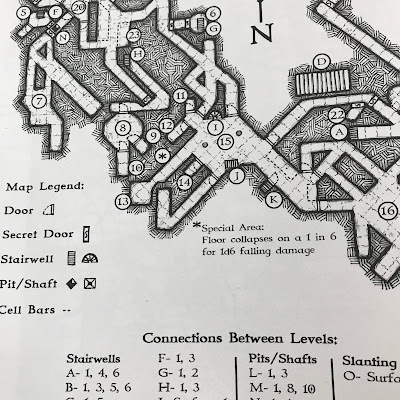
The Lost Dungeon of Tonisborg

I find this is a little different to more modern OSR dungeons where I think clustered rooms are connected by fewer hallways.

Tonisborg is "Jaquayed" Vertically: Each dungeon level feels like a bunch of "Y" shaped sections connect together at their southern arm and at that cluster there is usually a large room. So, when you proceed down one arm and explore it, you'd have to backtrack a fair bit to find a completely "fresh" arm. This is in contrast to the modern design philosophy which uses loops to discourage backtracking. However, what you do find in Tonisborg is the existence of many stairwells, climbable shafts, tunnels, and vents. So at the end of the northern arms of the "Y" are ways to go down or up. In fact, in further contrast to modern dungeon design, each level of Tonisborg contains on average of ~20 vertical connections between levels! Many spanning two floors, but about 1/3 spanning 4-5 floors.

Keying is Sparse: The book includes the original scans of not only the dungeon maps but also the keys that went with them. What jumps out is that each room description is just about one line: monster + treasure. This does not make for initially exciting setups, but the book outlines how to make these rooms more exciting. This makes Tonisborg more akin to Stonehell than other OSR medgadungeons. On the other hand, I think there is some wisdom to the one-line room key. It means the DM can get a megadungeon to the table fast which feels very similar to the advice given by Nick here on "The Two-Week Megadungeon". Too often I think we mistake good publishing advice for what is needed to get a game going, when in fact room + monster/trap/special + treasure (if any) is all that is needed to get going. The sparse key also reminds that reader that play at the table will bring a lot of energy to whatever is there.

Example of Level 10 keying

Room Size is Small But Unimportant?: Looking at the original map scans and monster placement, room dimensions are less important than distance. In several keys, at the end of long hallways are 10 x 10 rooms containing a dragon or 5+ headed hydra. This seems both pretty cramped for something that large and also pretty bland tactically. But something tells me, the rooms might actually be adjusted on the fly and the actual space is a bit more fluid. Distance is what matters because it affects movement and subsequent encounter checks which alters risk assessment by the players.

"Rules to Play With"

The final section of the book covers Zero Edition Dungeoneering (ZED) which for legal reasons is a copy of the play-test document of that game that would become the "OD&D" edition of Dungeons and Dragons. The rules here are extensive covering classes, mechanics, monsters, magic, treasure and dungeon stocking. We get a glimps into a D&D that could have been-- thief still absent. But a little warning that some of this might also be a house-rules influence too.  All my comments below will mainly come from a BX-heavy background with familiarity with OD&D and 2e AD&D. Let me try to hit some highlights:

Abilities: Characters are generated with 2d6+6, but like OD&D several of the bonuses for high values (15-16+) only range about +1 or 10%.

Classes: Halflings drown 90% of the time but have a +3 with bows/slings. Elves gain a forest direction sense and +1 to welding elvish-made weapons but only gain 1d3 HP per level. While dwarves take 1/2 damage from giant creatures.

Fighters have only a 85% chance of using a magic ring, cloak, or item correctly. Cleric can only keep 40% of money received and hording can cause level loss, but can use all weapons & armor. Magic-users can carry iron but it interferes with spell casting: 10% for a small objects, 75% for say chainmail.

Levels: It's interesting that it seems for all classes the XP needed to progress from levels 1-3 is reduced: Fighter 1>2 = 1000 XP, 2-3: 25000. Also, there is a point about level tiers: Veteran, Hero, Superhero, & Lord. These are more important designations because at Hero level you are able to resist fear & panic and the paralyzing aura of ghosts and ghouls. A PC is also considered "fantastic" and hirelings gain a +1 on all rolls when around said PC.

Combat: Two things here. First, the ZED rules allows a PC to make a number of attacks equal to their "fighting capability" against "mundane" opponents (those with < 4 HD). So a level 3 Fighter can make 3 attacks per round again mundane opponents in a 10' area. The similar leveled Cleric only gets 1 and Magic-Users get 2 interestingly.

Second, weapons are classified as long (2H sword or spear), medium (sword), short (dagger). When entering melee, whoever has the longer weapon gets to roll for the attack and damage first. Except in tight spaces like hallways of 10' or less or doorways, there the smaller weapon gets to roll attack and damage first. I think this is far easier than weapon speed and provides an easy demarcation like melee, ranged, and reach weapon designations provide.

Hirelings & Morale: Nothing earth-shattering here, but I like the strong emphasis on hirelings and morale and their role in play. This is a very important and often underused aspect of modern D&D.

1st Level MU Spells: I also find the composition of 1st Level MU spells lists interesting. For ZED edition they are: Charm Person, Dark Sight, Detect Magic, Hold Portal, Light/Darkness, Protection from Evil, Read Scripts, & Sleep. Very few offensive spells save for Charm Person, Light (blinding) and Sleep. But a lot of dungeon navigation.

REVIEW by QUESTIONS

How do you like the content? I like it a lot, again, because it is a complete package to understanding early play. Its interesting to me from a historical perspective as well as getting a hold on how D&D evolved. But given the effort and time that I feel would be required to make Tonisborg ready for play, I might run something else like Caverns of Thracia or Anomalous Subsurface Environment.

Is it something unique? Yes! Its context-dungeon-rules is only matched by the more recent Silent Titans which also includes the Into The ODD rules as well as a small how to play section. Another similar product is Super Blood Harvest, but even that product lacks discussion of the procedures of play. So Tonisborg really is a very unique product further enhanced by it fossilizes an important period of time-- the year right before D&D is officially published.

Do you like the old/new maps? Yup. Its important to be able to see exactly how dungeons were conceptualized back in 1973. Quite sparsely. But as I said above, there is wisdom here. I feel like the Blackmoor group understood getting something good enough onto the table for play is better than spending time and energy to make something perfect for publication. If we are worried about "plot", players will almost always provide a connection between two unrelated things.

Where does it fit in my gaming collection? Right now, right beside Playing at the World and The Elusive Shift, on top of The Secrets of Blackmoor. However, the book I think does give very good information on how to DM. I think it illustrates how to create a mysterious and engaging mood for the players while keeping to the forefront the game is supposed to be fair and fun. Two other situations: (1) A convention game to provide a unique experience that most people would not otherwise run at their FLAGs or at home; (2)  I would like to grab a group of 3-4 folks roll up characters by the rules in the back and run through the first couple of levels. Again to get a feel and appreciation for the genesis of the hobby.

ALT GREEN KNIGHTS for Game Nights


 There was an interesting question on Twitter about what is the best system for running The Green Knight. say any because at the core of the story is a simple question: Are you honorable? This is a question independent of the math/mechanics of any system and so can be run with any system.

However, I think another interesting question is: If all your players see The Green Knight how would you change the setup? See below suggestions that jumped to mind in ~10 min-- so some better than others


Roll a d10 for an Alternative Green Knight Story
0-1: Roll to actually land the opening blow: Pass play as normal (kinda boring). Fail well play out the consequences of demonstrating lack of character in front of the king and other knights

2-3: After beheading, PC becomes the Green Knight and is seen as monstrous. What must be done? And does PC care to do it?

4-5: Beheaded Green Knight's spirit possesses the king who then rides off. But the bet still stands, meet in a year

6-7: Beheaded Green Knight's spirit possesses PC, can land a beheading blow to anyone else at any time, NOT of the PC's choosing

8-9: Green Knight issues the same challenge, beheading blow lands, severed head now same as the PCs to the horror of everyone else

BONUS CALL OF CTHULHU SETUP: Replace King Arthur & Knights with Kingpin and bootlegger gang. One night at a party a previously killed rival kingpin shows back up and challenges one brave member to a duel. A PC accepts, kills the kingpin again. 

After much nervous laughing, kingpin re-animates (maybe by some leftover green formula of a late Dr. West) passes judgment on PC that shot them and leaves. Touching off the CoC investigation.


CRAWL OF THE WILD II: Super Cleric Bros. Session 8


We return to the cleric campaign! Previously the PCs had negotiated some blue mushrooms for the return of an obedientary's soul.


THE CALL OF THE WILD

The map outlines their travel in the very nice Beyond the Borderlands 'zine. It took them two game days to go from the Sea Witch's shell (hex 3,5) to a hex with blue mushrooms (hex 3,1) and back again.

DM Note: This session was interesting for me because there was not really anything that stood out in terms of big moments, but more small little bits each hex. I do think I need to work on refining the procedures that I want for these hexes. The nice thing is that Beyond the Borderlands provides aspects from weather to hunting. But still I need better refine how I present choices to the players.

PCs set off under sunny skies to pick some wild blue mushrooms.

* 3,5: Back through the raided merchant's caravan where they had a prior run-in with a slaad

* 2,3: The PCs meet Herbert the watcher from Stronglaw Keep who they met previously. They got some information about the noble hunting camp. And further strengthened their relationship and support if they go to Stronglaw Keep.

* 2,2: The PCs encounter fields and fields of berry bushes and strange holes. Wary, they decide to move quickly through and consume rations later.

* 3,2: The PCs make it to the hunting grounds of the nobility. No encounters here save for the baying of hounds and the blowing of horns. Again, they decide to keep moving

* 3,1: The clerics find a cave open where they can see the blue mushrooms in the fading light of the afternoon sun. 

THE CAVE OF THE BLUE MUSHROOM

The clerics can detect a nauseatingly sweet odor coming from the cave and while they can see them, they will have to at least walk 40-50ft into the interior of the cave.

DM NOTE: So I wasn't just going to let them saunter in, grab the 'shrooms, and leave. So I set the mushrooms back in the cave and made sure they needed to make CON checks to maintain consciousness in the cave. Also rolled for encounters.

The cleric's first plan was to send in their two followers, Dorn or Varoris, to collect the mushrooms. But the followers weren't convinced it was their place to complete this task [DM NOTE: Both failed their morale check; both clerics also have a -1 on that due to CHA scores].

The cleric's second plan is to get Dorn (sailor background) to tie a rope around Brother Cadfael and send him into the cave to fetch mushrooms. The first attempt is somewhat successful, 3/4 of the mushrooms recovered. So, once more into the breach. 

In the second attempt, Brother Cadfael is surprised by a giant wolf-bat who flattens him to the ground and lays on a vicious bite (dmg 6). Screaming out, Brother Phellius and Dorn pull him out of the cave entrance [DM Note: PC HD roll vs. Giant Wolf Bat HD roll].

The giant wolf bat keeps to the cave, afraid of the light. This gives Brother Phellius an idea to light a torch and grab a bottle of lamp oil. A strong initiative roll later, Phellius has driven back the wolf-bat and not completely ruined all the remaining mushrooms.

BACK TO WHERE THEY STARTED

The return trip to the Sea Witch is less eventful owning to good encounter rolls. The hand over the basket and the witch hands them one infernal iron coin with which 1/6th the man's soul is encased. 

"Wait, why do we only have 1/6th his soul instead of the full third?" asked Brother Cadfael

"Oh, well I used it to make a compass that would point to the owner's true desire, and its powered by a bit of soul to give it reach into the ethereal and astral. A noble from the hunting camp wanted it." Answered the Sea Witch

"And is that noble a narcissist so it only points to himself?" grumped Cadfael.

"Ha! That would be good dear, but poor business." chuckled the Sea Witch

The night closed with Brother Cadfael *promising* to speak well of the Witch and that elicited a "deal" from her lips. She let them once again sleep in her domain.

DM Note: This was a good move by the player because that is what the witch wants, but it will draw mild rebuke from their god.

And that is where I ended the session.

CRAWL OF THE WILD: Super Cleric Bros. Session 7


Previously...

A IS FOR ABBEY AND WE BEGIN THERE

Back in the confines of the Abbey, Brother Cadfael and Phelius have enjoyed their minor celebrity. The abbey has continued to prosper with the completion of the Ossuary and even the Obedientary have taken note that the two might be able to help them with problems of a more personal nature.

But first, some procedure:

Both previous follower's Lunell and Gersia have decided to stick around [DM Notes: I did not roll a "1" for either indicating they are leaving the abby]. And are joined by two additional followers, Follower Dorn of St. Ulther and Follower Varoris, elf, of St. Nemo [DM Note: I rolled a "1" and "6" on the Ossuary Table].

Obedient Radclyf is the first to implore the aid to the clerics given the loss of his soul ("Tricked!") to a sea witch. The reason wanting the love of a woman in Miller's Village. 

DM Note: I think it would be easy to make all the problems associated with some grand thing-- "sold my soul to save another"-- but that is not how humans work. Humans do really stupid things. Humans, I think, would do further stupid things if interacting with beings who can give power/manifest wants and have a longer life view.

So the clerics are off on a hexcrawl to visit the Sea Witch in the Slugy Bog using Alex Damaceno's Beyond the Borderlands. So the clerics prayed at the Reliquary to gain some small boons on top of their daily spell selections: +1 to the 2d6 turn undead roll and re-roll first save-throw.

ON THE ROAD

The distance is fairly condensed, so 1 hour any direction to the next hex or 2 hours if they cut through a hex with forest. Alex has set up Beyond very nicely because we have different regions with unique encounter tables, a system for weather and each hex has something going on. Here is what the clerics encountered on the way to the Sea Witch:

  • Start off following the river NE to hopefully reach the bog
  • Become lost in some woods, and exit into an open field with a large ostentatious sign pointing towards (1) Miller's Village and (2) the Hunting Camp. Also meet Herbet, a devote of the Lion of Light, who offers to help them out next time they visit the gatehouse at Stronglaw Keep.
  • Back into the woods, they try to seek out the cries for help that echo through the forest only to come upon a gleaming sword stuck into a rock. Suspicious, Brother Cadfael casts Detect Evil and learns the sword does have an aura not wholly good [DM Note: The sword is chaotic]. Follow Dorn on the other hand is very interested in that sword.
  • Find their way back to the bog and the lost merchant train. Forced to stay the night due to a storm. But no rest was had as a slaad barged into their camp hunting a walking fish. Surprising both sides and forcing a terse stand-off that ended in no bloodshed.
  • Finally, the next day, after skirting an abnormally large group of baby dragonflies, the cleric arrives at a large 3-story house made from a single giant shell-- the Sea Witch!
The results of the above. 


AT THE SEA WITCHE'S SHELL

Grandmother is of course delighted to have two strapping Lions of Light come and visit! What could such devout indviduals with a simple broker of broken souls and information need?

The clerics arrive and announce themselves in proper manner. They ask that their two followers stay in the periphery and ensure they are not murdered. Follower Dorn, devotee of St. Uthler who tried to control the sea, finds this whole business silly and they should slay with witch. Follower Varoris feels the witch is a meer broker in the old legalities and its not surprising humans, with their short lives, are hasty with the specifics of such deals.

Tea is served. Brother Cadfael having prepared Purify Food & Drink immediately employs this spell on the tea. Grandmother is agast and forces the cleric to drink least they further insult her: "Well?...Not poisoned eh? You just took all the beautiful flavor out of it!"

Brother Cadfael attempt to beg parden based on a weak stomach and unsophistocated tongue. The Sea Witch comments that perhaps he'd like to bargain with both as payment since he is clearly in no need for either given their weak state.

Negotiations begin in earnest over Radclyf's soul. With a lot of back and forth and attempts a securing the exact terms of the deal, the clerics agree to collect some blue mushrooms the Sea Witch so desires. And in return, they will get back the amount of Radclyf's soul that the Sea Witch possesses.

DM Note: This was actually difficult to role-play as one of the players is IRL professionally trained in contracts. I tried to handle this by letting the player provide some fiction for how supernatural contracts are done, but then answer with a slight variation. As a way to imulate that a Sea Witch knows a bit more than a cleric in these matters.

The clerics make camp near the Sea Witch who agrees they will be safe that night.

CLASSICALLY CRAWLING DUNGEONS: More links for good dungeon crawling


Spring Cleaning: Look at Each Room From a New Angle—You'll Find ...
MC ESCHER

Matt Colville posted on Twitter recently that this generation of 5e players doesn't have a good sense of what a dungeon crawl is versus just adventuring in a dungeon. I certainly think large dungeons or mega-dungeons (tent pole dungeons) can provide a continual and exciting locus of play. This has certainly been replicated in very popular videogames like Darkest Dungeon, Dead Cells, & Hades.

But the information and practice of this form of D&D has been very scant in recent years in mainstream D&D thought. Here are some links to nice articles about megadungeons:

Gus L alludes to them in a conversation about how what "classic" D&D play is and the issues of fitting it to contemporary time/life allotments. Even bored teenagers these days don't have the time they did in the 80's.

Wendell works to break down a 179 room dungeon of Dyson Logos and stock it using the Holmes Basic Edition of D&D. It's a fascinating process and really helps demonstrate how good those tools are and how to infuse "life" into a large dungeon.

Wayne R tells you why you should do the whole thing in the first place

And if you liked all those, then Ava was nice enough to link a whole bunch here at her blog. Also, this blog has a mini-post about megadungeons.

THE BASICS OF BX D&D: 25 Answers For 25 Questions From Someone New to BX (Part I)

Moldvay Basic (1981)

These questions were from a Reddit post found here. I thought it would be good to answer them as a way to explore my own thinking on BX D&D. And since they come from someone who was getting into Old-School Essentials, I thought this collection represented a base level of what people struggle with/need help understanding. Perhaps you'd like it to try it too. My answers are in basic red.

RULE QUESTIONS

'1) Number of players in a party. The book states 6-8. I already have a hard time pleasing my five 3.5 players. What is your experience? What would be the ideal number of players for you to be comfortable running the game? What would be the absolute maximum you cannot possibly imagine having at the table?

I think there is some debate as to if "players" mean people or total PCs. I have run satisfying BX games with 2-10 players. When playing with 2-4 players, they really do need extra bodies in the form of hirelings and torchbearers. 6-8 is a good sweet spot. 10+ players require the DM to have good table management: move fast around the table, quick decisions making ability. 

One good mix, I've found is 3-4 players with 2 characters each. It starts to promote that sorta "troup-style" play where players have a rotating cast of characters. And it lessens PC death.

2) I don't mind being limited to STR, INT and WIS to lower when trying to pump up other stats at character creation, but is there a reason it is these three in particular? Perhaps some of you just lower any chosen stat in your games?

The historical reasons behind this one have been recently pointed out by a poster in Grognardia, my take here. The other aspect is that in ODD, there were only three classes-- fighter, magic-user, & cleric whose prime scores were STR, INT, & WIS.

I really like Delving Deeper's take that you can use every 2 points over 10 of WIS to count toward your prime req when determining XP bonus. It gives WIS scores a little more impact in the game that we IRL ascribe to good wisdom. However, I appreciate the cleverness of Moldvey to just dispense with the Gygxaian complexity and just make the rule basically: lower by 2 to gain +1.

One other reason, Moldvay might have excluded DEX, CON, & CHA from this is because maybe they knew that AC bonus, HP bonus, and high retainer count/reaction bonus were important and really should not be touched (?).

3) Is there a reason saving throws for magic rods or staves are not included in the wand section?

Saves have always been open to interpretation. I've interpreted wands to also be rays emitted from devices aimed at a single target (like magic traps) where rods & staves tend to have more area of effect or passive effects.

I think the best way to think about save-throws is as a way to describe your game. For instance, if you were running a BX game based on a very fantasy gothic interpretation of the Catholic Church-- I'd make your saves the Seven Deadly Sins.

4) Alignment langage. How do you make it work in game? I can sorta get how chaotic people or even lawful people could speak a different jargon (or sign), but neutral? Have you used this mechanic and how to do so?

I use alignment languages as a way to roughly communicate if there is no other common language. But it is very difficult to communicate complex ideas: 

chaotic can only communicate in terms of destruction/change; lawful can only communicate growth/stability; neutral can only express cycle/nature/balance. 

These languages are in part divine and are known when a PC starts with or even switches alignment. Like tuning into a radio frequency.

At the table, I make players communicate their ask to the goblins to me the DM, only in destructive terms for instance. Then make a ruling on how the goblins react or call for a reaction roll. This should make for difficult precise communication that is open of miscommunication & mistakes--- all great role-play flavor.

5) Are the languages written under the demihuman classes automatically learned by the player? It seems very OP to have a total of 6 languages at level 1 (for the dwarf and elf) which is not even counting their intelligence bonus. Have I misunderstood the rules? Wouldn’t it be a little more realistic to give them common, alignment, elvish/dwarf + perhaps ONE of the three extra (chosen by the player)? What do you think or do?

This will only be OP depending on how important you make languages in your adventures and campaigns. I don't find it very disruptive. And there are plenty of other monsters they might not understand. Also at 4,000 XP from level 1 to level 2, elves can have a little extra.

6) Elves being immune to ghoul paralysis. Any reasons for that? Why no other monster paralysis (not even a paralysis bonus in general).

Ghouls are a great low-level threat so will frequently appear in dungeons. This is a little extra protection again losing an "expensive" (in XP terms) character. I am sure there is also a sorta mythological connection somewhere too, although I have not found it.

7) SO much money! For my 3.5 games, I tend to hold back on gold, because magic items + characters' abilities quickly become too OP. Now, I cannot do that for OSE, since the amount of gold is practically equal to the amount of XP they get. At first, I thought that the gold used for XP would be ‘destroyed’, literally converted in experience. But it appears it is not so… So, what do they do with all this money? Basic weapons, armor, and gear (which are relative luxuries at character creation, quickly becomes cheap for a player that needs 2000 gp to get a level. Are stronghold building and hirelings the only end to a PC’s massive treasure? (aside from magic users and cleric who can use money to create spells and magic items). Taxing the adventurer's gold might be a start.

Do tax! You can't walk around in a roughly feudal society with generally no standing in said society and expect people to let you carry around lordly sums. I also use a couple of other nice rules I picked up:

1. PC can pour gold into improving their gear, weapons but if they lose that stuff in a risky endeavor then they gain XP they "banked" in it. So, if the wizard threw their fancy gold and jade studded cloak over a basilisk's head, then they'd gain the 500 XP for the torn to shreds cloak

2. PCs can invest in carousing to convert gold into additional XP at a risk.

3. I do think given people's time constraints you should wait to long to bring in domain play to lower levels. Have clerics build shrines for instance then maintain them for additional benefit. Fighters can seek titles and thieves can seek gangs. Let wizards make wands for 1st level spells at 3rd level or so, but make them expensive.

4. Also try to break, tear, ruin, and sacrifice equipment and also make players qualify where they are sleeping and how they look. This is important for social standing.

5. Here is my downtime sheet which has additional things on it.

8) BTW, I wonder what the magic-user, who cannot wear armor nor use weapons, could do with his starting money if the player gets lucky with his 3d6 x 10 gp. Should I make him pay for his spell(book)s? It does not seem fair for M-U to pay for a class ability, but nonetheless, how much would cost a unique spell anyways? From what I can see, there is no price list on the magic items' menus. The M-U could use money for research, but it is a question I have for every class actually. It does not botter me that much that magic items are not priced in the book: I'd rather have players earn/find the magic items than paying for it. But then again, what to do with all the XP money ?

If a MU got 180 gp on the starting gold roll, I think the best thing to do is get some retainers (OSE p126). And that also goes for other classes as well.

9) Magical research : I like the idea, especially in the cleric’s case, to be able to craft spells. I now wonder how it is to be done. It seems like a hard thing to create ‘balanced’ magic, especially when the OSE spells are not so many (to help estimate the power/level of a spell. Do you have examples of PC created spells? 

I never had PCs do this, but I would just start out maybe asking for altered versions of current spells and build from there. Alternatively, you could just let them go with whatever they want and alter it later if it seems overpowered.

10) Turning the undead. I found it hard to comprehend at first, can you please tell me if I got this right : we roll 2d6 first to see if we are able to turn anything, depending on the monster(s)'s HD (and look at the table provided at page 23), then we roll 2d6 a second time to see how many creatures' HD are actually affected by the turning, right ? And you can try once per encounter?

Yes.

11) Strongholds. I like the idea, of course, but I wonder how it is actually done. Plus, it seems like an awesome mechanic for video games, but here, we have potentially 6-8+ people at the table, all of which may become eligible to build strongholds. Unless they all come together to build a mega keep, how exactly do we help each one create their own little world while still being part of a party? (Especially since it is one of the fighter’s class attribute to be able to build a stronghold from level one if he/she has money). Any examples from your games?

Strongholds are an awesome mechanic and no videogame still does them well. They should be aspirational for your players-- a mark on the world. I have often thought about what I can do to push this aspect of play into lower levels. 

The stronghold can be added to by all players, but certainly one would have to be designated as the lord. However, it could be used as a base of operations to launch other lower-level characters who grow into their own stories. Because by the time players get to traditional domain-level play, they often would retire those characters.

12) Small sized weapons (and armor). What about them? What is an "appropriate to size weapon"? Do you need a smaller sword for your halfling? I see 3 possible interpretations :

  • In 3e, any weapons can be converted in damage and price so that smaller or greater races could use them. Yet, here, no damage or price conversion for that. So I do not see it as the B/X way.
  • In the OSE Advanced rules, in the 'attacking with two weapons" optional rules, it is stated that secondary weapons 'must be of small size (e.g. a dagger or hand axe)'. Thinking this way, halflings would only be able to use actual physical "smaller" weapons, like a short bow or a hand axe, and on the other hand would be forbidden from using longbows or two-handed weapons in general. So it would greatly reduce the number of damage a halfling could do (not so bad, after all, since they are a really strong 'fighter' race to begin with).
  • Perhaps it is up to you to translate a "human" weapon to a smaller size (kinda adapting the 3e way but not needing a conversion table. You would simply take a 1d8 sword and see it as a double-handed sword for halflings, a human shortbow would be considered an halflin's longbow, and so forth

What do you guys do to adapt weapons to the appropriate size?

Yup. Sounds reasonable to me. See already getting the hand of "rulings" over explicit rules.

13) Monsters attacks.

  • The rules state that there are 'alternative attack routines in square brackets', but I genuinely have not noticed any square brackets related to monsters' attacks. Regular parenthesis, yes, but no brackets. Is that a mistake from the book? Or have I missed something?
  • The rules state "the attacks that the monster can use each round", so does that mean that when the book states "2 claws (2d4), 1 bite (1d6)", each time it attacks, the monster deals (if it hits) 2d4 + 1d6 of damage? Or do you roll 2d4 twice, once for each claw? Do you roll for both claws and bite, or do you have a separate roll for each?
If the stat is Att: 2x claw (1d4), 1x bite (1d6), then I interpret it as 3 attacks per round and I will roll for each attack and its dmg. If the word or is used in the attack description, I will interpret it as a choice.

​

14) Why is movement in a dungeon (per turn) so slow? (I mean, the book gives a reason, but still). Is it specially designed to burn resources? Would it break the exploration balance to change the rate? If PC's are so careful, it makes you wonder how they can still get surprised by wandering monsters or fall into a track pit.

Essentially yes; If you change the rate you are changing the number of encounters and resource burn. PCs are being careful, but monsters are careful too and adapted to this mythic underworld enviornment.

Increasing the rate does alter exploration balance and player decision. Because if adjusted too high, players will realize they can just zip around the dungeon. The decision to go deeper is not longer fraught with peril. Saping the dungeon and game of tension.

15) Searching: if the characters have a base movement rate of x feet per turn (because they are being cautious), does it mean that to search a corridor, they have to take one additional turn, or do we search secret doors and traps 'as we walk', using the base movement rate in feet per turn and rolling during this time ?

Yes, to search is a different action than moving. In ODD the elf character's ability could be interpreted as passive. However it is an important, risk, and interesting choice to decide to stop moving and spend time searching (which can draw a random encounter).

I think the key is don't make searching for secret doors sadistic as in 1 door in a 150 ft long blank hallway. Instead try to place them, say, behind 1 of 4 statues. Have the statue indicate something to the player-- 3 look right, 1 looks left.

16) Evasion : I don't really understand the wilderness evasion table. How does a group of 4+ pursuers have fewer chances to catch up with the fleeing group? Shouldn't that be the exact opposite (the more the pursuers, the more the chance of one being able to outrun the fleeing side, right?). Is it because percentages are upside down? I still have a hard time remembering which lower rolls are better and which higher rolls are better...

Its all roll under and for me it makes sense that if the pursuer group is large, then they start to confuse themselves. Sometimes even chasing their own party members mistakenly.

17) Retainers: what is your experience with retainers? It is a very nice mechanic, but it seems that a party with average charisma may well attract a dozen retainers if not more at their side. Of course, this may not be possible depending on the game/area/dice, but still, the raw rules allow it. How do you manage that many NPCs at a time in a game/dungeon/fight? Have you done it?

I like them and way to encourage their use more. You might attract them, but you still have to pay for them. Either by gold or magic items. As a DM I try to make what they are motivated by at least a little unique. 

Really retainers can be run like NPC monsters (MV, AC, HD, Weapon) and very importantly loyalty rating. They also don't want to just blindly get themselves killed. And if they do die, well maybe someone comes looking for them... maybe that someone could even be a demon looking to gather a soul.


18) Encounter balance. (this one is also a rant)So, I know there is no real balance, but still. The dungeon encounter table (p. 204) gives a 2d6 wolf on a 1st dungeon level. 2 freaking d6 wolves ! It's outrageous! That's a potential 12 HD 4+1; twelve 19-hp wolves that can deal 8 damage each turn, killing one PC character each in one round! And don't hit me with the "oh, but they can always run away if they be smart", this is three times a TPK, and that is especially given for 1st level dungeons! By comparison, the table gives 2d4 bugbears on a 3rd level dungeon, or 1) less creatures with 2) less HP than the bloodthirsty dire wolves from the 1st level. It does not make sense at all. And I have not really read the rest of the encounter table, mind you. Rant over.

Seriously, how do you do it? How do you give your world a tiny tad of balance? How do you keep your low-level players alive with such random tables? They cannot escape everything, and OK, they know the OSR games will be deadlier, but having few to no clue as to how to give appropriatish enemies is tough. Do we just look at the HD and consider that a party of x members of Y level is able to kill about x creatures of Y HD?

Ooo! This question could be a whole book!

The first thing is to stop thinking that an "encounter", at some level, must always also be a winnable combat by the PCs. 

Only when faced with overwhelming odds, do players really pull out all the stops. Only when faced with overwhelming odds, do utility spells or gear start to really make a difference; position & environment make a difference; alignment language or high CHA matter because negotiation is a quick way out.

BX explicitly points out ways this "imbalance" is managed in-game (using OSE):

The ENCOUNTER REACTION ROLL (OSE p115): What does it mean if these 2d6 wolves are friendly or wary? What about an Ogre who is "neutral"? The encounter reaction roll helps the DM not initially start off the encounter as the NPC side being aggressive.

But this also requires the DM to make a determination of what these creatures want. Maybe the Ogre wants to get into room #5, but is too large. Can a bargain be struck?

The "BRIBE" (OSE p116): While listed under PURSUIT, there is no reason to think a gift of food, wine, or gold won't go a long way in distracting monsters-- intelligent or otherwise.

Once in combat, the "MORALE CHECK" (OSE p123) provides a way the combat might end due to the first death being inflicted on the enemy or 50% of the forces destroyed. My own house rule allows for a check when the "leader" is killed as well.

But to go back to the earlier point about a DM knowning what a creature wants, this allows combat objectives other than kill everyone as I outlined here. [PART II]

THE BASICS OF BX D&D: 25 Answers For 25 Questions From Someone New to BX (Part II)


PART I HERE 

19) 'Wishing for more wishes: this will result in an infinite time loop, putting the character out if play.' Is the game saying that characters asking for infinite wishes are doomed to an infinite time loop? This is perhaps my english missing the subtlety here, but I'm not sure of what to make of this.

The point is that when players attempt to subvert magic for an unfair advantage- the DM should take their words and actions to the literal worst interpretation. So getting more wishes because you are stuck in an infinite time loop is the worst way to technically get more wishes. 

20) What does ESP stand for exactly? Extra Sensory Perception >>

21) No weapon seem to be actually cursed on the weapons table p.270. Is that a mistake and what would be a good percentage of cursed weapons if we had to roll for it?

I think this depends on the context of the weapon. A weapon forged by demonic hands might not be cursed, but it might seem that way to a lawful PC if all its magic powers are fueled by blood. Good cursed weapons have a great power that tempts players to risk the curse.

22) Is OSE compatible with ADD? What would be to adapt? Yes with some unimportant modifications. Most players back in the day freely mixed the two. 

23) How do you make exploration fun/exciting? I have read many on the sub who seem to enjoy exploration more than anything else in RPG's.

This itself is could also be the subject of a book. But I think it can be summed up more easily than combat: is what you are exploring interesting enough to risk going a little further in? And related, is player choice meaningful?

If the answer to both is "yes" then you have an interesting environment to explore. Might also be good to review this dungeon checklist by Goblin Punch.

24) How do you handle death since it may happen more often than in more recent editions? Do you created many characters from the start/make your players roll for several characters? Do you pick up an NPC from the town and bring him/her to the party? I am considering starting my PCs with family (spouse, children) than may or may not go on adventures if the first PC dies.

Just roll up a new character and jump back in terms of death. But yeah, sometimes players might enjoy 2+ characters because it lessens the impact of one death. The players to look then toward the campaign instead of just at their single character.

25) How do you deal with the 'may attack' on the monster reaction table? Attacking on a 2 only is quite low, and I'm guessing that many monsters would choose to attack rather than parleying. Do you have a moment where everything said or done by the players could start a fight?

Why would they rather attack than parley? Again think about what the creature wants only the really zealous or mindless (undead) fight to the death. A tiger will stop attack ing you if you hit it hard enough or if you make a threatening enough display initially.